

357
18 Amphioctopus aegina
The relationships between the ML (mm) and WW (g) from hatching to 210 days
can be expressed as a power regression (Fig. 18.11):
−
=
4
3.227
W 1.75 ×10 ML
(18.3)
The inflection point (Fig. 18.9) of the relationship between ML (mm) and age (days)
is at about day 40, in the early benthic stage. In the second phase (40–160 days), the
relationship can be described by a cubic regression model (Fig. 18.9):
3 2
5 3
1.342A 6.685 10 A 1.232 10 A 34.451
ML
−
−
−
×
+
×
−
=
(18.4)
The inflection points of the relationship between weight (g) and age (days) are at
about 30 (at the settling stage) and 70 days, where growth can be separated into
two phases. The phase after the settlement can be expressed by a power regression
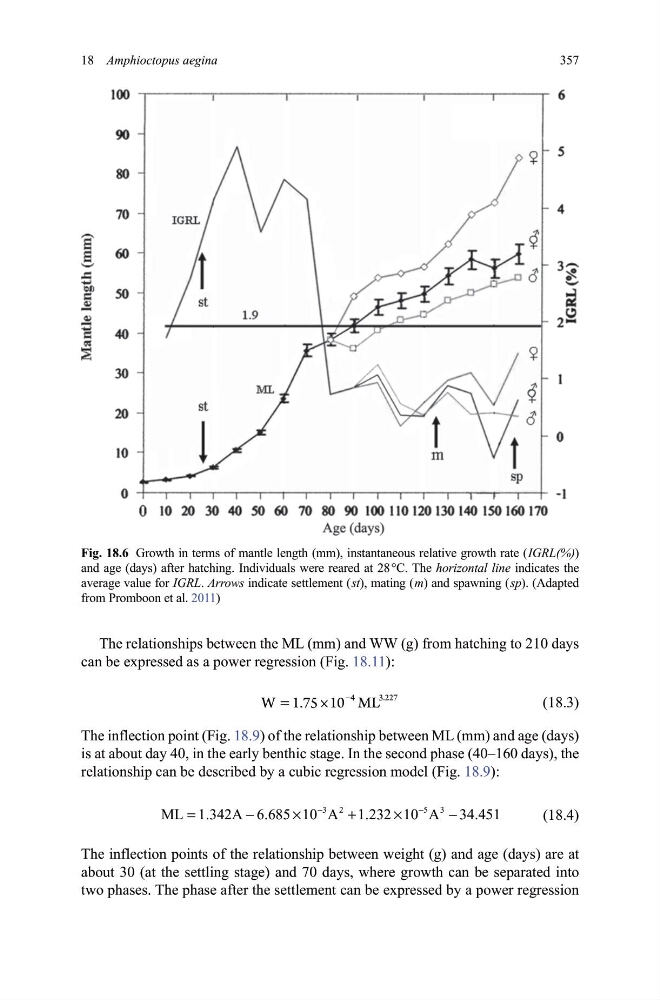
Fig. 18.6 Growth in terms of mantle length (mm), instantaneous relative growth rate ( IGRL(%))
and age (days) after hatching. Individuals were reared at 28 °C. The horizontal line indicates the
average value for IGRL. Arrows indicate settlement ( st), mating ( m) and spawning ( sp). (Adapted
from Promboon et al. 2011)
18 Amphioctopus aegina
The relationships between the ML (mm) and WW (g) from hatching to 210 days
can be expressed as a power regression (Fig. 18.11):
−
=
4
3.227
W 1.75 ×10 ML
(18.3)
The inflection point (Fig. 18.9) of the relationship between ML (mm) and age (days)
is at about day 40, in the early benthic stage. In the second phase (40–160 days), the
relationship can be described by a cubic regression model (Fig. 18.9):
3 2
5 3
1.342A 6.685 10 A 1.232 10 A 34.451
ML
−
−
−
×
+
×
−
=
(18.4)
The inflection points of the relationship between weight (g) and age (days) are at
about 30 (at the settling stage) and 70 days, where growth can be separated into
two phases. The phase after the settlement can be expressed by a power regression
Fig. 18.6 Growth in terms of mantle length (mm), instantaneous relative growth rate ( IGRL(%))
and age (days) after hatching. Individuals were reared at 28 °C. The horizontal line indicates the
average value for IGRL. Arrows indicate settlement ( st), mating ( m) and spawning ( sp). (Adapted
from Promboon et al. 2011)