

356
J. Nabhitabhata
(50 mm daily) to 400 mm depth. Coral pebbles are supplied as shelters from
30 to 50 days and after 50 days, they are replaced by PVC pipe pieces (50 mm
diameter, 150 mm length) for more effective tank cleaning. Other culture details
are similar to those for the previous nursing phase (Nabhitabhata et al. 2005;
Promboon et al. 2011).
After 50 days, the octopuses are able to feed on dead fish meat, S� leptolepis.
Live bivalves, Donax spp., Tegillarca granosa and Perna viridis and prawns ( M�
sintangense) are occasionally used as supplementary feed. The feeding schedule of
dead food is twice daily, at 0800 and 1700 h.
18.6.2 Growth
The peak conversion efficiency, 32–35 %, is at 50–70 days, when animals are
entering maturity and sustain an above average value until they mate at 125 days.
The average efficiency from hatching to 140 days is approximately 16 % (6–35 %).
The daily growth rate rapidly decreases to achieve relative stability, about 1 %, after
80 days. The average daily growth from hatching to 140 days of age is about 1.9 %
in ML and 6.4 % in weight (Promboon et al. 2011).
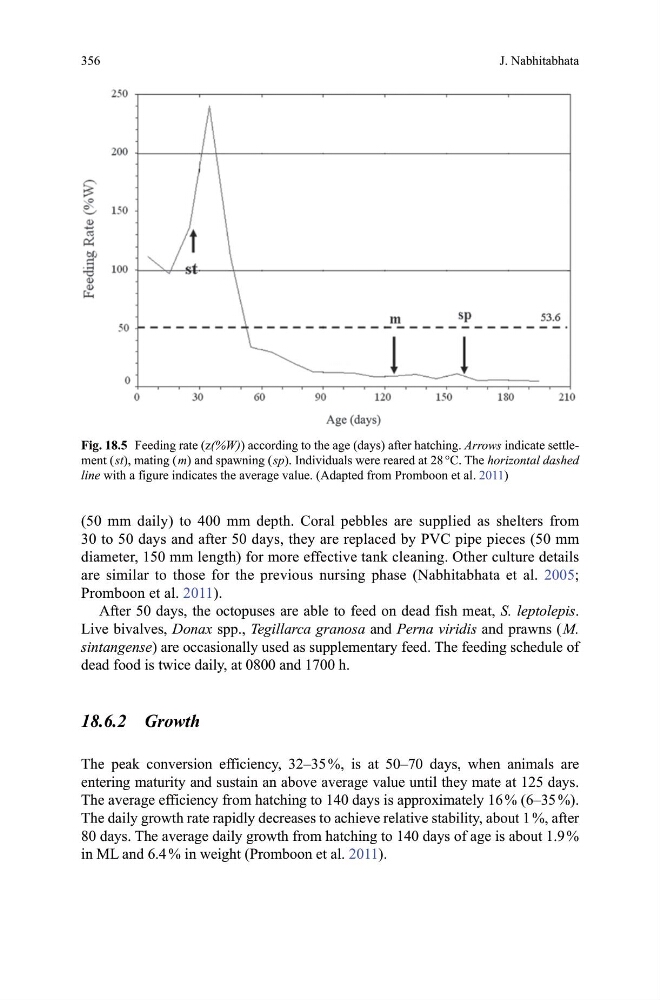
Fig. 18.5 Feeding rate (z(%W)) according to the age (days) after hatching. Arrows indicate settlement ( st), mating ( m) and spawning ( sp). Individuals were reared at 28 °C. The horizontal dashed
line with a figure indicates the average value. (Adapted from Promboon et al. 2011)
J. Nabhitabhata
(50 mm daily) to 400 mm depth. Coral pebbles are supplied as shelters from
30 to 50 days and after 50 days, they are replaced by PVC pipe pieces (50 mm
diameter, 150 mm length) for more effective tank cleaning. Other culture details
are similar to those for the previous nursing phase (Nabhitabhata et al. 2005;
Promboon et al. 2011).
After 50 days, the octopuses are able to feed on dead fish meat, S� leptolepis.
Live bivalves, Donax spp., Tegillarca granosa and Perna viridis and prawns ( M�
sintangense) are occasionally used as supplementary feed. The feeding schedule of
dead food is twice daily, at 0800 and 1700 h.
18.6.2 Growth
The peak conversion efficiency, 32–35 %, is at 50–70 days, when animals are
entering maturity and sustain an above average value until they mate at 125 days.
The average efficiency from hatching to 140 days is approximately 16 % (6–35 %).
The daily growth rate rapidly decreases to achieve relative stability, about 1 %, after
80 days. The average daily growth from hatching to 140 days of age is about 1.9 %
in ML and 6.4 % in weight (Promboon et al. 2011).
Fig. 18.5 Feeding rate (z(%W)) according to the age (days) after hatching. Arrows indicate settlement ( st), mating ( m) and spawning ( sp). Individuals were reared at 28 °C. The horizontal dashed
line with a figure indicates the average value. (Adapted from Promboon et al. 2011)