

355
18 Amphioctopus aegina
growth rate (IGR) during this period is about 4.1 % in length and 12.9 % in weight.
After the settlement, the feeding rate peaks at about 240 % after 30–40 days
(Fig. 18.5), and the growth rate increases to 5.1 % in ML (Fig. 18.6) and 17.5 % in
weight (Fig. 18.7). Food conversion efficiency is about 6–11 % from the planktonic
stage to settlement (Fig. 18.8), and this reveals a high energetic cost for the planktonic mode of the young (Promboon et al. 2011).
In the early period, from the planktonic to settling stages, the relationships between
ML (mm) and age (days; from 0 to 40 days) and between WW (g) and age (days; from
0 to 30 days) can be described by exponential models (Figs. 18.9 and 18.10):
ML
e
A
= 2 397
0 034
.
.
(18.1)
3 0.103A
W 2.559 10 e
−
=
×
(18.2)
18.6 Ongrowing
18.6.1 Feed, System Requirements and Management
The settling young (30–50 days) are transferred to 1,800 mm diameter circular
concrete grey-walled tanks and maintained at a density of one individual per litre.
Water depth is initially decreased to 150 mm and later on is gradually increased
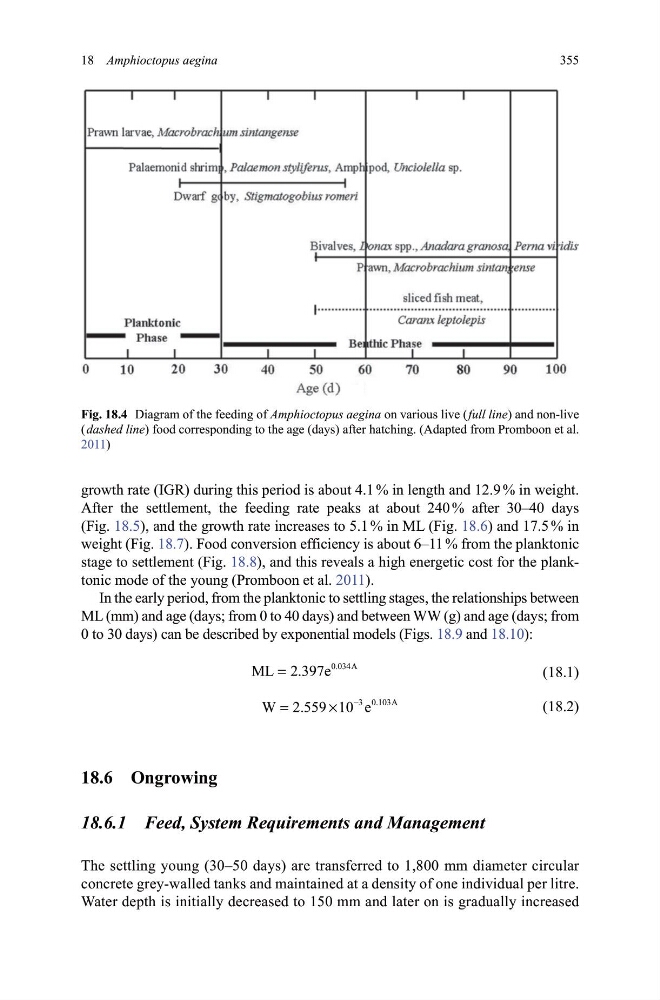
Fig. 18.4 Diagram of the feeding of Amphioctopus aegina on various live ( full line) and non-live
( dashed line) food corresponding to the age (days) after hatching. (Adapted from Promboon et al.
2011)
18 Amphioctopus aegina
growth rate (IGR) during this period is about 4.1 % in length and 12.9 % in weight.
After the settlement, the feeding rate peaks at about 240 % after 30–40 days
(Fig. 18.5), and the growth rate increases to 5.1 % in ML (Fig. 18.6) and 17.5 % in
weight (Fig. 18.7). Food conversion efficiency is about 6–11 % from the planktonic
stage to settlement (Fig. 18.8), and this reveals a high energetic cost for the planktonic mode of the young (Promboon et al. 2011).
In the early period, from the planktonic to settling stages, the relationships between
ML (mm) and age (days; from 0 to 40 days) and between WW (g) and age (days; from
0 to 30 days) can be described by exponential models (Figs. 18.9 and 18.10):
ML
e
A
= 2 397
0 034
.
.
(18.1)
3 0.103A
W 2.559 10 e
−
=
×
(18.2)
18.6 Ongrowing
18.6.1 Feed, System Requirements and Management
The settling young (30–50 days) are transferred to 1,800 mm diameter circular
concrete grey-walled tanks and maintained at a density of one individual per litre.
Water depth is initially decreased to 150 mm and later on is gradually increased
Fig. 18.4 Diagram of the feeding of Amphioctopus aegina on various live ( full line) and non-live
( dashed line) food corresponding to the age (days) after hatching. (Adapted from Promboon et al.
2011)