

232
J. Nabhitabhata
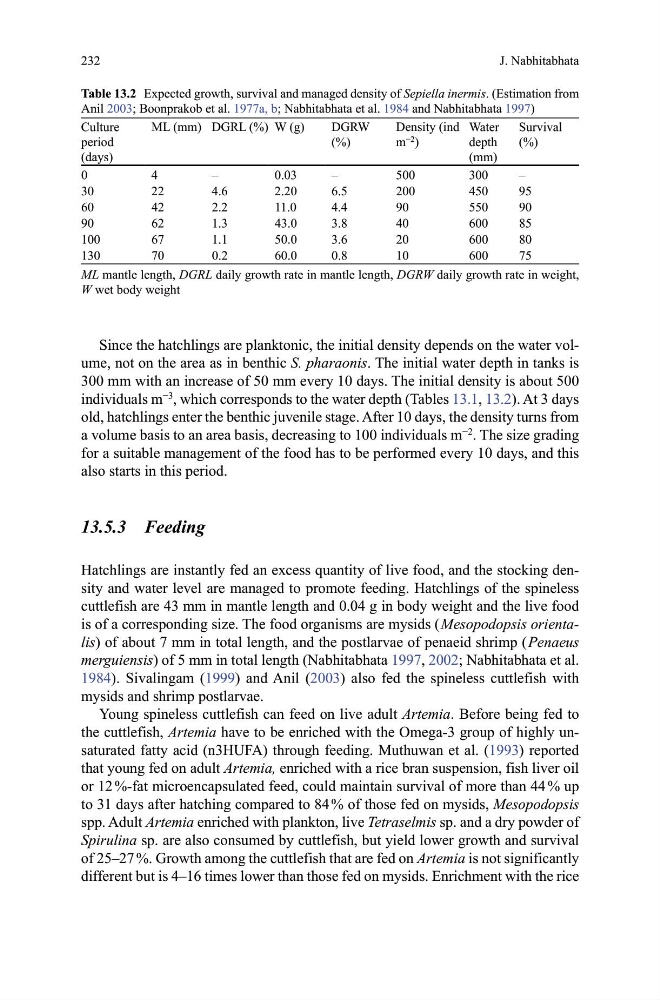
Since the hatchlings are planktonic, the initial density depends on the water volume, not on the area as in benthic S� pharaonis. The initial water depth in tanks is
300 mm with an increase of 50 mm every 10 days. The initial density is about 500
individuals m
−3
, which corresponds to the water depth (Tables 13.1, 13.2). At 3 days
old, hatchlings enter the benthic juvenile stage. After 10 days, the density turns from
a volume basis to an area basis, decreasing to 100 individuals m
−2
. The size grading
for a suitable management of the food has to be performed every 10 days, and this
also starts in this period.
13.5.3 Feeding
Hatchlings are instantly fed an excess quantity of live food, and the stocking density and water level are managed to promote feeding. Hatchlings of the spineless
cuttlefish are 43 mm in mantle length and 0.04 g in body weight and the live food
is of a corresponding size. The food organisms are mysids ( Mesopodopsis orientalis) of about 7 mm in total length, and the postlarvae of penaeid shrimp ( Penaeus
merguiensis) of 5 mm in total length (Nabhitabhata 1997, 2002; Nabhitabhata et al.
1984). Sivalingam (1999) and Anil (2003) also fed the spineless cuttlefish with
mysids and shrimp postlarvae.
Young spineless cuttlefish can feed on live adult Artemia. Before being fed to
the cuttlefish, Artemia have to be enriched with the Omega-3 group of highly unsaturated fatty acid (n3HUFA) through feeding. Muthuwan et al. (1993) reported
that young fed on adult Artemia, enriched with a rice bran suspension, fish liver oil
or 12 %-fat microencapsulated feed, could maintain survival of more than 44 % up
to 31 days after hatching compared to 84 % of those fed on mysids, Mesopodopsis
spp. Adult Artemia enriched with plankton, live Tetraselmis sp. and a dry powder of
Spirulina sp. are also consumed by cuttlefish, but yield lower growth and survival
of 25–27 %. Growth among the cuttlefish that are fed on Artemia is not significantly
different but is 4–16 times lower than those fed on mysids. Enrichment with the rice
Table 13.2 Expected growth, survival and managed density of Sepiella inermis. (Estimation from
Anil 2003; Boonprakob et al. 1977a, b; Nabhitabhata et al. 1984 and Nabhitabhata 1997)
Culture
period
(days)
ML (mm) DGRL (%) W (g)
DGRW
(%)
Density (ind
m
−2
)
Water
depth
(mm)
Survival
(%)
0
4
–
0.03
–
500
300
–
30
22
4.6
2.20
6.5
200
450
95
60
42
2.2
11.0
4.4
90
550
90
90
62
1.3
43.0
3.8
40
600
85
100
67
1.1
50.0
3.6
20
600
80
130
70
0.2
60.0
0.8
10
600
75
ML mantle length, DGRL daily growth rate in mantle length, DGRW daily growth rate in weight,
W wet body weight
J. Nabhitabhata
Since the hatchlings are planktonic, the initial density depends on the water volume, not on the area as in benthic S� pharaonis. The initial water depth in tanks is
300 mm with an increase of 50 mm every 10 days. The initial density is about 500
individuals m
−3
, which corresponds to the water depth (Tables 13.1, 13.2). At 3 days
old, hatchlings enter the benthic juvenile stage. After 10 days, the density turns from
a volume basis to an area basis, decreasing to 100 individuals m
−2
. The size grading
for a suitable management of the food has to be performed every 10 days, and this
also starts in this period.
13.5.3 Feeding
Hatchlings are instantly fed an excess quantity of live food, and the stocking density and water level are managed to promote feeding. Hatchlings of the spineless
cuttlefish are 43 mm in mantle length and 0.04 g in body weight and the live food
is of a corresponding size. The food organisms are mysids ( Mesopodopsis orientalis) of about 7 mm in total length, and the postlarvae of penaeid shrimp ( Penaeus
merguiensis) of 5 mm in total length (Nabhitabhata 1997, 2002; Nabhitabhata et al.
1984). Sivalingam (1999) and Anil (2003) also fed the spineless cuttlefish with
mysids and shrimp postlarvae.
Young spineless cuttlefish can feed on live adult Artemia. Before being fed to
the cuttlefish, Artemia have to be enriched with the Omega-3 group of highly unsaturated fatty acid (n3HUFA) through feeding. Muthuwan et al. (1993) reported
that young fed on adult Artemia, enriched with a rice bran suspension, fish liver oil
or 12 %-fat microencapsulated feed, could maintain survival of more than 44 % up
to 31 days after hatching compared to 84 % of those fed on mysids, Mesopodopsis
spp. Adult Artemia enriched with plankton, live Tetraselmis sp. and a dry powder of
Spirulina sp. are also consumed by cuttlefish, but yield lower growth and survival
of 25–27 %. Growth among the cuttlefish that are fed on Artemia is not significantly
different but is 4–16 times lower than those fed on mysids. Enrichment with the rice
Table 13.2 Expected growth, survival and managed density of Sepiella inermis. (Estimation from
Anil 2003; Boonprakob et al. 1977a, b; Nabhitabhata et al. 1984 and Nabhitabhata 1997)
Culture
period
(days)
ML (mm) DGRL (%) W (g)
DGRW
(%)
Density (ind
m
−2
)
Water
depth
(mm)
Survival
(%)
0
4
–
0.03
–
500
300
–
30
22
4.6
2.20
6.5
200
450
95
60
42
2.2
11.0
4.4
90
550
90
90
62
1.3
43.0
3.8
40
600
85
100
67
1.1
50.0
3.6
20
600
80
130
70
0.2
60.0
0.8
10
600
75
ML mantle length, DGRL daily growth rate in mantle length, DGRW daily growth rate in weight,
W wet body weight