

233
13 Sepiella inermis
bran suspension is the most appropriate method according to economic viability
and the most convenient process compared to the encapsulated diet and fish liver
oil. From a mass culture point of view, the enriched Artemia can be used as a substitutional feed for a short period when the main feed (e.g. live mysids) is in short
supply. It is notable that the cuttlefish eats only a small quantity of each Artemia
body and the rest are left uneaten. According to such habits, it is not appropriate to
use live Artemia as additional feed (e.g. night feed) since the cuttlefish will learn to
wait for their favourable feed in the subsequent feeding (Nabhitabhata et al. 1984).
13.5.4 Growth
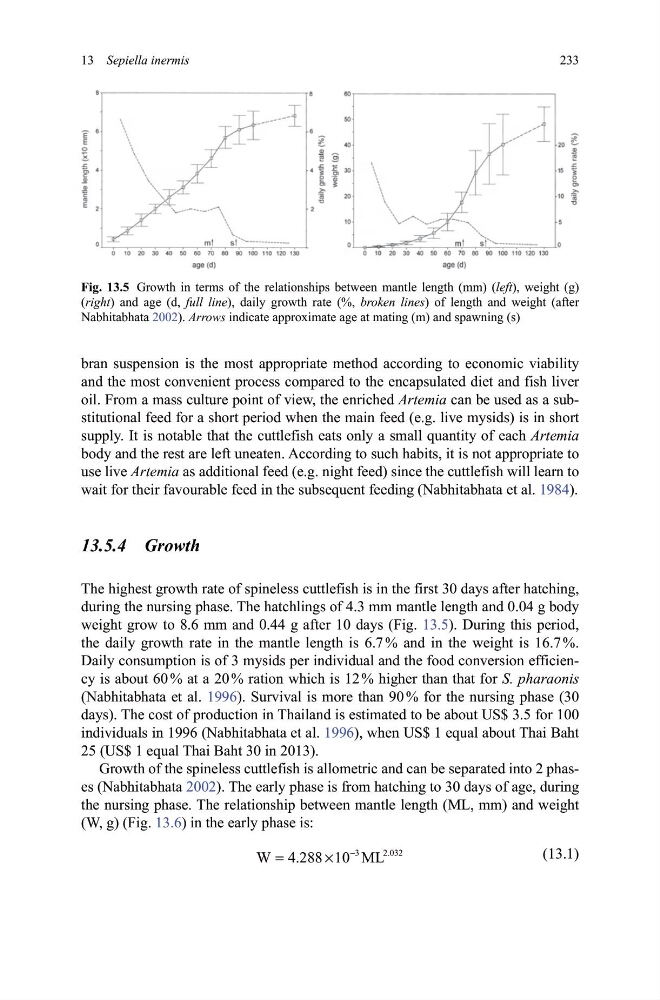
The highest growth rate of spineless cuttlefish is in the first 30 days after hatching,
during the nursing phase. The hatchlings of 4.3 mm mantle length and 0.04 g body
weight grow to 8.6 mm and 0.44 g after 10 days (Fig. 13.5). During this period,
the daily growth rate in the mantle length is 6.7 % and in the weight is 16.7 %.
Daily consumption is of 3 mysids per individual and the food conversion efficiency is about 60 % at a 20 % ration which is 12 % higher than that for S� pharaonis
(Nabhitabhata et al. 1996). Survival is more than 90 % for the nursing phase (30
days). The cost of production in Thailand is estimated to be about US$ 3.5 for 100
individuals in 1996 (Nabhitabhata et al. 1996), when US$ 1 equal about Thai Baht
25 (US$ 1 equal Thai Baht 30 in 2013).
Growth of the spineless cuttlefish is allometric and can be separated into 2 phases (Nabhitabhata 2002). The early phase is from hatching to 30 days of age, during
the nursing phase. The relationship between mantle length (ML, mm) and weight
(W, g) (Fig. 13.6) in the early phase is:
3
2.032
W 4.288 10 ML
−
=
×
(13.1)
Fig. 13.5 Growth in terms of the relationships between mantle length (mm) (left), weight (g)
(right) and age (d, full line), daily growth rate (%, broken lines) of length and weight (after
Nabhitabhata 2002). Arrows indicate approximate age at mating (m) and spawning (s)
13 Sepiella inermis
bran suspension is the most appropriate method according to economic viability
and the most convenient process compared to the encapsulated diet and fish liver
oil. From a mass culture point of view, the enriched Artemia can be used as a substitutional feed for a short period when the main feed (e.g. live mysids) is in short
supply. It is notable that the cuttlefish eats only a small quantity of each Artemia
body and the rest are left uneaten. According to such habits, it is not appropriate to
use live Artemia as additional feed (e.g. night feed) since the cuttlefish will learn to
wait for their favourable feed in the subsequent feeding (Nabhitabhata et al. 1984).
13.5.4 Growth
The highest growth rate of spineless cuttlefish is in the first 30 days after hatching,
during the nursing phase. The hatchlings of 4.3 mm mantle length and 0.04 g body
weight grow to 8.6 mm and 0.44 g after 10 days (Fig. 13.5). During this period,
the daily growth rate in the mantle length is 6.7 % and in the weight is 16.7 %.
Daily consumption is of 3 mysids per individual and the food conversion efficiency is about 60 % at a 20 % ration which is 12 % higher than that for S� pharaonis
(Nabhitabhata et al. 1996). Survival is more than 90 % for the nursing phase (30
days). The cost of production in Thailand is estimated to be about US$ 3.5 for 100
individuals in 1996 (Nabhitabhata et al. 1996), when US$ 1 equal about Thai Baht
25 (US$ 1 equal Thai Baht 30 in 2013).
Growth of the spineless cuttlefish is allometric and can be separated into 2 phases (Nabhitabhata 2002). The early phase is from hatching to 30 days of age, during
the nursing phase. The relationship between mantle length (ML, mm) and weight
(W, g) (Fig. 13.6) in the early phase is:
3
2.032
W 4.288 10 ML
−
=
×
(13.1)
Fig. 13.5 Growth in terms of the relationships between mantle length (mm) (left), weight (g)
(right) and age (d, full line), daily growth rate (%, broken lines) of length and weight (after
Nabhitabhata 2002). Arrows indicate approximate age at mating (m) and spawning (s)