

231
13 Sepiella inermis
13.5.2 System Requirements and Management
The planktonic habit of hatchlings requires a directed water flow in the tanks which
enables them to suspend in the water column. Aeration should be managed to serve
another function, as the current generator in the tanks. Adjusting the current velocity to an optimum velocity can reduce stress and energy consumption in countercurrent swimming. The optimum current velocity which enhances survival, growth and
hence production can be observed from the angle of hovering that has to be more
than 45° to the tank bottom at all times (Nabhitabhata et al. 1984; Nabhitabhata
1997). A simple air-lift system is used to generate the horizontal flow in the cylindrical tank. A PVC pipe of 50 mm diameter and 800 mm length is longitudinally
cut into two halves and each half is drilled at one end. The air pipe and air stone are
attached to the interior face of the half-pipe at one end through the drilled hole. The
set of prepared half-pipe is placed upright at 45° with the air stone at the bottom of
the tank. At least two sets are placed in one circular tank. The air stones and halfpipe sets face the same direction to generate a continuous flow. The current velocity
is adjusted by adjusting the aeration rate. The numbers of the flow-generating pipe
sets can be increased, depending on the size and shape of the tanks. A rectangular
tank requires one set for each corner.
The criteria of the required water quality and tank management in the nursing
phase are similar to that in the egg-nursing phase. The optimum temperature is
below 34°C (Junpramuk 1981), while the tolerable salinity range of hatchlings of
S� inermis is very wide, between 16 and 44 psu. The salinity required for 50 %
survival, after a brief change, is 18–44 psu (Anil 2003; Boonprakob et al. 1977b;
Nabhitabhata and Darunchoo 2001). The young cuttlefish can tolerate high levels of
ammonia (NH 4 -N) of up to 0.6 mg L
−1
for at least 24 h and 0.12 mg L
−1
for at least
48 h (Wongwiwathanawut et al. 2001).
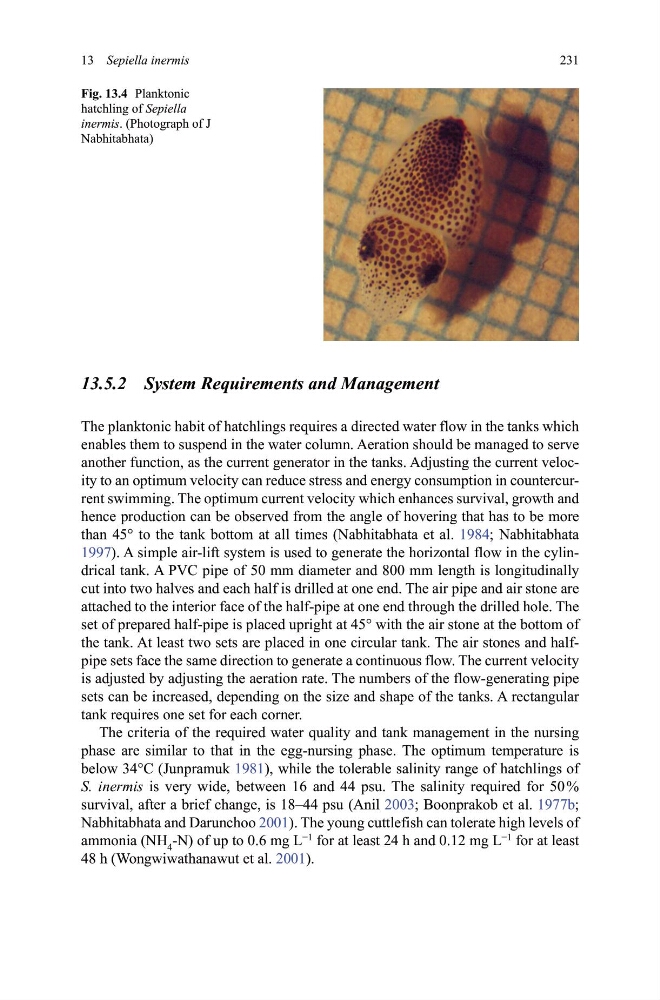
Fig. 13.4 Planktonic
hatchling of Sepiella
inermis. (Photograph of J
Nabhitabhata)
13 Sepiella inermis
13.5.2 System Requirements and Management
The planktonic habit of hatchlings requires a directed water flow in the tanks which
enables them to suspend in the water column. Aeration should be managed to serve
another function, as the current generator in the tanks. Adjusting the current velocity to an optimum velocity can reduce stress and energy consumption in countercurrent swimming. The optimum current velocity which enhances survival, growth and
hence production can be observed from the angle of hovering that has to be more
than 45° to the tank bottom at all times (Nabhitabhata et al. 1984; Nabhitabhata
1997). A simple air-lift system is used to generate the horizontal flow in the cylindrical tank. A PVC pipe of 50 mm diameter and 800 mm length is longitudinally
cut into two halves and each half is drilled at one end. The air pipe and air stone are
attached to the interior face of the half-pipe at one end through the drilled hole. The
set of prepared half-pipe is placed upright at 45° with the air stone at the bottom of
the tank. At least two sets are placed in one circular tank. The air stones and halfpipe sets face the same direction to generate a continuous flow. The current velocity
is adjusted by adjusting the aeration rate. The numbers of the flow-generating pipe
sets can be increased, depending on the size and shape of the tanks. A rectangular
tank requires one set for each corner.
The criteria of the required water quality and tank management in the nursing
phase are similar to that in the egg-nursing phase. The optimum temperature is
below 34°C (Junpramuk 1981), while the tolerable salinity range of hatchlings of
S� inermis is very wide, between 16 and 44 psu. The salinity required for 50 %
survival, after a brief change, is 18–44 psu (Anil 2003; Boonprakob et al. 1977b;
Nabhitabhata and Darunchoo 2001). The young cuttlefish can tolerate high levels of
ammonia (NH 4 -N) of up to 0.6 mg L
−1
for at least 24 h and 0.12 mg L
−1
for at least
48 h (Wongwiwathanawut et al. 2001).
Fig. 13.4 Planktonic
hatchling of Sepiella
inermis. (Photograph of J
Nabhitabhata)