

228
J. Nabhitabhata
number of batches laid by one female depends upon the number of eggs in one batch
which ranges from 20 to 500 eggs (Nabhitabhata 1997). Any interruption during
egg laying will delay the process for at least 24 h. The female does not take care of
her eggs. The male will turn to form a pair with another female after the last spawning of his mate. The healthy male switches to mate with another selected female
after the final egg laying of his mate.
13.4 Incubation of Egg Masses
13.4.1 Egg Characteristics and Hatching
The characteristics of the eggs are similar to S� pharaonis, except for the capsule
colour. The egg capsule of spineless cuttlefish contains a single egg that is attached
in clusters to the underwater substrate. The capsules are stained black in colour with
ink from the female. They are round in shape with a tip and a short stalk (Fig. 13.3).
The healthy female spawns dark black egg capsules, while the weak female spawns
egg capsules that are paler in colour. Paler and white-coloured egg capsules are the
result of an abnormal coating without ink, revealing that the female is weak or not in
good condition (Nabhitabhata et al. 1984; Nabhitabhata 1997). The offsprings that
hatch from the pale and white capsules usually have low survival. The egg capsules
with a pale black colour are also pilot eggs which are first laid by the female in order
to test the substrates. The eggs become comparatively larger and more transparent
during the progress of their embryonic development compared to the freshly laid
ones and reach their largest size just before hatching.
The length of the embryonic period and hatching pattern are also similar to that
of S� pharaonis. The embryonic period is between 8 and 19 days, on a mean of 13
days at about 28 °C (Table 13.1). Hatching occurs mostly at night and the hatching
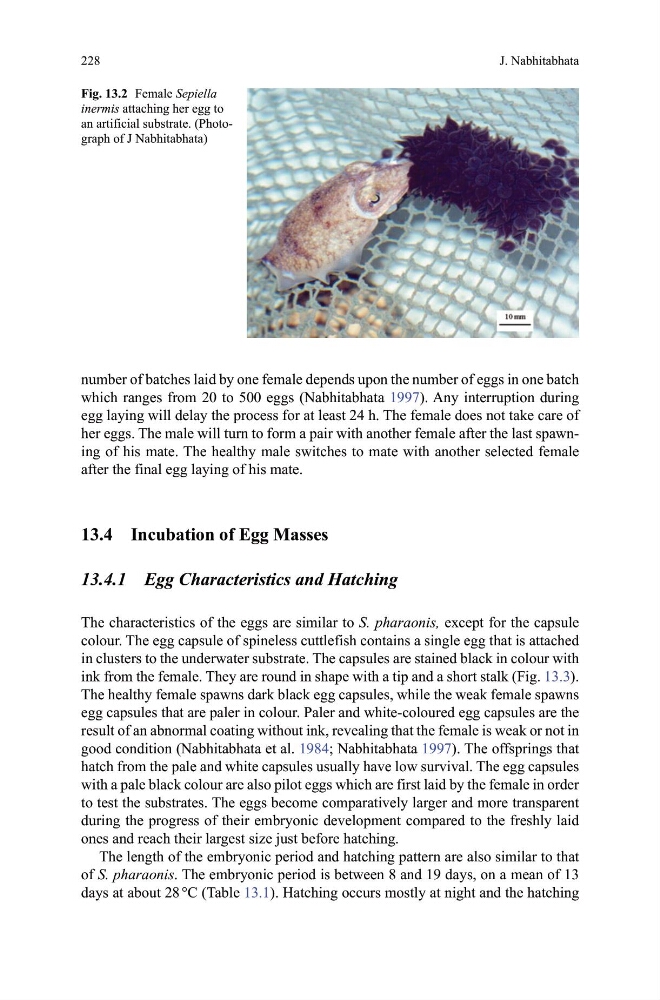
Fig. 13.2 Female Sepiella
inermis attaching her egg to
an artificial substrate. (Photograph of J Nabhitabhata)
J. Nabhitabhata
number of batches laid by one female depends upon the number of eggs in one batch
which ranges from 20 to 500 eggs (Nabhitabhata 1997). Any interruption during
egg laying will delay the process for at least 24 h. The female does not take care of
her eggs. The male will turn to form a pair with another female after the last spawning of his mate. The healthy male switches to mate with another selected female
after the final egg laying of his mate.
13.4 Incubation of Egg Masses
13.4.1 Egg Characteristics and Hatching
The characteristics of the eggs are similar to S� pharaonis, except for the capsule
colour. The egg capsule of spineless cuttlefish contains a single egg that is attached
in clusters to the underwater substrate. The capsules are stained black in colour with
ink from the female. They are round in shape with a tip and a short stalk (Fig. 13.3).
The healthy female spawns dark black egg capsules, while the weak female spawns
egg capsules that are paler in colour. Paler and white-coloured egg capsules are the
result of an abnormal coating without ink, revealing that the female is weak or not in
good condition (Nabhitabhata et al. 1984; Nabhitabhata 1997). The offsprings that
hatch from the pale and white capsules usually have low survival. The egg capsules
with a pale black colour are also pilot eggs which are first laid by the female in order
to test the substrates. The eggs become comparatively larger and more transparent
during the progress of their embryonic development compared to the freshly laid
ones and reach their largest size just before hatching.
The length of the embryonic period and hatching pattern are also similar to that
of S� pharaonis. The embryonic period is between 8 and 19 days, on a mean of 13
days at about 28 °C (Table 13.1). Hatching occurs mostly at night and the hatching
Fig. 13.2 Female Sepiella
inermis attaching her egg to
an artificial substrate. (Photograph of J Nabhitabhata)