

227
13 Sepiella inermis
After enrichment with fatty acids, mass-produced Artemia can be used for nursing
whenever other live feed is unavailable. The ongrowing phase starts after the young
accept dead food. The daily growth rate is 2.4 % in length and 5.5 % in weight
through the culture period of 130 days. The high tolerability to changing environments enables their ongrowing in saltwater earthen ponds.
13.3 Broodstock Maintenance
Broodstocks of the spineless cuttlefish are collected alive with push netting near the
shore and in the estuarine area. Onboard, they are maintained in circular polyvinyl
chloride (PVC) tanks of 50-L capacity equipped with portable aeration devices.
The cuttlefish size ranges between 40 and 60 mm in mantle length and 30–50 g
in weight. The tanks and the live cuttlefish are transported with an air supply to
the hatchery and then maintained in 2 m
3
concrete tanks at a male to female ratio
of 1:2. The broodstock tanks must be previously prepared before introducing the
cuttlefish, and artificial substrates for attaching eggs, made from pieces of fishing
net of 25 mm mesh size with sinkers, have to be provided (Nabhitabhata et al. 1984;
Nabhitabhata 1997).
The acclimatisation period to captivity is short; mating and spawning in the tank
occur within 12 h. The male selects his mate by displaying a dark brown colour
with white and orange spots on its fins, raising a pair of dorsal arms (arms I) and
spreading out the other pairs of arms, while the consenting female displays small
white spots along the base of the fins. During and after this stage, the male escorts
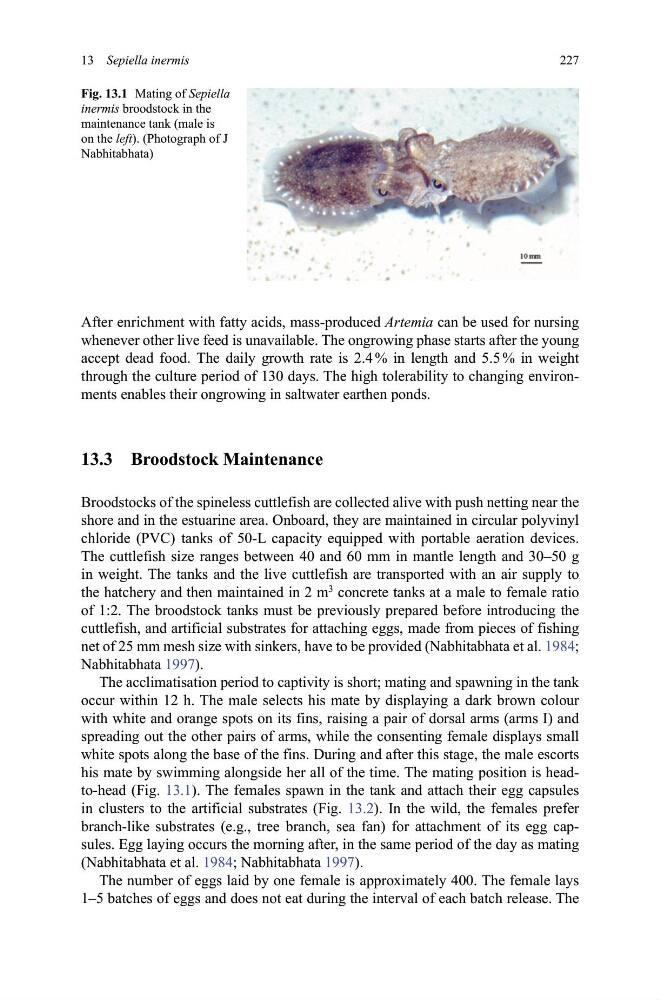
his mate by swimming alongside her all of the time. The mating position is headto-head (Fig. 13.1). The females spawn in the tank and attach their egg capsules
in clusters to the artificial substrates (Fig. 13.2). In the wild, the females prefer
branch-like substrates (e.g., tree branch, sea fan) for attachment of its egg capsules. Egg laying occurs the morning after, in the same period of the day as mating
(Nabhitabhata et al. 1984; Nabhitabhata 1997).
The number of eggs laid by one female is approximately 400. The female lays
1–5 batches of eggs and does not eat during the interval of each batch release. The
Fig. 13.1 Mating of Sepiella
inermis broodstock in the
maintenance tank (male is
on the left). (Photograph of J
Nabhitabhata)
13 Sepiella inermis
After enrichment with fatty acids, mass-produced Artemia can be used for nursing
whenever other live feed is unavailable. The ongrowing phase starts after the young
accept dead food. The daily growth rate is 2.4 % in length and 5.5 % in weight
through the culture period of 130 days. The high tolerability to changing environments enables their ongrowing in saltwater earthen ponds.
13.3 Broodstock Maintenance
Broodstocks of the spineless cuttlefish are collected alive with push netting near the
shore and in the estuarine area. Onboard, they are maintained in circular polyvinyl
chloride (PVC) tanks of 50-L capacity equipped with portable aeration devices.
The cuttlefish size ranges between 40 and 60 mm in mantle length and 30–50 g
in weight. The tanks and the live cuttlefish are transported with an air supply to
the hatchery and then maintained in 2 m
3
concrete tanks at a male to female ratio
of 1:2. The broodstock tanks must be previously prepared before introducing the
cuttlefish, and artificial substrates for attaching eggs, made from pieces of fishing
net of 25 mm mesh size with sinkers, have to be provided (Nabhitabhata et al. 1984;
Nabhitabhata 1997).
The acclimatisation period to captivity is short; mating and spawning in the tank
occur within 12 h. The male selects his mate by displaying a dark brown colour
with white and orange spots on its fins, raising a pair of dorsal arms (arms I) and
spreading out the other pairs of arms, while the consenting female displays small
white spots along the base of the fins. During and after this stage, the male escorts
his mate by swimming alongside her all of the time. The mating position is headto-head (Fig. 13.1). The females spawn in the tank and attach their egg capsules
in clusters to the artificial substrates (Fig. 13.2). In the wild, the females prefer
branch-like substrates (e.g., tree branch, sea fan) for attachment of its egg capsules. Egg laying occurs the morning after, in the same period of the day as mating
(Nabhitabhata et al. 1984; Nabhitabhata 1997).
The number of eggs laid by one female is approximately 400. The female lays
1–5 batches of eggs and does not eat during the interval of each batch release. The
Fig. 13.1 Mating of Sepiella
inermis broodstock in the
maintenance tank (male is
on the left). (Photograph of J
Nabhitabhata)