

229
13 Sepiella inermis
rate is normally more than 90 % in controlled conditions. Brief changes of temperature and salinity and mechanical stimuli cause premature hatching and yield
hatchlings of comparatively smaller size. The smaller and weaker the hatchlings,
the lower is their survival rate.
13.4.2 System Requirements and Management
Eggs are collected in the morning and the nursing is performed in other concrete
tanks of similar size and water quality. Small clusters of eggs may be nursed in
a small 50-L tank. In the egg cluster, the egg stalks are twined to the substratum
and also to stalks of other eggs and each other at the base of the cluster. The eggs
are separated from the cluster by hand or by scissor cutting. They are aerated and
maintained until hatching in plastic baskets for better ventilation. The egg baskets
of 2 mm mesh size are floated and aerated in the tanks. Flow-through systems are
employed in S� inermis culture, to maintain optimum water quality. Temperature
variations are minimised at a rate of 1 L min
−1
. This maintains an average temperature of 28 °C, a salinity of 30–33 psu and a pH of 6.0–8.0 (Nabhitabhata et al. 2005).
Light is reduced with a camouflage net to prevent algal growth. All other details of
the method are similar to those described for S� pharaonis (Chap. 12, this volume).
The optimum temperature for 99 % hatching rate is 24–32 °C (Junpramuk 1981) and
the salinity for 50 % hatching ranges from 20 to 36 psu (Boonprakob et al. 1982).
13.5 Nursing of Young
13.5.1 Hatchling Characteristics
Hatchlings are miniature adults in their morphology, but with a planktonic habit.
This habit is different from benthic habit of Sepia hatchling, since the life mode of
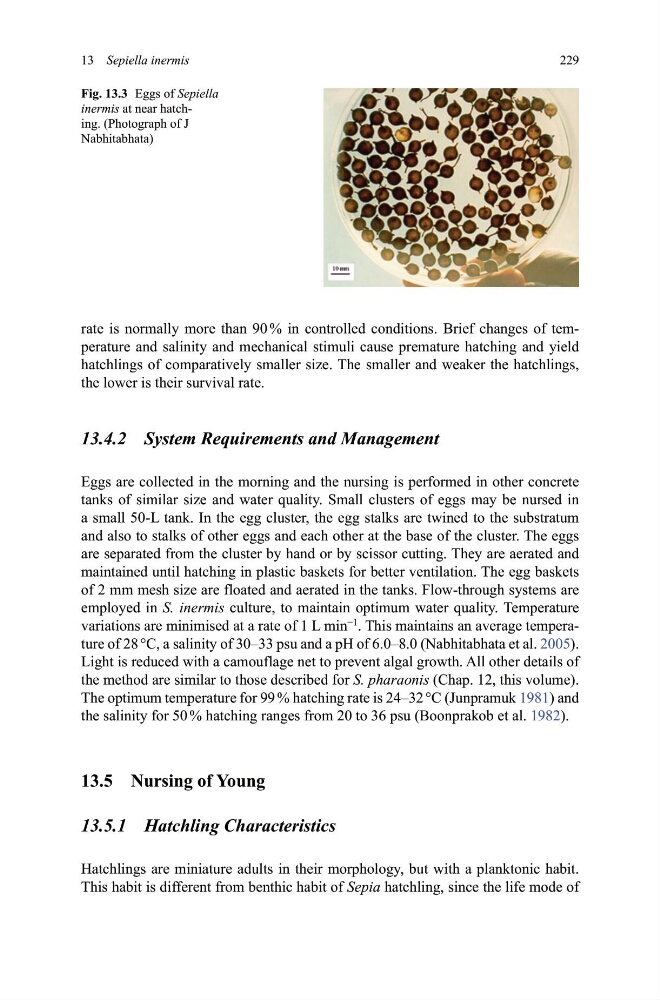
Fig. 13.3 Eggs of Sepiella
inermis at near hatching. (Photograph of J
Nabhitabhata)
13 Sepiella inermis
rate is normally more than 90 % in controlled conditions. Brief changes of temperature and salinity and mechanical stimuli cause premature hatching and yield
hatchlings of comparatively smaller size. The smaller and weaker the hatchlings,
the lower is their survival rate.
13.4.2 System Requirements and Management
Eggs are collected in the morning and the nursing is performed in other concrete
tanks of similar size and water quality. Small clusters of eggs may be nursed in
a small 50-L tank. In the egg cluster, the egg stalks are twined to the substratum
and also to stalks of other eggs and each other at the base of the cluster. The eggs
are separated from the cluster by hand or by scissor cutting. They are aerated and
maintained until hatching in plastic baskets for better ventilation. The egg baskets
of 2 mm mesh size are floated and aerated in the tanks. Flow-through systems are
employed in S� inermis culture, to maintain optimum water quality. Temperature
variations are minimised at a rate of 1 L min
−1
. This maintains an average temperature of 28 °C, a salinity of 30–33 psu and a pH of 6.0–8.0 (Nabhitabhata et al. 2005).
Light is reduced with a camouflage net to prevent algal growth. All other details of
the method are similar to those described for S� pharaonis (Chap. 12, this volume).
The optimum temperature for 99 % hatching rate is 24–32 °C (Junpramuk 1981) and
the salinity for 50 % hatching ranges from 20 to 36 psu (Boonprakob et al. 1982).
13.5 Nursing of Young
13.5.1 Hatchling Characteristics
Hatchlings are miniature adults in their morphology, but with a planktonic habit.
This habit is different from benthic habit of Sepia hatchling, since the life mode of
Fig. 13.3 Eggs of Sepiella
inermis at near hatching. (Photograph of J
Nabhitabhata)