

209
12.4 Incubation of Egg Masses
12.4.1 Egg Characteristics and Hatching
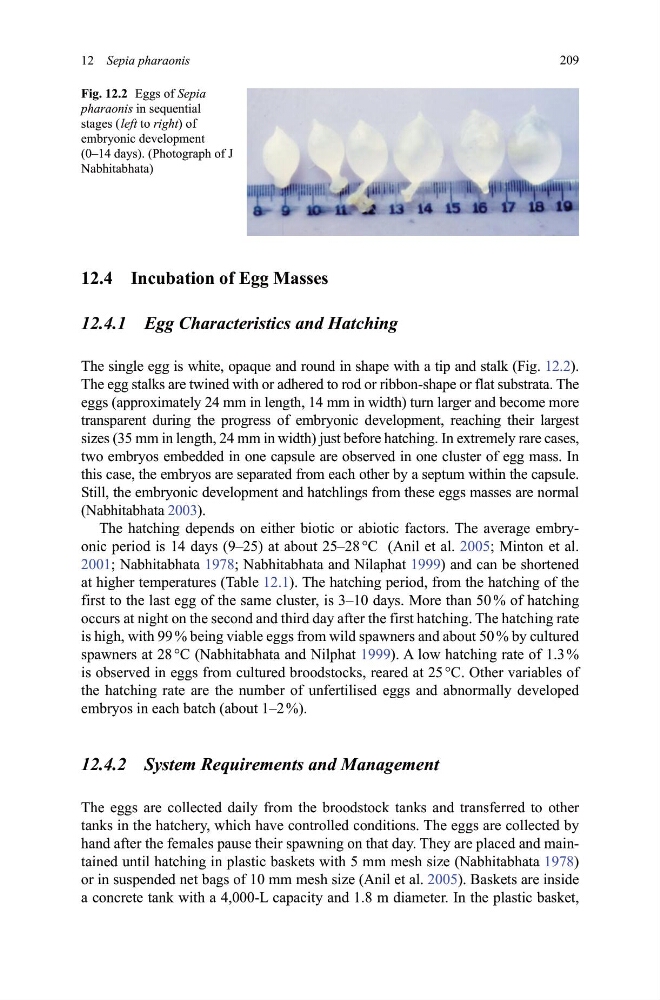
The single egg is white, opaque and round in shape with a tip and stalk (Fig. 12.2).
The egg stalks are twined with or adhered to rod or ribbon-shape or flat substrata. The
eggs (approximately 24 mm in length, 14 mm in width) turn larger and become more
transparent during the progress of embryonic development, reaching their largest
sizes (35 mm in length, 24 mm in width) just before hatching. In extremely rare cases,
two embryos embedded in one capsule are observed in one cluster of egg mass. In
this case, the embryos are separated from each other by a septum within the capsule.
Still, the embryonic development and hatchlings from these eggs masses are normal
(Nabhitabhata 2003).
The hatching depends on either biotic or abiotic factors. The average embryonic period is 14 days (9–25) at about 25‒28 °C (Anil et al. 2005; Minton et al.
2001; Nabhitabhata 1978; Nabhitabhata and Nilaphat 1999) and can be shortened
at higher temperatures (Table 12.1). The hatching period, from the hatching of the
first to the last egg of the same cluster, is 3–10 days. More than 50 % of hatching
occurs at night on the second and third day after the first hatching. The hatching rate
is high, with 99 % being viable eggs from wild spawners and about 50 % by cultured
spawners at 28 °C (Nabhitabhata and Nilphat 1999). A low hatching rate of 1.3 %
is observed in eggs from cultured broodstocks, reared at 25 °C. Other variables of
the hatching rate are the number of unfertilised eggs and abnormally developed
embryos in each batch (about 1–2 %).
12.4.2 System Requirements and Management
The eggs are collected daily from the broodstock tanks and transferred to other
tanks in the hatchery, which have controlled conditions. The eggs are collected by
hand after the females pause their spawning on that day. They are placed and maintained until hatching in plastic baskets with 5 mm mesh size (Nabhitabhata 1978)
or in suspended net bags of 10 mm mesh size (Anil et al. 2005). Baskets are inside
a concrete tank with a 4,000-L capacity and 1.8 m diameter. In the plastic basket,
Fig. 12.2 Eggs of Sepia
pharaonis in sequential
stages ( left to right) of
embryonic development
(0–14 days). (Photograph of J
Nabhitabhata)
12 Sepia pharaonis
12.4 Incubation of Egg Masses
12.4.1 Egg Characteristics and Hatching
The single egg is white, opaque and round in shape with a tip and stalk (Fig. 12.2).
The egg stalks are twined with or adhered to rod or ribbon-shape or flat substrata. The
eggs (approximately 24 mm in length, 14 mm in width) turn larger and become more
transparent during the progress of embryonic development, reaching their largest
sizes (35 mm in length, 24 mm in width) just before hatching. In extremely rare cases,
two embryos embedded in one capsule are observed in one cluster of egg mass. In
this case, the embryos are separated from each other by a septum within the capsule.
Still, the embryonic development and hatchlings from these eggs masses are normal
(Nabhitabhata 2003).
The hatching depends on either biotic or abiotic factors. The average embryonic period is 14 days (9–25) at about 25‒28 °C (Anil et al. 2005; Minton et al.
2001; Nabhitabhata 1978; Nabhitabhata and Nilaphat 1999) and can be shortened
at higher temperatures (Table 12.1). The hatching period, from the hatching of the
first to the last egg of the same cluster, is 3–10 days. More than 50 % of hatching
occurs at night on the second and third day after the first hatching. The hatching rate
is high, with 99 % being viable eggs from wild spawners and about 50 % by cultured
spawners at 28 °C (Nabhitabhata and Nilphat 1999). A low hatching rate of 1.3 %
is observed in eggs from cultured broodstocks, reared at 25 °C. Other variables of
the hatching rate are the number of unfertilised eggs and abnormally developed
embryos in each batch (about 1–2 %).
12.4.2 System Requirements and Management
The eggs are collected daily from the broodstock tanks and transferred to other
tanks in the hatchery, which have controlled conditions. The eggs are collected by
hand after the females pause their spawning on that day. They are placed and maintained until hatching in plastic baskets with 5 mm mesh size (Nabhitabhata 1978)
or in suspended net bags of 10 mm mesh size (Anil et al. 2005). Baskets are inside
a concrete tank with a 4,000-L capacity and 1.8 m diameter. In the plastic basket,
Fig. 12.2 Eggs of Sepia
pharaonis in sequential
stages ( left to right) of
embryonic development
(0–14 days). (Photograph of J
Nabhitabhata)
12 Sepia pharaonis