

210
J. Nabhitabhata
the capsules are then separated from clusters by scissor cutting. Eggs are visually
checked every day and the ones with dead and abnormally developed embryos are
discarded in order to prevent the infection—decomposition of the remaining.
In an open system, the change of physical and chemical parameters should be
minimised during the embryonic stage. Brief changes in temperature and salinity as
well as mechanical stimuli cause premature hatching. To minimise the temperature
fluctuation, a low water flow-through of 1 L min
−1
is used. The fresh seawater is
first pumped through a carbon filter and stored in a 200-m
3
concrete tank before being supplied by gravity to the hatchery tanks. This open system is able to maintain
an average temperature of 28 °C, with a salinity of 30–33 psu and a pH of 6.0–8.0
(Nabhitabhata et al. 2005). The salinity required for a 50 % hatching rate of eggs is
22–38 psu (Nabhitabhata et al. 1993b, 2001c).
Other important physical factors are turbidity or suspended solids and light.
Turbidity should be maintained as low as possible (Nabhitabhata 1995) through
filtration and/or prior sedimentation, particularly in open systems. Cephalopod gills
have a low efficiency for removing sediment, high levels of suspended solids or
high turbidity, which clog the gills and will block oxygen exchange. Any artificial
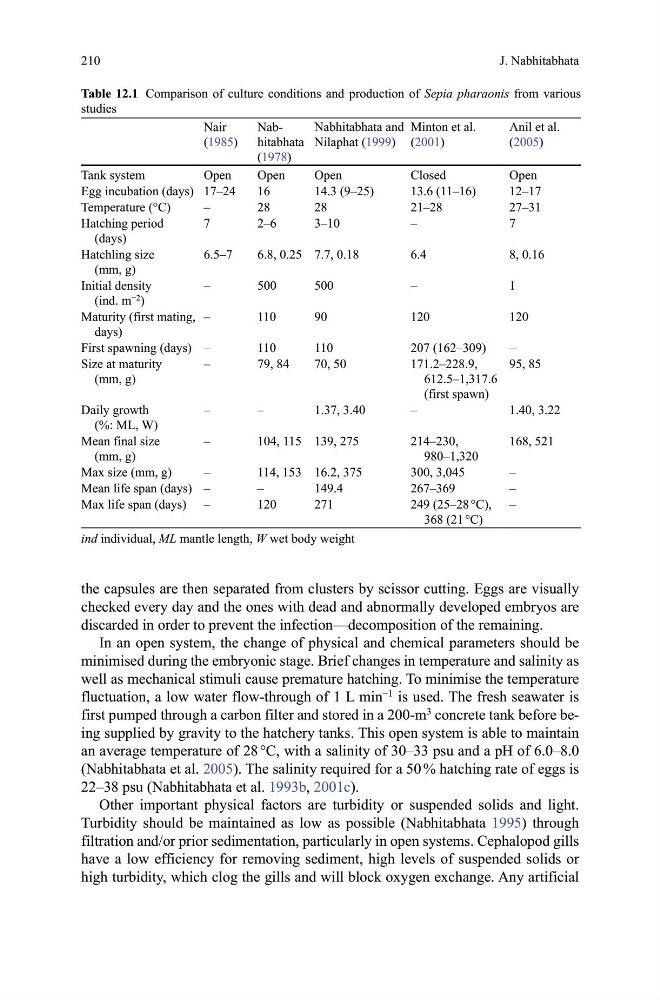
Table 12.1 Comparison of culture conditions and production of Sepia pharaonis from various
studies
Nair
(1985)
Nabhitabhata
(1978)
Nabhitabhata and
Nilaphat (1999)
Minton et al.
(2001)
Anil et al.
(2005)
Tank system
Open
Open
Open
Closed
Open
Egg incubation (days) 17–24
16
14.3 (9–25)
13.6 (11–16)
12–17
Temperature (°C)
–
28
28
21–28
27–31
Hatching period
(days)
7
2–6
3–10
–
7
Hatchling size
(mm, g)
6.5–7
6.8, 0.25 7.7, 0.18
6.4
8, 0.16
Initial density
(ind. m
−2
)
–
500
500
–
1
Maturity (first mating,
days)
–
110
90
120
120
First spawning (days) –
110
110
207 (162–309)
–
Size at maturity
(mm, g)
–
79, 84
70, 50
171.2–228.9,
612.5–1,317.6
(first spawn)
95, 85
Daily growth
(%: ML, W)
–
–
1.37, 3.40
–
1.40, 3.22
Mean final size
(mm, g)
–
104, 115 139, 275
214–230,
980–1,320
168, 521
Max size (mm, g)
–
114, 153 16.2, 375
300, 3,045
–
Mean life span (days) –
–
149.4
267–369
–
Max life span (days) –
120
271
249 (25–28 °C),
368 (21 °C)
–
ind individual, ML mantle length, W wet body weight
J. Nabhitabhata
the capsules are then separated from clusters by scissor cutting. Eggs are visually
checked every day and the ones with dead and abnormally developed embryos are
discarded in order to prevent the infection—decomposition of the remaining.
In an open system, the change of physical and chemical parameters should be
minimised during the embryonic stage. Brief changes in temperature and salinity as
well as mechanical stimuli cause premature hatching. To minimise the temperature
fluctuation, a low water flow-through of 1 L min
−1
is used. The fresh seawater is
first pumped through a carbon filter and stored in a 200-m
3
concrete tank before being supplied by gravity to the hatchery tanks. This open system is able to maintain
an average temperature of 28 °C, with a salinity of 30–33 psu and a pH of 6.0–8.0
(Nabhitabhata et al. 2005). The salinity required for a 50 % hatching rate of eggs is
22–38 psu (Nabhitabhata et al. 1993b, 2001c).
Other important physical factors are turbidity or suspended solids and light.
Turbidity should be maintained as low as possible (Nabhitabhata 1995) through
filtration and/or prior sedimentation, particularly in open systems. Cephalopod gills
have a low efficiency for removing sediment, high levels of suspended solids or
high turbidity, which clog the gills and will block oxygen exchange. Any artificial
Table 12.1 Comparison of culture conditions and production of Sepia pharaonis from various
studies
Nair
(1985)
Nabhitabhata
(1978)
Nabhitabhata and
Nilaphat (1999)
Minton et al.
(2001)
Anil et al.
(2005)
Tank system
Open
Open
Open
Closed
Open
Egg incubation (days) 17–24
16
14.3 (9–25)
13.6 (11–16)
12–17
Temperature (°C)
–
28
28
21–28
27–31
Hatching period
(days)
7
2–6
3–10
–
7
Hatchling size
(mm, g)
6.5–7
6.8, 0.25 7.7, 0.18
6.4
8, 0.16
Initial density
(ind. m
−2
)
–
500
500
–
1
Maturity (first mating,
days)
–
110
90
120
120
First spawning (days) –
110
110
207 (162–309)
–
Size at maturity
(mm, g)
–
79, 84
70, 50
171.2–228.9,
612.5–1,317.6
(first spawn)
95, 85
Daily growth
(%: ML, W)
–
–
1.37, 3.40
–
1.40, 3.22
Mean final size
(mm, g)
–
104, 115 139, 275
214–230,
980–1,320
168, 521
Max size (mm, g)
–
114, 153 16.2, 375
300, 3,045
–
Mean life span (days) –
–
149.4
267–369
–
Max life span (days) –
120
271
249 (25–28 °C),
368 (21 °C)
–
ind individual, ML mantle length, W wet body weight