

208
J. Nabhitabhata
Acclimatisation to captivity is fast, since mating and spawning in the tank proceed on the same day or in the next morning (Nabhitabhata 1978; Nabhitabhata and
Nilaphat 1999). The females attach their egg capsules in clusters to the artificial
substrates. The process of spawning one egg capsule takes about 1 min. In captivity,
the wild females are able to spawn 1,600 (500–3,000) egg capsules in total before
they die (Nabhitabhata 1978; Nabhitabhata and Nilaphat 1999). The females of cultured consecutive generations produce comparatively lower numbers of eggs. The
average individual fecundity is 175 (50–200) eggs per female, with comparatively
smaller egg capsules being observed at 28 °C (Nabhitabhata and Nilaphat 1999)
and 11–485 eggs at a lower temperature of 25 °C (Minton et al. 2001). Each female,
either of wild or of cultured batches, lays eggs in one cluster or more every day or
every other day, if they are interrupted while spawning. The species displays intermittent spawning, with mating being observed between spawns. After spawning
each cluster, the female will be tired and lies at the bottom, escorted by her mate.
However, when she is ready to eat, she immediately seizes the first passing prey
or dead feed. The spawning period ranges from 1 to 24 days, depending on the
female’s size, condition and the number of eggs produced. The male escorts and
protects her from other males during spawning (Nabhitabhata 1978; Nabhitabhata
and Nilaphat 1999). Only other females are allowed to approach and spawn at the
same site and time. The healthy male will turn to form a pair with another selected
female after the last spawning of his mate. The mating and spawning are observed
early in the morning and late afternoon.
Egg clusters are also available from the wild. The egg clusters are found attached
to underwater substrates, i.e. seaweeds and rocks, and can be collected by skin divers (Anil et al. 2005).
Artificial in vitro fertilisation has been studied between mature oocytes from the
female oviducts and sperm from the spermatophores in the male Needham’s sac.
About 40 % of oocytes were successfully fertilised (Nabhitabhata et al. 2001a). The
oviducal and nidamental gland jellies are not applied to the eggs in this study. The
eggs develop for about 4 h to the blastula stage before ceasing. In the case of naturally fertilised eggs, the embryos in the capsules with a damaged coating tend to be
infected by bacteria or fungi after a few days.
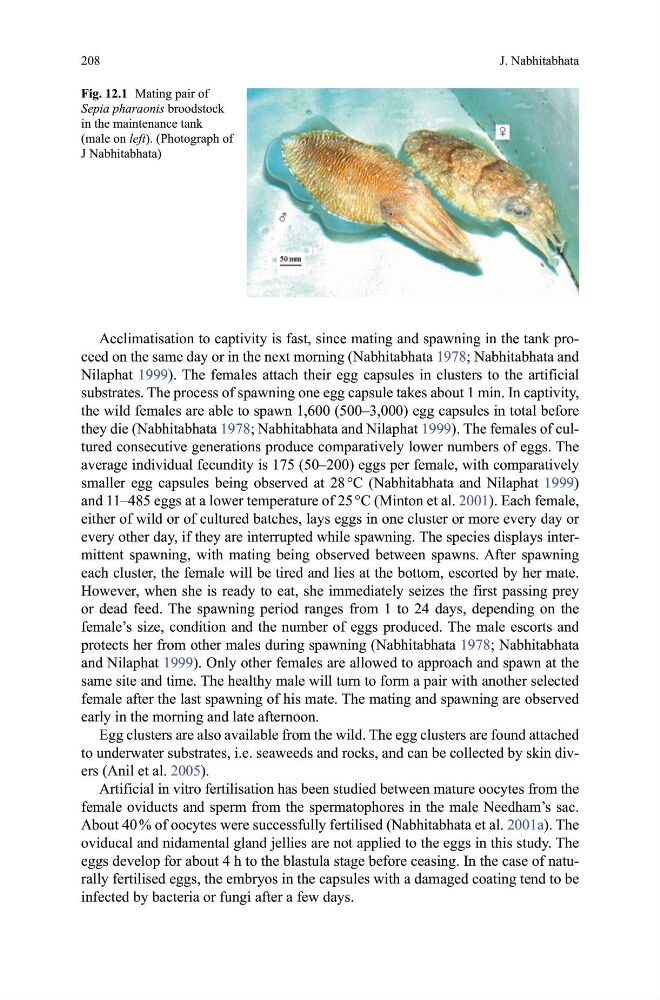
Fig. 12.1 Mating pair of
Sepia pharaonis broodstock
in the maintenance tank
(male on left). (Photograph of
J Nabhitabhata)
J. Nabhitabhata
Acclimatisation to captivity is fast, since mating and spawning in the tank proceed on the same day or in the next morning (Nabhitabhata 1978; Nabhitabhata and
Nilaphat 1999). The females attach their egg capsules in clusters to the artificial
substrates. The process of spawning one egg capsule takes about 1 min. In captivity,
the wild females are able to spawn 1,600 (500–3,000) egg capsules in total before
they die (Nabhitabhata 1978; Nabhitabhata and Nilaphat 1999). The females of cultured consecutive generations produce comparatively lower numbers of eggs. The
average individual fecundity is 175 (50–200) eggs per female, with comparatively
smaller egg capsules being observed at 28 °C (Nabhitabhata and Nilaphat 1999)
and 11–485 eggs at a lower temperature of 25 °C (Minton et al. 2001). Each female,
either of wild or of cultured batches, lays eggs in one cluster or more every day or
every other day, if they are interrupted while spawning. The species displays intermittent spawning, with mating being observed between spawns. After spawning
each cluster, the female will be tired and lies at the bottom, escorted by her mate.
However, when she is ready to eat, she immediately seizes the first passing prey
or dead feed. The spawning period ranges from 1 to 24 days, depending on the
female’s size, condition and the number of eggs produced. The male escorts and
protects her from other males during spawning (Nabhitabhata 1978; Nabhitabhata
and Nilaphat 1999). Only other females are allowed to approach and spawn at the
same site and time. The healthy male will turn to form a pair with another selected
female after the last spawning of his mate. The mating and spawning are observed
early in the morning and late afternoon.
Egg clusters are also available from the wild. The egg clusters are found attached
to underwater substrates, i.e. seaweeds and rocks, and can be collected by skin divers (Anil et al. 2005).
Artificial in vitro fertilisation has been studied between mature oocytes from the
female oviducts and sperm from the spermatophores in the male Needham’s sac.
About 40 % of oocytes were successfully fertilised (Nabhitabhata et al. 2001a). The
oviducal and nidamental gland jellies are not applied to the eggs in this study. The
eggs develop for about 4 h to the blastula stage before ceasing. In the case of naturally fertilised eggs, the embryos in the capsules with a damaged coating tend to be
infected by bacteria or fungi after a few days.
Fig. 12.1 Mating pair of
Sepia pharaonis broodstock
in the maintenance tank
(male on left). (Photograph of
J Nabhitabhata)