

287
15 The Damage Schedule Approach
By examining how much they value conservation as it competes with other interests,
we may acquire a deeper understanding of what motivates illegal fi shing and fi nd
support for focusing on values, images and principles in dealing with illegal
fi shing.
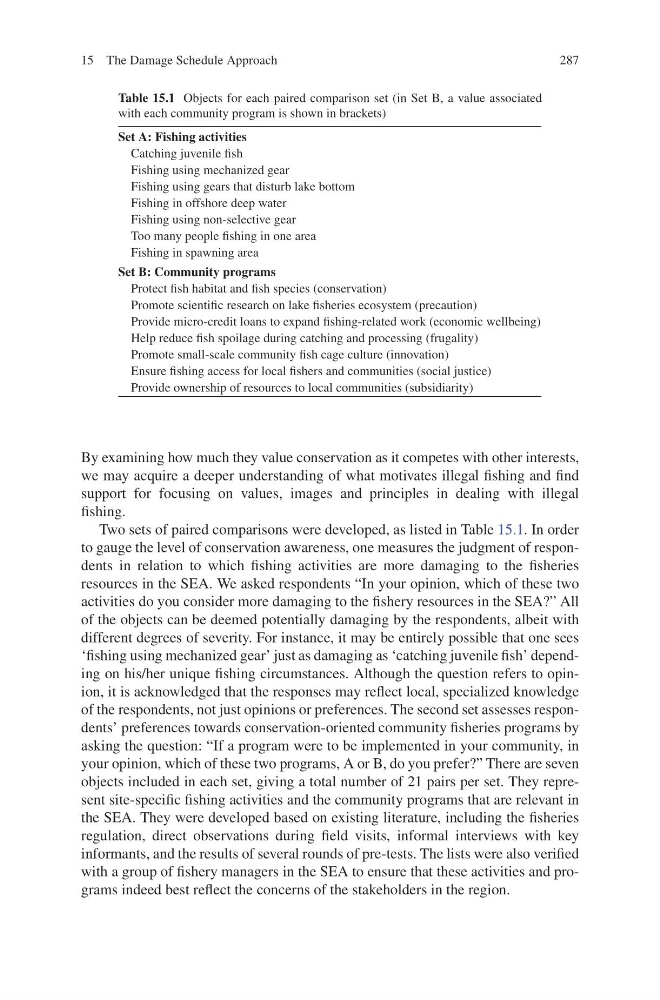
Two sets of paired comparisons were developed, as listed in Table 15.1 . In order
to gauge the level of conservation awareness, one measures the judgment of respondents in relation to which fi shing activities are more damaging to the fi sheries
resources in the SEA. We asked respondents “In your opinion, which of these two
activities do you consider more damaging to the fi shery resources in the SEA?” All
of the objects can be deemed potentially damaging by the respondents, albeit with
different degrees of severity. For instance, it may be entirely possible that one sees
‘ fi shing using mechanized gear’ just as damaging as ‘catching juvenile fi sh’ depending on his/her unique fi shing circumstances. Although the question refers to opinion, it is acknowledged that the responses may re fl ect local, specialized knowledge
of the respondents, not just opinions or preferences. The second set assesses respondents’ preferences towards conservation-oriented community fi sheries programs by
asking the question: “If a program were to be implemented in your community, in
your opinion, which of these two programs, A or B, do you prefer?” There are seven
objects included in each set, giving a total number of 21 pairs per set. They represent site-speci fi c fi shing activities and the community programs that are relevant in
the SEA. They were developed based on existing literature, including the fi sheries
regulation, direct observations during fi eld visits, informal interviews with key
informants, and the results of several rounds of pre-tests. The lists were also veri fi ed
with a group of fi shery managers in the SEA to ensure that these activities and programs indeed best re fl ect the concerns of the stakeholders in the region.
Table 15.1 Objects for each paired comparison set (in Set B, a value associated
with each community program is shown in brackets)
Set A: Fishing activities
Catching juvenile fi sh
Fishing using mechanized gear
Fishing using gears that disturb lake bottom
Fishing in offshore deep water
Fishing using non-selective gear
Too many people fi shing in one area
Fishing in spawning area
Set B: Community programs
Protect fi sh habitat and fi sh species (conservation)
Promote scienti fi c research on lake fi sheries ecosystem (precaution)
Provide micro-credit loans to expand fi shing-related work (economic wellbeing)
Help reduce fi sh spoilage during catching and processing (frugality)
Promote small-scale community fi sh cage culture (innovation)
Ensure fi shing access for local fi shers and communities (social justice)
Provide ownership of resources to local communities (subsidiarity)
15 The Damage Schedule Approach
By examining how much they value conservation as it competes with other interests,
we may acquire a deeper understanding of what motivates illegal fi shing and fi nd
support for focusing on values, images and principles in dealing with illegal
fi shing.
Two sets of paired comparisons were developed, as listed in Table 15.1 . In order
to gauge the level of conservation awareness, one measures the judgment of respondents in relation to which fi shing activities are more damaging to the fi sheries
resources in the SEA. We asked respondents “In your opinion, which of these two
activities do you consider more damaging to the fi shery resources in the SEA?” All
of the objects can be deemed potentially damaging by the respondents, albeit with
different degrees of severity. For instance, it may be entirely possible that one sees
‘ fi shing using mechanized gear’ just as damaging as ‘catching juvenile fi sh’ depending on his/her unique fi shing circumstances. Although the question refers to opinion, it is acknowledged that the responses may re fl ect local, specialized knowledge
of the respondents, not just opinions or preferences. The second set assesses respondents’ preferences towards conservation-oriented community fi sheries programs by
asking the question: “If a program were to be implemented in your community, in
your opinion, which of these two programs, A or B, do you prefer?” There are seven
objects included in each set, giving a total number of 21 pairs per set. They represent site-speci fi c fi shing activities and the community programs that are relevant in
the SEA. They were developed based on existing literature, including the fi sheries
regulation, direct observations during fi eld visits, informal interviews with key
informants, and the results of several rounds of pre-tests. The lists were also veri fi ed
with a group of fi shery managers in the SEA to ensure that these activities and programs indeed best re fl ect the concerns of the stakeholders in the region.
Table 15.1 Objects for each paired comparison set (in Set B, a value associated
with each community program is shown in brackets)
Set A: Fishing activities
Catching juvenile fi sh
Fishing using mechanized gear
Fishing using gears that disturb lake bottom
Fishing in offshore deep water
Fishing using non-selective gear
Too many people fi shing in one area
Fishing in spawning area
Set B: Community programs
Protect fi sh habitat and fi sh species (conservation)
Promote scienti fi c research on lake fi sheries ecosystem (precaution)
Provide micro-credit loans to expand fi shing-related work (economic wellbeing)
Help reduce fi sh spoilage during catching and processing (frugality)
Promote small-scale community fi sh cage culture (innovation)
Ensure fi shing access for local fi shers and communities (social justice)
Provide ownership of resources to local communities (subsidiarity)