

288
A. Song and R. Chuenpagdee
Responses to the fi rst set, Set A, produce a scale, from most damaging to least
damaging fi shing activity, on the basis of respondents’ perceptions. It is an indication
of their level of understanding about the lake’s fi sheries and ecosystems, and may
enable voluntary engagement in conservation-oriented fi shing practices. The assumption is that, for any principle to in fl uence one’s fi shing decisions and behavior
(both legal and illegal), s/he must fi rst be equipped with suf fi cient understanding of
which activities promote conservation and should thus be encouraged, and which
activities jeopardize conservation and should therefore be made illegal. As shown in
Table 15.1 , the objects are void of any speci fi c details. For example, there is no
number indicating the degree of mechanization in ‘ fi shing using mechanized gear’,
and any mention of a speci fi c fi shing gear is avoided. This was to minimize strategic
voting of the respondents by basing the comparisons on the concept – or the image –
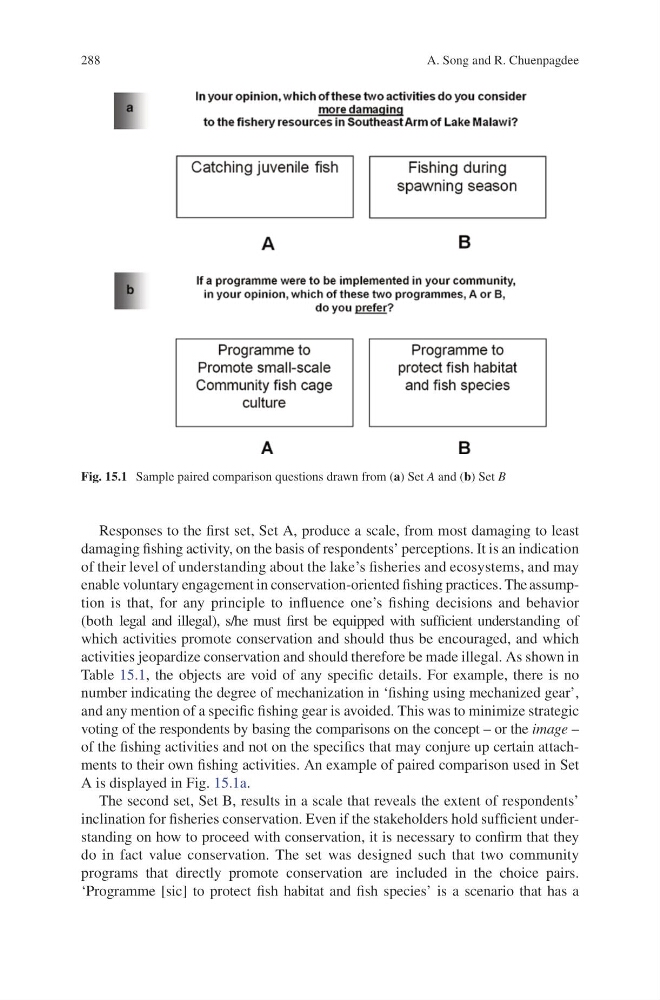
of the fi shing activities and not on the speci fi cs that may conjure up certain attachments to their own fi shing activities. An example of paired comparison used in Set
A is displayed in Fig. 15.1a .
The second set, Set B, results in a scale that reveals the extent of respondents’
inclination for fi sheries conservation. Even if the stakeholders hold suf fi cient understanding on how to proceed with conservation, it is necessary to con fi rm that they
do in fact value conservation. The set was designed such that two community
programs that directly promote conservation are included in the choice pairs.
‘Programme [sic] to protect fi sh habitat and fi sh species’ is a scenario that has a
Fig. 15.1 Sample paired comparison questions drawn from ( a ) Set A and ( b ) Set B
A. Song and R. Chuenpagdee
Responses to the fi rst set, Set A, produce a scale, from most damaging to least
damaging fi shing activity, on the basis of respondents’ perceptions. It is an indication
of their level of understanding about the lake’s fi sheries and ecosystems, and may
enable voluntary engagement in conservation-oriented fi shing practices. The assumption is that, for any principle to in fl uence one’s fi shing decisions and behavior
(both legal and illegal), s/he must fi rst be equipped with suf fi cient understanding of
which activities promote conservation and should thus be encouraged, and which
activities jeopardize conservation and should therefore be made illegal. As shown in
Table 15.1 , the objects are void of any speci fi c details. For example, there is no
number indicating the degree of mechanization in ‘ fi shing using mechanized gear’,
and any mention of a speci fi c fi shing gear is avoided. This was to minimize strategic
voting of the respondents by basing the comparisons on the concept – or the image –
of the fi shing activities and not on the speci fi cs that may conjure up certain attachments to their own fi shing activities. An example of paired comparison used in Set
A is displayed in Fig. 15.1a .
The second set, Set B, results in a scale that reveals the extent of respondents’
inclination for fi sheries conservation. Even if the stakeholders hold suf fi cient understanding on how to proceed with conservation, it is necessary to con fi rm that they
do in fact value conservation. The set was designed such that two community
programs that directly promote conservation are included in the choice pairs.
‘Programme [sic] to protect fi sh habitat and fi sh species’ is a scenario that has a
Fig. 15.1 Sample paired comparison questions drawn from ( a ) Set A and ( b ) Set B