

Biological phosphorus removal
3.6.4 Kinetics, biological phosphorus removal
Anaerobic phase
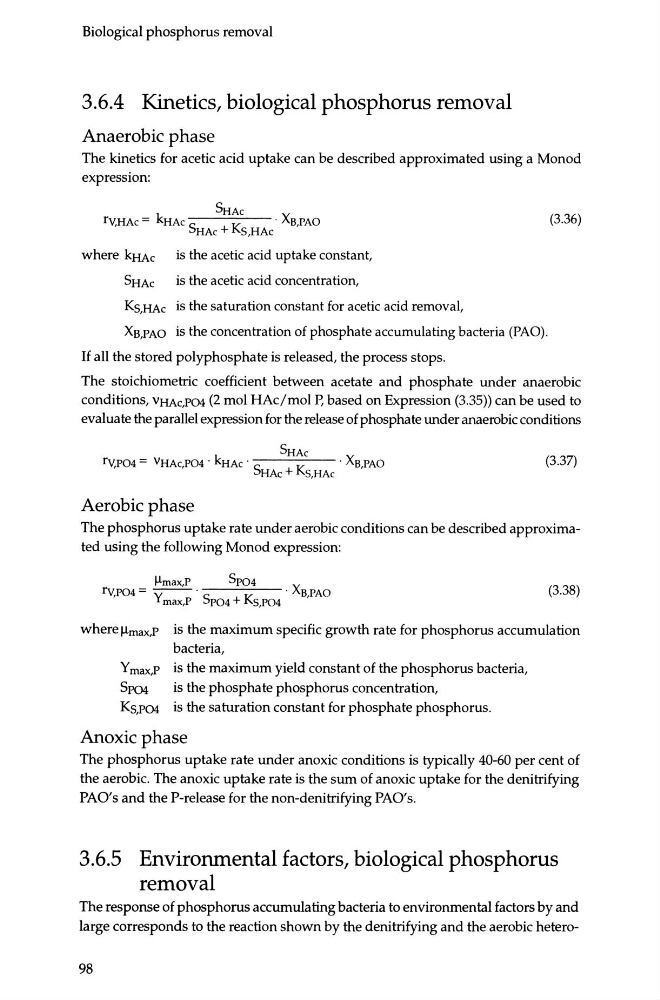
The kinetics for acetic acid uptake can be described approximated using a Monod
expression:
St!Ac
rv,HAc = kHAc S
K
· Xs,PAO
HAc+ S,HAc
(3.36)
where kHAc is the acetic acid uptake constant,
SHAc
is the acetic acid concentration,
Ks,HAc is the saturation constant for acetic acid removal,
Xs,PAO is the concentration of phosphate accumulating bacteria (PAO).
If all the stored polyphosphate is released, the process stops.
The stoichiometric coefficient between acetate and phosphate under anaerobic
conditions, VHAc,P04 (2 mol HAc/mol P, based on Expression (3.35)) can be used to
evaluate the parallel expression for the release of phosphate under anaerobic conditions
SHAc
rv,P04 = VHAc,P04 · kHAc · S
K
· Xs,PAO
HAc+ S,HAc
(3.37)
Aerobic phase
The phosphorus uptake rate under aerobic conditions can be described approximated using the following Monod expression:
llrnax,P
Spo4
rvP04 = - - ·
· Xs PAO
'
Y rnax,P Spo4 + Ks,P04
'
(3.38)
where f.lmax,P is the maximum specific growth rate for phosphorus accumulation
bacteria,
Ymax,P
Sp04
Ks,P04
is the maximum yield constant of the phosphorus bacteria,
is the phosphate phosphorus concentration,
is the saturation constant for phosphate phosphorus.
Anoxic phase
The phosphorus uptake rate under anoxic conditions is typically 40-60 per cent of
the aerobic. The anoxic uptake rate is the sum of anoxic uptake for the denitrifying
PAO's and the P-release for the non-denitrifying PAO's.
3.6.5 Environmental factors, biological phosphorus
removal
The response of phosphorus accumulating bacteria to environmental factors by and
large corresponds to the reaction shown by the denitrifying and the aerobic hetero98
3.6.4 Kinetics, biological phosphorus removal
Anaerobic phase
The kinetics for acetic acid uptake can be described approximated using a Monod
expression:
St!Ac
rv,HAc = kHAc S
K
· Xs,PAO
HAc+ S,HAc
(3.36)
where kHAc is the acetic acid uptake constant,
SHAc
is the acetic acid concentration,
Ks,HAc is the saturation constant for acetic acid removal,
Xs,PAO is the concentration of phosphate accumulating bacteria (PAO).
If all the stored polyphosphate is released, the process stops.
The stoichiometric coefficient between acetate and phosphate under anaerobic
conditions, VHAc,P04 (2 mol HAc/mol P, based on Expression (3.35)) can be used to
evaluate the parallel expression for the release of phosphate under anaerobic conditions
SHAc
rv,P04 = VHAc,P04 · kHAc · S
K
· Xs,PAO
HAc+ S,HAc
(3.37)
Aerobic phase
The phosphorus uptake rate under aerobic conditions can be described approximated using the following Monod expression:
llrnax,P
Spo4
rvP04 = - - ·
· Xs PAO
'
Y rnax,P Spo4 + Ks,P04
'
(3.38)
where f.lmax,P is the maximum specific growth rate for phosphorus accumulation
bacteria,
Ymax,P
Sp04
Ks,P04
is the maximum yield constant of the phosphorus bacteria,
is the phosphate phosphorus concentration,
is the saturation constant for phosphate phosphorus.
Anoxic phase
The phosphorus uptake rate under anoxic conditions is typically 40-60 per cent of
the aerobic. The anoxic uptake rate is the sum of anoxic uptake for the denitrifying
PAO's and the P-release for the non-denitrifying PAO's.
3.6.5 Environmental factors, biological phosphorus
removal
The response of phosphorus accumulating bacteria to environmental factors by and
large corresponds to the reaction shown by the denitrifying and the aerobic hetero98