

Basic Biological Processes
Concentration
3.0 mM
2.0
1.0
·,•
•-,
Acetate
\ .•. ~
Time
"---'--1 ...... 0_..___....J2'-0----'-3 ...... 0-..___....J 4 '- 0 ----'+ minutes
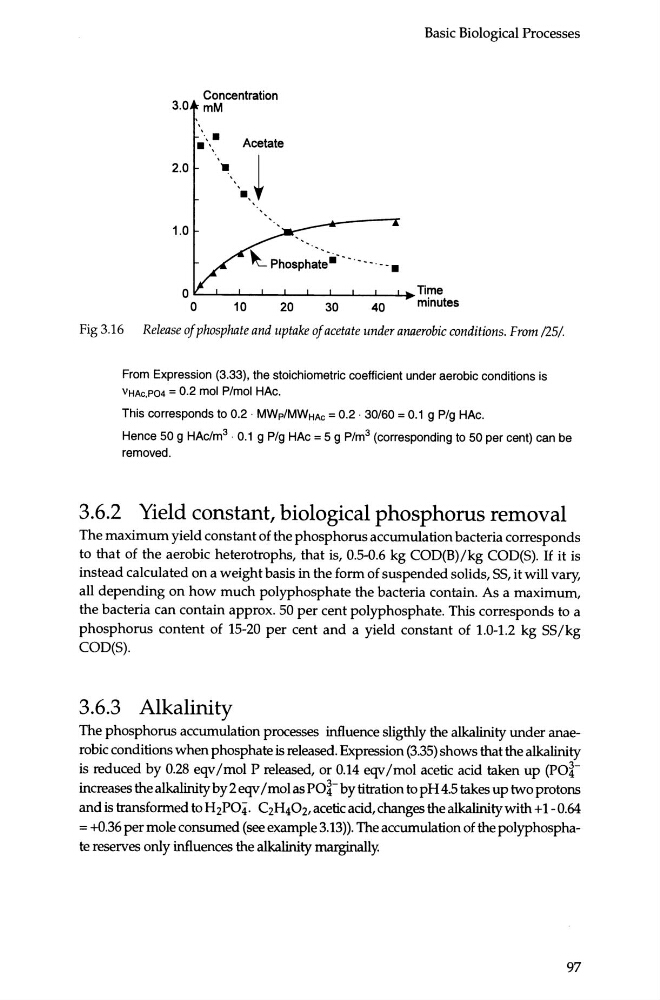
Fig 3.16 Release of phosphate and uptake of acetate under anaerobic conditions. From /25/.
From Expression (3.33), the stoichiometric coefficient under aerobic conditions is
VHAc.P04 = 0.2 mol P/mol HAc.
This corresponds to 0.2 · MWp/MWHAc = 0.2 · 30/60 = 0.1 g P/g HAc.
Hence 50 g HAc/m 3 · 0.1 g P/g HAc= 5 g P/m 3 (corresponding to 50 per cent) can be
removed.
3.6.2 Yield constant, biological phosphorus removal
The maximum yield constant of the phosphorus accumulation bacteria corresponds
to that of the aerobic heterotrophs, that is, 0.5-0.6 kg COD(B)/kg COD(S). If it is
instead calculated on a weight basis in the form of suspended solids, SS, it will vary,
all depending on how much polyphosphate the bacteria contain. As a maximum,
the bacteria can contain approx. 50 per cent polyphosphate. This corresponds to a
phosphorus content of 15-20 per cent and a yield constant of 1.0-1.2 kg SS/kg
COD(S).
3.6.3 Alkalinity
The phosphorus accumulation processes influence sligthly the alkalinity under anaerobic conditions when phosphate is released. Expression (3.35) shows that the alkalinity
is reduced by 0.28 eqv /mol P released, or 0.14 eqv /mol acetic acid taken up (PO~increases the alkalinity by 2 eqv I mol as PO~- by titration to pH 4.5 takes up two protons
and is transformed to HzP04. C2H40z,aceticacid,changes the alkalinity with+ 1-0.64
= +0.36 per mole consumed (see example 3.13)). The accumulation of the polyphosphate reserves only influences the alkalinity marginally.
97
Concentration
3.0 mM
2.0
1.0
·,•
•-,
Acetate
\ .•. ~
Time
"---'--1 ...... 0_..___....J2'-0----'-3 ...... 0-..___....J 4 '- 0 ----'+ minutes
Fig 3.16 Release of phosphate and uptake of acetate under anaerobic conditions. From /25/.
From Expression (3.33), the stoichiometric coefficient under aerobic conditions is
VHAc.P04 = 0.2 mol P/mol HAc.
This corresponds to 0.2 · MWp/MWHAc = 0.2 · 30/60 = 0.1 g P/g HAc.
Hence 50 g HAc/m 3 · 0.1 g P/g HAc= 5 g P/m 3 (corresponding to 50 per cent) can be
removed.
3.6.2 Yield constant, biological phosphorus removal
The maximum yield constant of the phosphorus accumulation bacteria corresponds
to that of the aerobic heterotrophs, that is, 0.5-0.6 kg COD(B)/kg COD(S). If it is
instead calculated on a weight basis in the form of suspended solids, SS, it will vary,
all depending on how much polyphosphate the bacteria contain. As a maximum,
the bacteria can contain approx. 50 per cent polyphosphate. This corresponds to a
phosphorus content of 15-20 per cent and a yield constant of 1.0-1.2 kg SS/kg
COD(S).
3.6.3 Alkalinity
The phosphorus accumulation processes influence sligthly the alkalinity under anaerobic conditions when phosphate is released. Expression (3.35) shows that the alkalinity
is reduced by 0.28 eqv /mol P released, or 0.14 eqv /mol acetic acid taken up (PO~increases the alkalinity by 2 eqv I mol as PO~- by titration to pH 4.5 takes up two protons
and is transformed to HzP04. C2H40z,aceticacid,changes the alkalinity with+ 1-0.64
= +0.36 per mole consumed (see example 3.13)). The accumulation of the polyphosphate reserves only influences the alkalinity marginally.
97