

Biological phosphorus removal
easily degradable org . matter
Anaerobic
Aerobic or anoxic
oxygen or
nitrate present
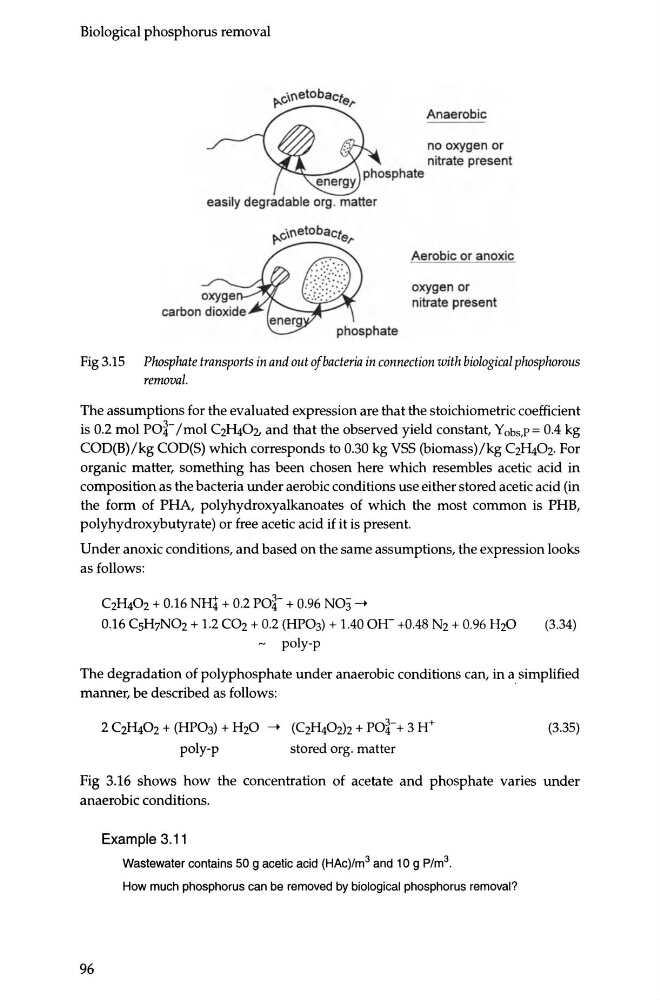
Fig 3.15 Plwspluzte transports in and out of bacteria in connection with biological phosphorous
removal.
The assumptions for the evaluated expression are that the stoichiometric coefficient
is 0.2 mol PO~- /mol Czl-40:u and that the observed yield constant, Yobs,r= 0.4 kg
COD(B)/kg COD(S) which corresponds to 0.30 kg VSS (biomass)/kg Czl-40z. For
organic matter, something has been chosen here which resembles acetic acid in
composition as the bacteria under aerobic conditions use either stored acetic acid (in
the form of PHA, polyhydroxyalkanoates of which the most common is PHB,
polyhydroxybutyrate) or free acetic acid if it is present.
Under anoxic conditions, and based on the same assumptions, the expression looks
as follows:
C2J-402 + 0.16 NH;i + 0.2 PO~-+ 0.96 N03 --t
0.16 CsH7NOz + 1.2 COz + 0.2 (HP03) + 1.40 OW +0.48 N2 + 0.96 H20
(3.34)
poly-p
The degradation of polyphosphate under anaerobic conditions can, in a simplified
manner, be described as follows:
(3.35)
poly-p
stored org. matter
Fig 3.16 shows how the concentration of acetate and phosphate varies under
anaerobic conditions.
Example 3.11
Wastewater contains 50 g acetic acid (HAc)/m 3 and 10 g P/m 3 .
How much phosphorus can be removed by biological phosphorus removal?
96
easily degradable org . matter
Anaerobic
Aerobic or anoxic
oxygen or
nitrate present
Fig 3.15 Plwspluzte transports in and out of bacteria in connection with biological phosphorous
removal.
The assumptions for the evaluated expression are that the stoichiometric coefficient
is 0.2 mol PO~- /mol Czl-40:u and that the observed yield constant, Yobs,r= 0.4 kg
COD(B)/kg COD(S) which corresponds to 0.30 kg VSS (biomass)/kg Czl-40z. For
organic matter, something has been chosen here which resembles acetic acid in
composition as the bacteria under aerobic conditions use either stored acetic acid (in
the form of PHA, polyhydroxyalkanoates of which the most common is PHB,
polyhydroxybutyrate) or free acetic acid if it is present.
Under anoxic conditions, and based on the same assumptions, the expression looks
as follows:
C2J-402 + 0.16 NH;i + 0.2 PO~-+ 0.96 N03 --t
0.16 CsH7NOz + 1.2 COz + 0.2 (HP03) + 1.40 OW +0.48 N2 + 0.96 H20
(3.34)
poly-p
The degradation of polyphosphate under anaerobic conditions can, in a simplified
manner, be described as follows:
(3.35)
poly-p
stored org. matter
Fig 3.16 shows how the concentration of acetate and phosphate varies under
anaerobic conditions.
Example 3.11
Wastewater contains 50 g acetic acid (HAc)/m 3 and 10 g P/m 3 .
How much phosphorus can be removed by biological phosphorus removal?
96