

Basic Biological Processes
Reaction rate constants for denitrification
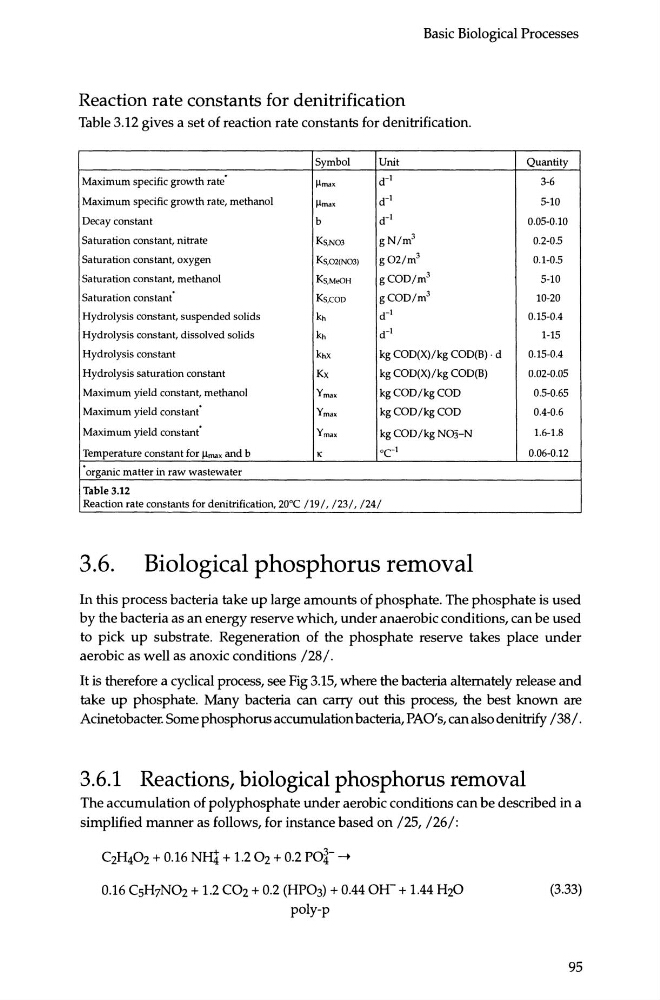
Table 3.12 gives a set of reaction rate constants for denitrification.
Symbol
Unit
Quantity
Maximum specific growth rate'
llmax
d-1
3-6
Maximum specific growth rate, methanol
llmax
d-1
5-10
Decay constant
b
d-1
0.05-0.10
Saturation constant, nitrate
Ks,N03
gN/m 3
0.2-0.5
Saturation constant, oxygen
Ks,02(N03)
g02/m 3
0.1-0.5
Saturation constant, methanol
Ks,MeOH
gCOD/m 3
5-10
Saturation constant'
Ks,coo
gCOD/m 3
10-20
Hydrolysis constant, suspended solids
kh
d-1
0.15-0.4
Hydrolysis constant, dissolved solids
kh
d-1
1-15
Hydrolysis constant
khX
kg COD(X)/kg COD(B) · d
0.15-0.4
Hydrolysis saturation constant
Kx
kg COD(X)/kg COD(B)
0.02-0.05
Maximum yield constant, methanol
Ymax
kgCOD/kgCOD
0.5-D.65
Maximum yield constant
Ymax
kgCOD/kgCOD
0.4-0.6
Maximum yield constant'
Ymax
kg COD/kg N03-N
1.6-1.8
Temperature constant for !!max and b
1(
oc-t
0.06-0.12
organic matter in raw wastewater
Table3.12
Reaction rate constants for denitrification, zooc /19 I, /23/, /24/
3.6. Biological phosphorus removal
In this process bacteria take up large amounts of phosphate. The phosphate is used
by the bacteria as an energy reserve which, under anaerobic conditions, can be used
to pick up substrate. Regeneration of the phosphate reserve takes place under
aerobic as well as anoxic conditions /28/.
It is therefore a cyclical process, see Fig 3.15, where the bacteria alternately release and
take up phosphate. Many bacteria can carry out this process, the best known are
Acinetobacter. Some phosphorus accumulation bacteria, PAO's, can also denitrify /38/.
3.6.1 Reactions, biological phosphorus removal
The accumulation of polyphosphate under aerobic conditions can be described in a
simplified manner as follows, for instance based on /25, /26/:
Cz~Oz + 0.16 NI-f4 + 1.2 0 2 + 0.2 PO~--+
0.16 C5H7NOz + 1.2 COz + 0.2 (HP03) + 0.44 Oir + 1.44 HzO
poly-p
(3.33)
95
Reaction rate constants for denitrification
Table 3.12 gives a set of reaction rate constants for denitrification.
Symbol
Unit
Quantity
Maximum specific growth rate'
llmax
d-1
3-6
Maximum specific growth rate, methanol
llmax
d-1
5-10
Decay constant
b
d-1
0.05-0.10
Saturation constant, nitrate
Ks,N03
gN/m 3
0.2-0.5
Saturation constant, oxygen
Ks,02(N03)
g02/m 3
0.1-0.5
Saturation constant, methanol
Ks,MeOH
gCOD/m 3
5-10
Saturation constant'
Ks,coo
gCOD/m 3
10-20
Hydrolysis constant, suspended solids
kh
d-1
0.15-0.4
Hydrolysis constant, dissolved solids
kh
d-1
1-15
Hydrolysis constant
khX
kg COD(X)/kg COD(B) · d
0.15-0.4
Hydrolysis saturation constant
Kx
kg COD(X)/kg COD(B)
0.02-0.05
Maximum yield constant, methanol
Ymax
kgCOD/kgCOD
0.5-D.65
Maximum yield constant
Ymax
kgCOD/kgCOD
0.4-0.6
Maximum yield constant'
Ymax
kg COD/kg N03-N
1.6-1.8
Temperature constant for !!max and b
1(
oc-t
0.06-0.12
organic matter in raw wastewater
Table3.12
Reaction rate constants for denitrification, zooc /19 I, /23/, /24/
3.6. Biological phosphorus removal
In this process bacteria take up large amounts of phosphate. The phosphate is used
by the bacteria as an energy reserve which, under anaerobic conditions, can be used
to pick up substrate. Regeneration of the phosphate reserve takes place under
aerobic as well as anoxic conditions /28/.
It is therefore a cyclical process, see Fig 3.15, where the bacteria alternately release and
take up phosphate. Many bacteria can carry out this process, the best known are
Acinetobacter. Some phosphorus accumulation bacteria, PAO's, can also denitrify /38/.
3.6.1 Reactions, biological phosphorus removal
The accumulation of polyphosphate under aerobic conditions can be described in a
simplified manner as follows, for instance based on /25, /26/:
Cz~Oz + 0.16 NI-f4 + 1.2 0 2 + 0.2 PO~--+
0.16 C5H7NOz + 1.2 COz + 0.2 (HP03) + 0.44 Oir + 1.44 HzO
poly-p
(3.33)
95