

Denitrification
Oxygen
Oxygen inhibits the denitrification process. Like for all other factors, it is the oxygen
concentration experienced by the micro-organisms themselves, that is, within floes
or biofilms, which is crucial, and not the oxygen concentration which is normally
measured in the liquid phase (the bulk phase). However, the effect of oxygen can
still be described using the following approximated expression which is multiplied
by using the reaction rate Expression (3.32):
Ks,02(N03)
Ks,02(N03) + Sm
where Ks,02(N03) is the "saturation constant" for oxygen inhibition,
So2
is the oxygen concentration in the liquid phase.
Ks,ozvaries with the existing conditions. In an activated sludge plant, Ks,ozwill be
lower than in a biofilm plant. And in an activated sludge plant, Ks,02(N03) will
decrease by decreasing floc sizes (stirring intensity). In model calculations, the same
saturation constant is frequently used for denitrification, Ks,02(N031 and for aerobic
oxidation, Ks,02·
pH
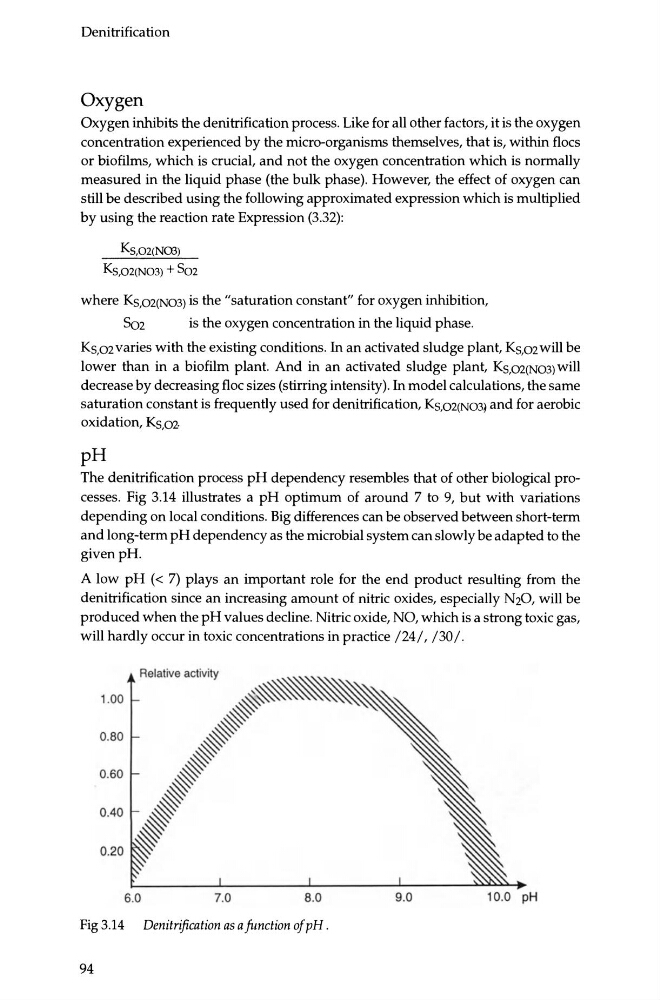
The denitrification process pH dependency resembles that of other biological processes. Fig 3.14 illustrates a pH optimum of around 7 to 9, but with variations
depending on local conditions. Big differences can be observed between short-term
and long-term pH dependency as the microbial system can slowly be adapted to the
given pH.
A low pH (< 7) plays an important role for the end product resulting from the
denitrification since an increasing amount of nitric oxides, especially NzO, will be
produced when the pH values decline. Nitric oxide, NO, which is a strong toxic gas,
will hardly occur in toxic concentrations in practice /24/ , /30/.
1.00
0.80
0.60
0.40
0.20
6.0
7.0
8.0
9.0
10.0 pH
Fig 3.14 Denitrification as a function of pH .
94
Oxygen
Oxygen inhibits the denitrification process. Like for all other factors, it is the oxygen
concentration experienced by the micro-organisms themselves, that is, within floes
or biofilms, which is crucial, and not the oxygen concentration which is normally
measured in the liquid phase (the bulk phase). However, the effect of oxygen can
still be described using the following approximated expression which is multiplied
by using the reaction rate Expression (3.32):
Ks,02(N03)
Ks,02(N03) + Sm
where Ks,02(N03) is the "saturation constant" for oxygen inhibition,
So2
is the oxygen concentration in the liquid phase.
Ks,ozvaries with the existing conditions. In an activated sludge plant, Ks,ozwill be
lower than in a biofilm plant. And in an activated sludge plant, Ks,02(N03) will
decrease by decreasing floc sizes (stirring intensity). In model calculations, the same
saturation constant is frequently used for denitrification, Ks,02(N031 and for aerobic
oxidation, Ks,02·
pH
The denitrification process pH dependency resembles that of other biological processes. Fig 3.14 illustrates a pH optimum of around 7 to 9, but with variations
depending on local conditions. Big differences can be observed between short-term
and long-term pH dependency as the microbial system can slowly be adapted to the
given pH.
A low pH (< 7) plays an important role for the end product resulting from the
denitrification since an increasing amount of nitric oxides, especially NzO, will be
produced when the pH values decline. Nitric oxide, NO, which is a strong toxic gas,
will hardly occur in toxic concentrations in practice /24/ , /30/.
1.00
0.80
0.60
0.40
0.20
6.0
7.0
8.0
9.0
10.0 pH
Fig 3.14 Denitrification as a function of pH .
94