

Basic Biological Processes
The 4.96 mol HAc per 3.94 mol NOJ-N, are equal to 1.26 mol HAc/mol NOg-N. Of
each mole of HAc, 36 per cent is dissociated at a pH of 4.5. This means a removal of
alkalinity corresponding to 36 per cent of the acetic acid added, that is, 0.36 · 1.26 =
0.45 eqv/mol N03-N. (The 36 per cent are derived from Example 3.13).
The final result is that the alkalinity has been increased by 0.30 eqv/mol N03-N.
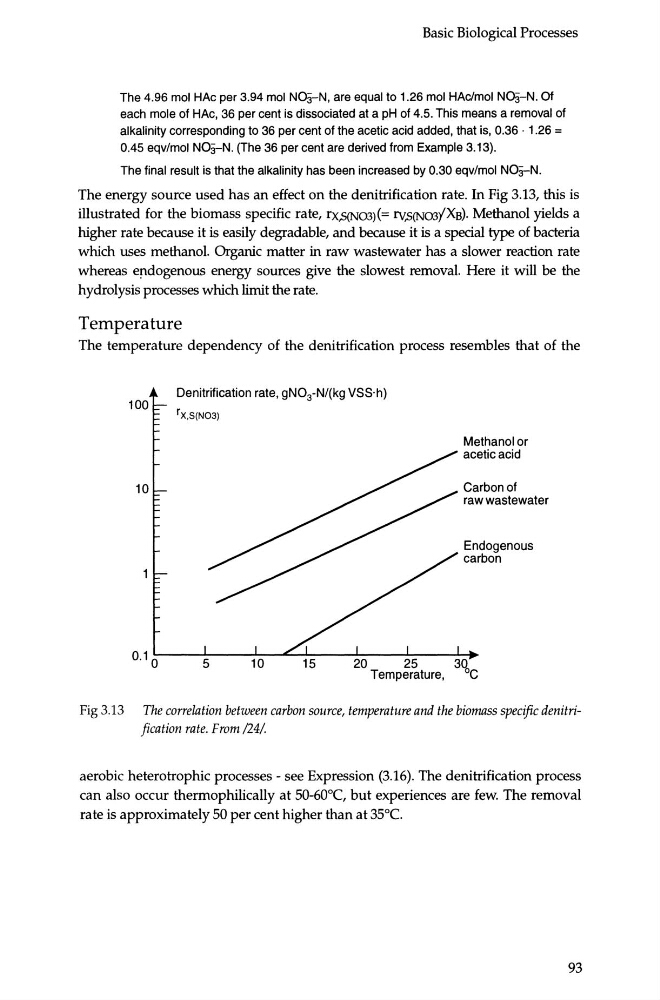
The energy source used has an effect on the denitrification rate. In Fig 3.13, this is
illustrated for the biomass specific rate, fX,S(N03J(= rv,s(N03YXB). Methanol yields a
higher rate because it is easily degradable, and because it is a special type of bacteria
which uses methanol. Organic matter in raw wastewater has a slower reaction rate
whereas e~dogenous energy sources give the slowest removal. Here it will be the
hydrolysis processes which limit the rate.
Temperature
The temperature dependency of the denitrification process resembles that of the
100
10
Denitrification rate, gN0 3 -N/(kg VSS·h)
rx.s(N03)
Methanol or
acetic acid
Carbon of
raw wastewater
Endogenous
carbon
20
25
3~
Temperature,
C
Fig 3.13 The correlation between carbon source, temperature and the biomass specific denitrification rate. From /24/.
aerobic heterotrophic processes- see Expression (3.16). The denitrification process
can also occur thermophilically at 50-60°C, but experiences are few. The removal
rate is approximately 50 per cent higher than at 35°C.
93
The 4.96 mol HAc per 3.94 mol NOJ-N, are equal to 1.26 mol HAc/mol NOg-N. Of
each mole of HAc, 36 per cent is dissociated at a pH of 4.5. This means a removal of
alkalinity corresponding to 36 per cent of the acetic acid added, that is, 0.36 · 1.26 =
0.45 eqv/mol N03-N. (The 36 per cent are derived from Example 3.13).
The final result is that the alkalinity has been increased by 0.30 eqv/mol N03-N.
The energy source used has an effect on the denitrification rate. In Fig 3.13, this is
illustrated for the biomass specific rate, fX,S(N03J(= rv,s(N03YXB). Methanol yields a
higher rate because it is easily degradable, and because it is a special type of bacteria
which uses methanol. Organic matter in raw wastewater has a slower reaction rate
whereas e~dogenous energy sources give the slowest removal. Here it will be the
hydrolysis processes which limit the rate.
Temperature
The temperature dependency of the denitrification process resembles that of the
100
10
Denitrification rate, gN0 3 -N/(kg VSS·h)
rx.s(N03)
Methanol or
acetic acid
Carbon of
raw wastewater
Endogenous
carbon
20
25
3~
Temperature,
C
Fig 3.13 The correlation between carbon source, temperature and the biomass specific denitrification rate. From /24/.
aerobic heterotrophic processes- see Expression (3.16). The denitrification process
can also occur thermophilically at 50-60°C, but experiences are few. The removal
rate is approximately 50 per cent higher than at 35°C.
93