

Denitrification
3.5.6 The influence of the environmental factors,
denitrification
Energy sources (substrate)
Denitrifying bacteria can utilize a broad spectrum of energy sources. Inorganic
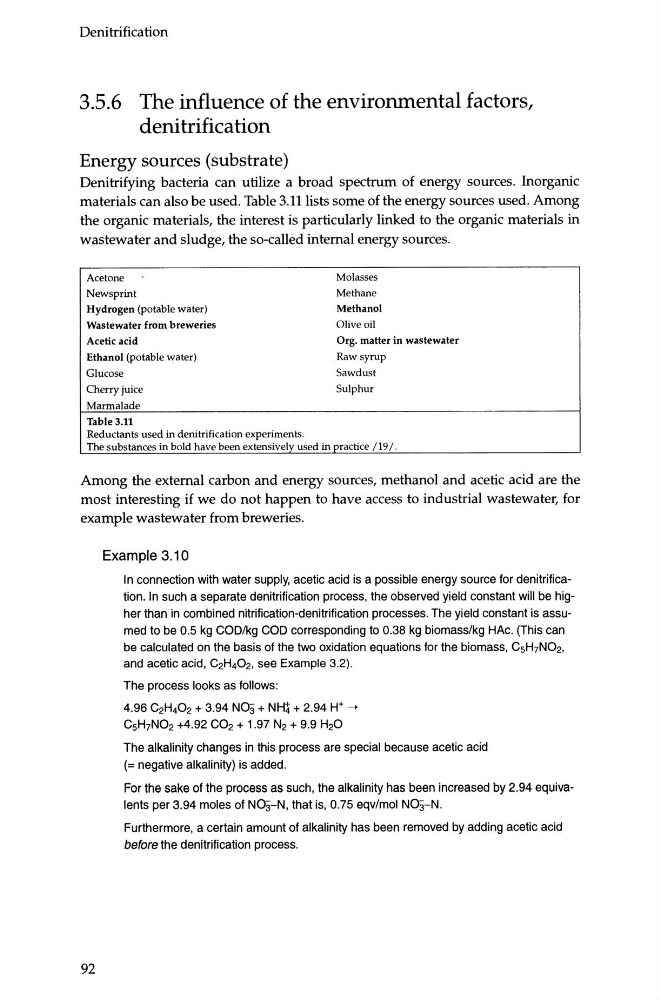
materials can also be used. Table 3.lllists some of the energy sources used. Among
the organic materials, the interest is particularly linked to the organic materials in
wastewater and sludge, the so-called internal energy sources.
Acetone
Newsprint
Molasses
Methane
Methanol
Olive oil
Hydrogen (potable water)
Wastewater from breweries
Acetic acid
Org. matter in wastewater
Raw syrup
Ethanol (potable water)
Glucose
Sawdust
Cherry juice
Marmalade
Sulphur
Table 3.11
Reductants used in denitrification experiments.
The substances in bold have been extensively used in practice /19/.
Among the external carbon and energy sources, methanol and acetic acid are the
most interesting if we do not happen to have access to industrial wastewater, for
example wastewater from breweries.
92
Example 3.1 0
In connection with water supply, acetic acid is a possible energy source for denitrification. In such a separate denitrification process, the observed yield constant will be higher than in combined nitrification-denitrification processes. The yield constant is assumed to be 0.5 kg COD/kg COD corresponding to 0.38 kg biomass/kg HAc. (This can
be calculated on the basis of the two oxidation equations for the biomass, C5H7N02,
and acetic acid, C2H40 2, see Example 3.2).
The process looks as follows:
4.96 C2H402 + 3.94 N03 + NH! + 2.94 W ->
C5H7N02 +4.92 C02 + 1.97 N2 + 9.9 H20
The alkalinity changes in this process are special because acetic acid
(=negative alkalinity) is added.
For the sake of the process as such, the alkalinity has been increased by 2.94 equivalents per 3.94 moles of NO:J-N, that is, 0.75 eqv/mol NO:J-N.
Furthermore, a certain amount of alkalinity has been removed by adding acetic acid
before the denitrification process.
3.5.6 The influence of the environmental factors,
denitrification
Energy sources (substrate)
Denitrifying bacteria can utilize a broad spectrum of energy sources. Inorganic
materials can also be used. Table 3.lllists some of the energy sources used. Among
the organic materials, the interest is particularly linked to the organic materials in
wastewater and sludge, the so-called internal energy sources.
Acetone
Newsprint
Molasses
Methane
Methanol
Olive oil
Hydrogen (potable water)
Wastewater from breweries
Acetic acid
Org. matter in wastewater
Raw syrup
Ethanol (potable water)
Glucose
Sawdust
Cherry juice
Marmalade
Sulphur
Table 3.11
Reductants used in denitrification experiments.
The substances in bold have been extensively used in practice /19/.
Among the external carbon and energy sources, methanol and acetic acid are the
most interesting if we do not happen to have access to industrial wastewater, for
example wastewater from breweries.
92
Example 3.1 0
In connection with water supply, acetic acid is a possible energy source for denitrification. In such a separate denitrification process, the observed yield constant will be higher than in combined nitrification-denitrification processes. The yield constant is assumed to be 0.5 kg COD/kg COD corresponding to 0.38 kg biomass/kg HAc. (This can
be calculated on the basis of the two oxidation equations for the biomass, C5H7N02,
and acetic acid, C2H40 2, see Example 3.2).
The process looks as follows:
4.96 C2H402 + 3.94 N03 + NH! + 2.94 W ->
C5H7N02 +4.92 C02 + 1.97 N2 + 9.9 H20
The alkalinity changes in this process are special because acetic acid
(=negative alkalinity) is added.
For the sake of the process as such, the alkalinity has been increased by 2.94 equivalents per 3.94 moles of NO:J-N, that is, 0.75 eqv/mol NO:J-N.
Furthermore, a certain amount of alkalinity has been removed by adding acetic acid
before the denitrification process.