

Basic Biological Processes
flmax
SN03
S
rvs= - - .
·
Xs
'
Y max SNo3 + Ks,N03 S + Ks
(3.32)
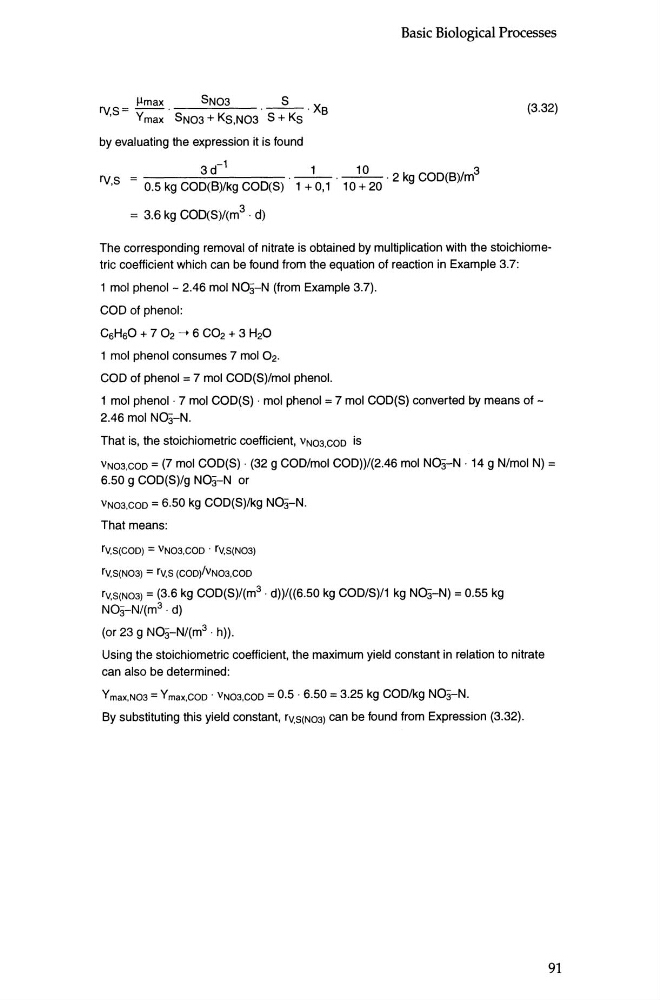
by evaluating the expression it is found
rv.s
3d- 1
10
3
· 10 + 20 · 2 kg COD(B)/m
0.5 kg COD(B)/kg COD(S) 1 + 0,1
= 3.6 kg COD(S)/(m 3 · d)
The corresponding removal of nitrate is obtained by multiplication with the stoichiometric coefficient which can be found from the equation of reaction in Example 3.7:
1 mol phenol - 2.46 mol N03-N (from Example 3.7).
COD of phenol:
CsHsO + 7 02 --> 6 C02 + 3 H20
1 mol phenol consumes 7 mol 0 2.
COD of phenol = 7 mol COD(S)/mol phenol.
1 mol phenol · 7 mol COD(S) · mol phenol = 7 mol COD(S) converted by means of -
2.46 mol N03-N.
That is, the stoichiometric coefficient, VNo3.coo is
VNo3.coo = (7 mol COD(S) · (32 g COD/mol COD))/(2.46 mol N03-N · 14 g N/mol N) =
6.50 g COD(S)/g N03-N or
VNQ3,COD = 6.50 kg COD(S)/kg N03-N.
That means:
rv,S(COD) = VN03,COD · rv,S(N03)
rv,S(N03) = rv,s (COo/VN03,COD
rv,s(No3) = (3.6 kg COD(S)/(m 3 · d))/((6.50 kg COD/S)/1 kg N03-N) = 0.55 kg
N03-N/(m 3 · d)
(or 23 g N03-N/(m 3 · h)).
Using the stoichiometric coefficient, the maximum yield constant in relation to nitrate
can also be determined:
Y max,N03 = Y max,COD · VNQ3,COD = 0.5 · 6.50 = 3.25 kg COD/kg N03-N.
By substituting this yield constant, rv,S(Na3) can be found from Expression (3.32).
91
flmax
SN03
S
rvs= - - .
·
Xs
'
Y max SNo3 + Ks,N03 S + Ks
(3.32)
by evaluating the expression it is found
rv.s
3d- 1
10
3
· 10 + 20 · 2 kg COD(B)/m
0.5 kg COD(B)/kg COD(S) 1 + 0,1
= 3.6 kg COD(S)/(m 3 · d)
The corresponding removal of nitrate is obtained by multiplication with the stoichiometric coefficient which can be found from the equation of reaction in Example 3.7:
1 mol phenol - 2.46 mol N03-N (from Example 3.7).
COD of phenol:
CsHsO + 7 02 --> 6 C02 + 3 H20
1 mol phenol consumes 7 mol 0 2.
COD of phenol = 7 mol COD(S)/mol phenol.
1 mol phenol · 7 mol COD(S) · mol phenol = 7 mol COD(S) converted by means of -
2.46 mol N03-N.
That is, the stoichiometric coefficient, VNo3.coo is
VNo3.coo = (7 mol COD(S) · (32 g COD/mol COD))/(2.46 mol N03-N · 14 g N/mol N) =
6.50 g COD(S)/g N03-N or
VNQ3,COD = 6.50 kg COD(S)/kg N03-N.
That means:
rv,S(COD) = VN03,COD · rv,S(N03)
rv,S(N03) = rv,s (COo/VN03,COD
rv,s(No3) = (3.6 kg COD(S)/(m 3 · d))/((6.50 kg COD/S)/1 kg N03-N) = 0.55 kg
N03-N/(m 3 · d)
(or 23 g N03-N/(m 3 · h)).
Using the stoichiometric coefficient, the maximum yield constant in relation to nitrate
can also be determined:
Y max,N03 = Y max,COD · VNQ3,COD = 0.5 · 6.50 = 3.25 kg COD/kg N03-N.
By substituting this yield constant, rv,S(Na3) can be found from Expression (3.32).
91