

Basic Biological Processes
trophic bacteria. In order for the accumulation of polyphosphate to take place, two
requirements are important in practice:
- alternating anaerobic/ aerobic conditions
- no nitrate in the anaerobic period
Anaerobic/ aerobic conditions
The anaerobic condition is important for the selection mechanism in the plant. By
introducing this condition we increase the selection pressure to the advantage of the
phosphorus accumulating bacteria, and the result is that a larger part of the biomass
will consist of these bacteria.
Nitrate
During the anaerobic period, nitrate has two negative effects:
1)
Denitrification removes some of the easily degradable organic matter which
was supposed to be stored in the phosphorus accumulating bacteria. The result
is that the phosphorus removal is reduced as the amount of easily degradable
organic matter available has been reduced. The denitrification process with
acetic acid takes place according to the expression in Example 3.10, from which
it appears that 4.96 mol HAc/3.94 mol N03 = 1.26 mol HAc/mol N03 are
consumed. Hence the phosphorus removal process has been depleted of the
organic matter consumed by denitrification.
2)
Apparently nitrate influences the metabolisms of the phosphorus accumulating bacteria so that no polyphosphate is being stored.
Reaction rate constants, phosphorus accumulating bacteria
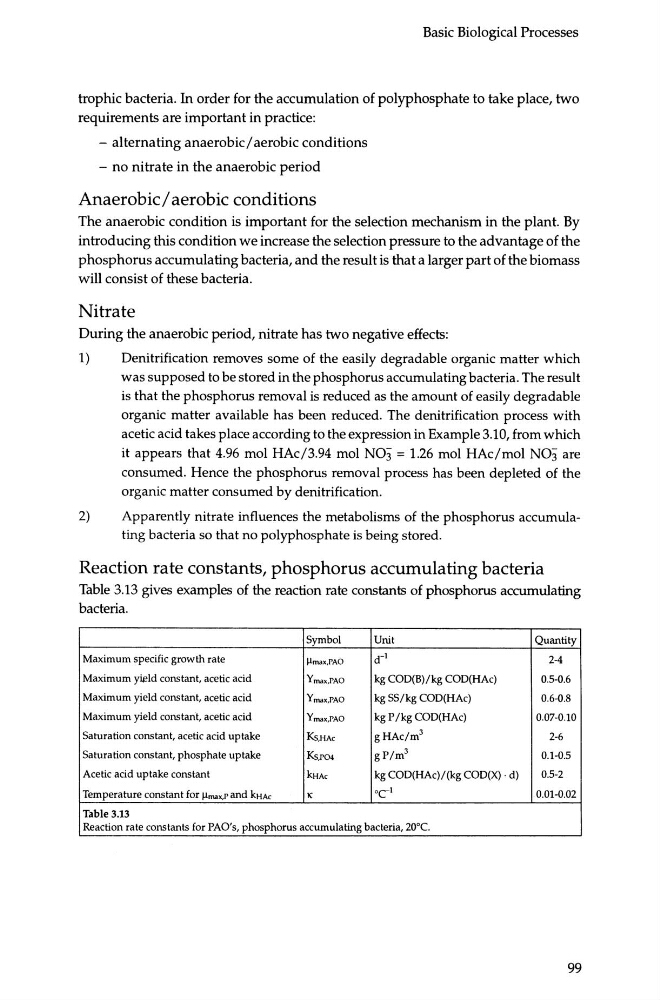
Table 3.13 gives examples of the reaction rate constants of phosphorus accumulating
bacteria.
Symbol
Unit
Quantity
Maximum specific growth rate
!lrnax,PAO
d-1
2-4
Maximum ywld constant, acetic acid
Ymax,PAO
kg COD(B)/kg COD(HAc)
0.5-0.6
Maximum yield constant, acetic acid
Ymax,PAO
kg SS/kg COD(HAc)
0.6-0.8
Maximum yield constant, acetic acid
Ymax,PAO
kg P /kg COD(HAc)
0.07-0.10
Saturation constant, acetic acid uptake
Ks,HAc
gHAc/m 3
2-6
Saturation constant, phosphate uptake
Ks,Po4
gP/m 3
0.1-0.5
Acetic acid uptake constant
kHAc
kg COD(HAc)/(kg COD(X) d)
0.5-2
Temperature constant for J.lmax,P and kHAc
1C
oL1
O.Ql-O.D2
Table 3.13
Reaction rate constants for PAO's, phosphorus accumulating bacteria, 20'C.
99
trophic bacteria. In order for the accumulation of polyphosphate to take place, two
requirements are important in practice:
- alternating anaerobic/ aerobic conditions
- no nitrate in the anaerobic period
Anaerobic/ aerobic conditions
The anaerobic condition is important for the selection mechanism in the plant. By
introducing this condition we increase the selection pressure to the advantage of the
phosphorus accumulating bacteria, and the result is that a larger part of the biomass
will consist of these bacteria.
Nitrate
During the anaerobic period, nitrate has two negative effects:
1)
Denitrification removes some of the easily degradable organic matter which
was supposed to be stored in the phosphorus accumulating bacteria. The result
is that the phosphorus removal is reduced as the amount of easily degradable
organic matter available has been reduced. The denitrification process with
acetic acid takes place according to the expression in Example 3.10, from which
it appears that 4.96 mol HAc/3.94 mol N03 = 1.26 mol HAc/mol N03 are
consumed. Hence the phosphorus removal process has been depleted of the
organic matter consumed by denitrification.
2)
Apparently nitrate influences the metabolisms of the phosphorus accumulating bacteria so that no polyphosphate is being stored.
Reaction rate constants, phosphorus accumulating bacteria
Table 3.13 gives examples of the reaction rate constants of phosphorus accumulating
bacteria.
Symbol
Unit
Quantity
Maximum specific growth rate
!lrnax,PAO
d-1
2-4
Maximum ywld constant, acetic acid
Ymax,PAO
kg COD(B)/kg COD(HAc)
0.5-0.6
Maximum yield constant, acetic acid
Ymax,PAO
kg SS/kg COD(HAc)
0.6-0.8
Maximum yield constant, acetic acid
Ymax,PAO
kg P /kg COD(HAc)
0.07-0.10
Saturation constant, acetic acid uptake
Ks,HAc
gHAc/m 3
2-6
Saturation constant, phosphate uptake
Ks,Po4
gP/m 3
0.1-0.5
Acetic acid uptake constant
kHAc
kg COD(HAc)/(kg COD(X) d)
0.5-2
Temperature constant for J.lmax,P and kHAc
1C
oL1
O.Ql-O.D2
Table 3.13
Reaction rate constants for PAO's, phosphorus accumulating bacteria, 20'C.
99