

Anaerobic processes
3.7. Anaerobic processes
In this context anaerobic processes are defined as processes where neither oxygen
nor nitrate is present. These processes are carried out by a large and varied group of
micro-organisms which normally live in a symbiotic relationship. The energy conditions are extremely complicated and for many bacteria so bad that it is almost
impossible to exist, but still they have been successful in many cases.
Many of the bacteria are strictly anaerobic and thus cannot tolerate oxygen at all;
this is particularly true for methane-forming bacteria.
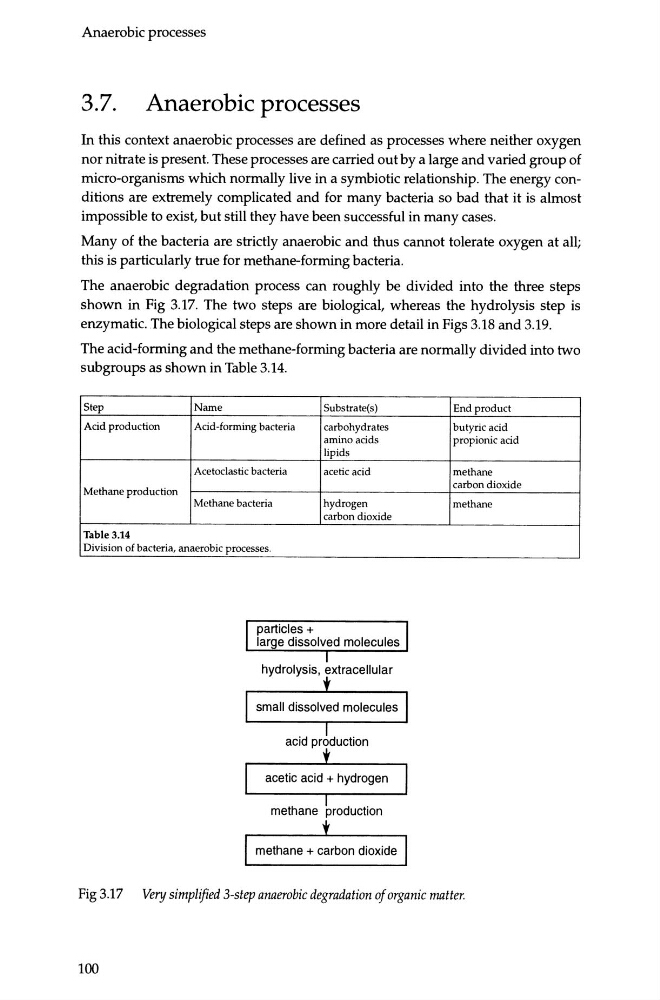
The anaerobic degradation process can roughly be divided into the three steps
shown in Fig 3.17. The two steps are biological, whereas the hydrolysis step is
enzymatic. The biological steps are shown in more detail in Figs 3.18 and 3.19.
The acid-forming and the methane-forming bacteria are normally divided into two
subgroups as shown in Table 3.14.
Step
Name
Substrate(s)
End product
Acid production
Acid-forming bacteria
carbohydrates
butyric acid
amino acids
propionic acid
lipids
Acetoclastic bacteria
acetic acid
methane
Methane production
Methane bacteria
hydrogen
carbon dioxide
methane
carbon dioxide
Table 3.14
Division of bacteria, anaerobic processes.
hydrolysis, extracellular
acid production
methane production
Fig 3.17 Very simplified 3-step anaerobic degradation of organic matter.
100
3.7. Anaerobic processes
In this context anaerobic processes are defined as processes where neither oxygen
nor nitrate is present. These processes are carried out by a large and varied group of
micro-organisms which normally live in a symbiotic relationship. The energy conditions are extremely complicated and for many bacteria so bad that it is almost
impossible to exist, but still they have been successful in many cases.
Many of the bacteria are strictly anaerobic and thus cannot tolerate oxygen at all;
this is particularly true for methane-forming bacteria.
The anaerobic degradation process can roughly be divided into the three steps
shown in Fig 3.17. The two steps are biological, whereas the hydrolysis step is
enzymatic. The biological steps are shown in more detail in Figs 3.18 and 3.19.
The acid-forming and the methane-forming bacteria are normally divided into two
subgroups as shown in Table 3.14.
Step
Name
Substrate(s)
End product
Acid production
Acid-forming bacteria
carbohydrates
butyric acid
amino acids
propionic acid
lipids
Acetoclastic bacteria
acetic acid
methane
Methane production
Methane bacteria
hydrogen
carbon dioxide
methane
carbon dioxide
Table 3.14
Division of bacteria, anaerobic processes.
hydrolysis, extracellular
acid production
methane production
Fig 3.17 Very simplified 3-step anaerobic degradation of organic matter.
100