

Basic Biological Processes
3.3.4 Kinetics, aerobic heterotrophic conversions
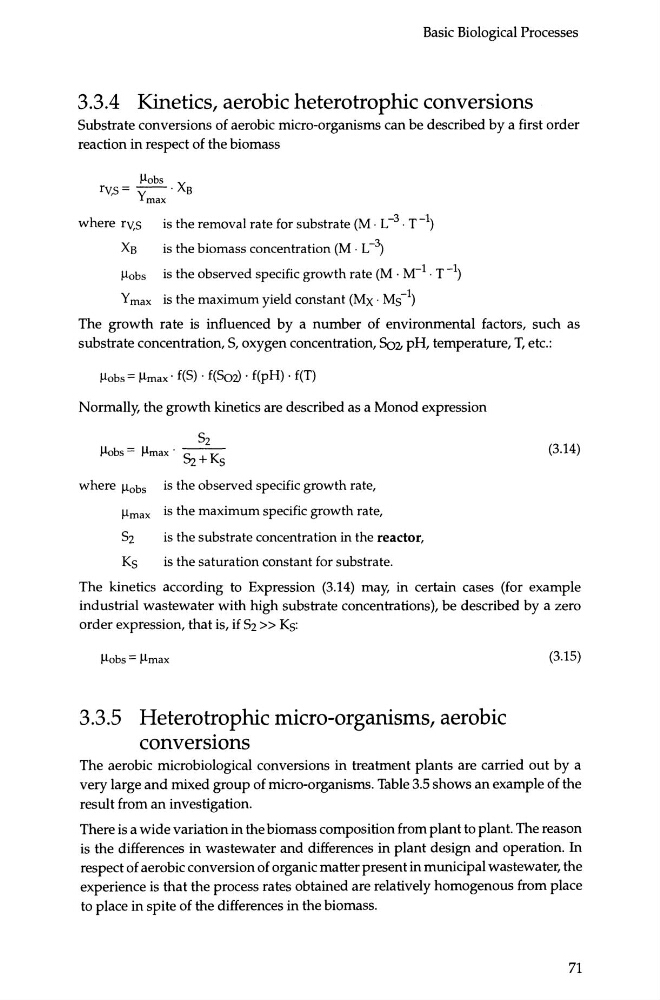
Substrate conversions of aerobic micro-organisms can be described by a first order
reaction in respect of the biomass
Jlobs
rv;s= - - . Xs
Ymax
where rv;s is the removal rate for substrate (M · L - 3 · T - 1 )
Xs
is the biomass concentration (M · L -~
Jlobs is the observed specific growth rate (M · ~ 1 · T - 1 )
Ymax is the maximum yield constant (Mx · Ms- 1 )
The growth rate is influenced by a number of environmental factors, such as
substrate concentration, S, oxygen concentration, So2, pH, temperature, T, etc.:
Jlobs = f..l.max · f(S) · f(So2) · f(pH) · f(T)
Normally, the growth kinetics are described as a Monod expression
Sz
f..l.obs= f..l.max · ~+Ks
where Jlobs is the observed specific growth rate,
Jlmax is the maximum specific growth rate,
Sz
is the substrate concentration in the reactor,
Ks
is the saturation constant for substrate.
(3.14)
The kinetics according to Expression (3.14) may, in certain cases (for example
industrial wastewater with high substrate concentrations), be described by a zero
order expression, that is, if Sz >> Ks:
Jlobs= f..l.max
(3.15)
3.3.5 Heterotrophic micro-organisms, aerobic
conversions
The aerobic microbiological conversions in treatment plants are carried out by a
very large and mixed group of micro-organisms. Table 3.5 shows an example of the
result from an investigation.
There is a wide variation in the biomass composition from plant to plant. The reason
is the differences in wastewater and differences in plant design and operation. In
respect of aerobic conversion of organic matter present in municipal wastewater, the
experience is that the process rates obtained are relatively homogenous from place
to place in spite of the differences in the biomass.
71
3.3.4 Kinetics, aerobic heterotrophic conversions
Substrate conversions of aerobic micro-organisms can be described by a first order
reaction in respect of the biomass
Jlobs
rv;s= - - . Xs
Ymax
where rv;s is the removal rate for substrate (M · L - 3 · T - 1 )
Xs
is the biomass concentration (M · L -~
Jlobs is the observed specific growth rate (M · ~ 1 · T - 1 )
Ymax is the maximum yield constant (Mx · Ms- 1 )
The growth rate is influenced by a number of environmental factors, such as
substrate concentration, S, oxygen concentration, So2, pH, temperature, T, etc.:
Jlobs = f..l.max · f(S) · f(So2) · f(pH) · f(T)
Normally, the growth kinetics are described as a Monod expression
Sz
f..l.obs= f..l.max · ~+Ks
where Jlobs is the observed specific growth rate,
Jlmax is the maximum specific growth rate,
Sz
is the substrate concentration in the reactor,
Ks
is the saturation constant for substrate.
(3.14)
The kinetics according to Expression (3.14) may, in certain cases (for example
industrial wastewater with high substrate concentrations), be described by a zero
order expression, that is, if Sz >> Ks:
Jlobs= f..l.max
(3.15)
3.3.5 Heterotrophic micro-organisms, aerobic
conversions
The aerobic microbiological conversions in treatment plants are carried out by a
very large and mixed group of micro-organisms. Table 3.5 shows an example of the
result from an investigation.
There is a wide variation in the biomass composition from plant to plant. The reason
is the differences in wastewater and differences in plant design and operation. In
respect of aerobic conversion of organic matter present in municipal wastewater, the
experience is that the process rates obtained are relatively homogenous from place
to place in spite of the differences in the biomass.
71