

Aerobic heterotrophic conversion of organic matter
3.3.3 Nutrients, aerobic heterotrophic conversions
In order that the micro-organisms can grow, nutrients are required. If the chemical
composition of the organisms is known, the demand for nutrients can be calculated
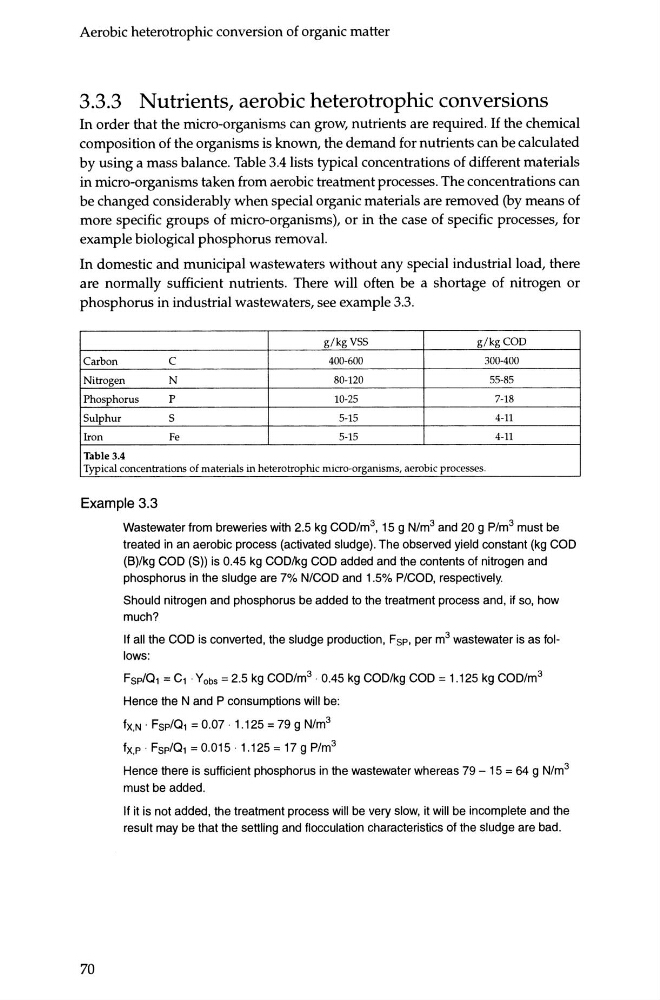
by using a mass balance. Table 3.4 lists typical concentrations of different materials
in micro-organisms taken from aerobic treatment processes. The concentrations can
be changed considerably when special organic materials are removed (by means of
more specific groups of micro-organisms), or in the case of specific processes, for
example biological phosphorus removal.
In domestic and municipal wastewaters without any special industrial load, there
are normally sufficient nutrients. There will often be a shortage of nitrogen or
phosphorus in industrial wastewaters, see example 3.3.
g/kg vss
g/kgCOD
Carbon
c
400-600
300-400
Nitrogen
N
80-120
55-85
Phosphorus
p
10-25
7-18
Sulphur
s
5-15
4-11
lron
Fe
5-15
4-11
Table 3.4
Typical concentrations of materials in heterotrophic micro-organisms, aerobic processes.
Example 3.3
70
Wastewater from breweries with 2.5 kg COD/m 3 , 15 g N/m 3 and 20 g P/m 3 must be
treated in an aerobic process (activated sludge). The observed yield constant (kg COD
(B)/kg COD (S)) is 0.45 kg COD/kg COD added and the contents of nitrogen and
phosphorus in the sludge are 7% N/COD and 1.5% P/COD, respectively.
Should nitrogen and phosphorus be added to the treatment process and, if so, how
much?
If all the COD is converted, the sludge production, Fsp, per m 3 wastewater is as follows:
Fsp/01 = C1 · Y abs = 2.5 kg COD/m 3 · 0.45 kg COD/kg COD = 1.125 kg COD/m 3
Hence the N and P consumptions will be:
fx.N · Fsp/01 = 0.07 · 1.125 = 79 g N/m 3
fx.P · Fsp/01 = 0.015 · 1.125 = 17 g P/m 3
Hence there is sufficient phosphorus in the wastewater whereas 79 - 15 = 64 g N/m 3
must be added.
If it is not added, the treatment process will be very slow, it will be incomplete and the
result may be that the settling and flocculation characteristics of the sludge are bad.
3.3.3 Nutrients, aerobic heterotrophic conversions
In order that the micro-organisms can grow, nutrients are required. If the chemical
composition of the organisms is known, the demand for nutrients can be calculated
by using a mass balance. Table 3.4 lists typical concentrations of different materials
in micro-organisms taken from aerobic treatment processes. The concentrations can
be changed considerably when special organic materials are removed (by means of
more specific groups of micro-organisms), or in the case of specific processes, for
example biological phosphorus removal.
In domestic and municipal wastewaters without any special industrial load, there
are normally sufficient nutrients. There will often be a shortage of nitrogen or
phosphorus in industrial wastewaters, see example 3.3.
g/kg vss
g/kgCOD
Carbon
c
400-600
300-400
Nitrogen
N
80-120
55-85
Phosphorus
p
10-25
7-18
Sulphur
s
5-15
4-11
lron
Fe
5-15
4-11
Table 3.4
Typical concentrations of materials in heterotrophic micro-organisms, aerobic processes.
Example 3.3
70
Wastewater from breweries with 2.5 kg COD/m 3 , 15 g N/m 3 and 20 g P/m 3 must be
treated in an aerobic process (activated sludge). The observed yield constant (kg COD
(B)/kg COD (S)) is 0.45 kg COD/kg COD added and the contents of nitrogen and
phosphorus in the sludge are 7% N/COD and 1.5% P/COD, respectively.
Should nitrogen and phosphorus be added to the treatment process and, if so, how
much?
If all the COD is converted, the sludge production, Fsp, per m 3 wastewater is as follows:
Fsp/01 = C1 · Y abs = 2.5 kg COD/m 3 · 0.45 kg COD/kg COD = 1.125 kg COD/m 3
Hence the N and P consumptions will be:
fx.N · Fsp/01 = 0.07 · 1.125 = 79 g N/m 3
fx.P · Fsp/01 = 0.015 · 1.125 = 17 g P/m 3
Hence there is sufficient phosphorus in the wastewater whereas 79 - 15 = 64 g N/m 3
must be added.
If it is not added, the treatment process will be very slow, it will be incomplete and the
result may be that the settling and flocculation characteristics of the sludge are bad.