

Aerobic heterotrophic conversion of organic matter
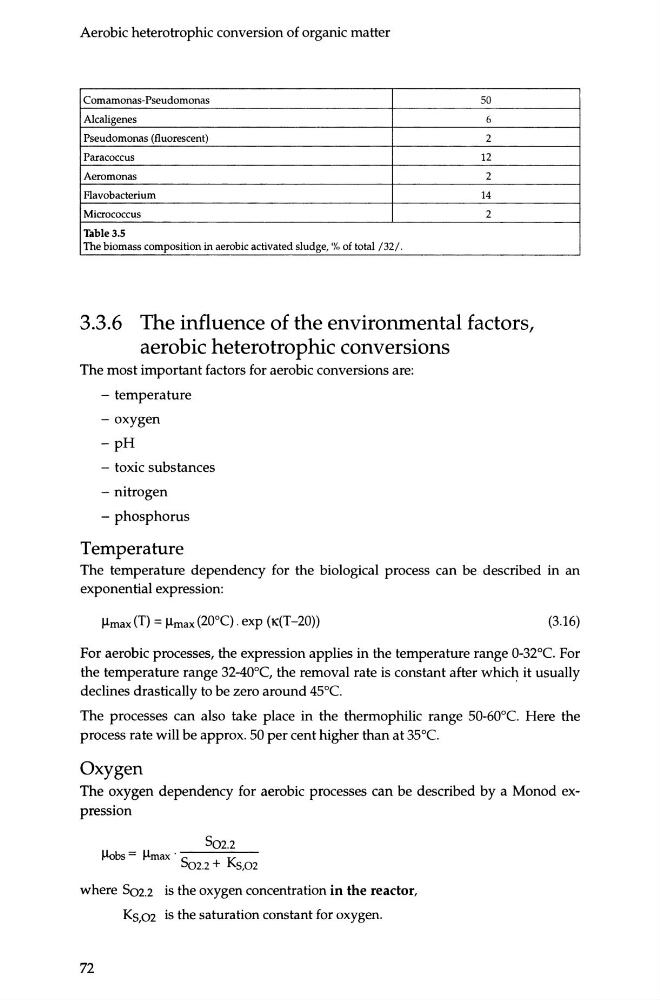
Comamonas-Pseudomonas
50
Alcaligenes
6
Pseudomonas (fluorescent)
2
Para coccus
12
Aero monas
2
Flavobacterium
14
Micrococcus
2
Table3.5
The biomass composition in aerobic activated sludge,% of total /32/.
3.3.6 The influence of the environmental factors,
aerobic heterotrophic conversions
The most important factors for aerobic conversions are:
- temperature
-oxygen
-pH
- toxic substances
-nitrogen
- phosphorus
Temperature
The temperature dependency for the biological process can be described in an
exponential expression:
!lmax (T) = !lmax (20°C). exp (1C(T -20))
(3.16)
For aerobic processes, the expression applies in the temperature range 0-32°C. For
the temperature range 32-40°C, the removal rate is constant after whic~ it usually
declines drastically to be zero around 45°C.
The processes can also take place in the thermophilic range 50-60°C. Here the
process rate will be approx. 50 per cent higher than at 35°C.
Oxygen
The oxygen dependency for aerobic processes can be described by a Monod expression
So2.2
!lobs = !lmax · So + K
2.2
5,02
where So2.2 is the oxygen concentration in the reactor,
Ks,oz is the saturation constant for oxygen.
72
Comamonas-Pseudomonas
50
Alcaligenes
6
Pseudomonas (fluorescent)
2
Para coccus
12
Aero monas
2
Flavobacterium
14
Micrococcus
2
Table3.5
The biomass composition in aerobic activated sludge,% of total /32/.
3.3.6 The influence of the environmental factors,
aerobic heterotrophic conversions
The most important factors for aerobic conversions are:
- temperature
-oxygen
-pH
- toxic substances
-nitrogen
- phosphorus
Temperature
The temperature dependency for the biological process can be described in an
exponential expression:
!lmax (T) = !lmax (20°C). exp (1C(T -20))
(3.16)
For aerobic processes, the expression applies in the temperature range 0-32°C. For
the temperature range 32-40°C, the removal rate is constant after whic~ it usually
declines drastically to be zero around 45°C.
The processes can also take place in the thermophilic range 50-60°C. Here the
process rate will be approx. 50 per cent higher than at 35°C.
Oxygen
The oxygen dependency for aerobic processes can be described by a Monod expression
So2.2
!lobs = !lmax · So + K
2.2
5,02
where So2.2 is the oxygen concentration in the reactor,
Ks,oz is the saturation constant for oxygen.
72