

Treatment Plants for Phosphorus Removal from Wastewater
~--------------- Recycle
Recycle
t·v,·H~·
Recycle
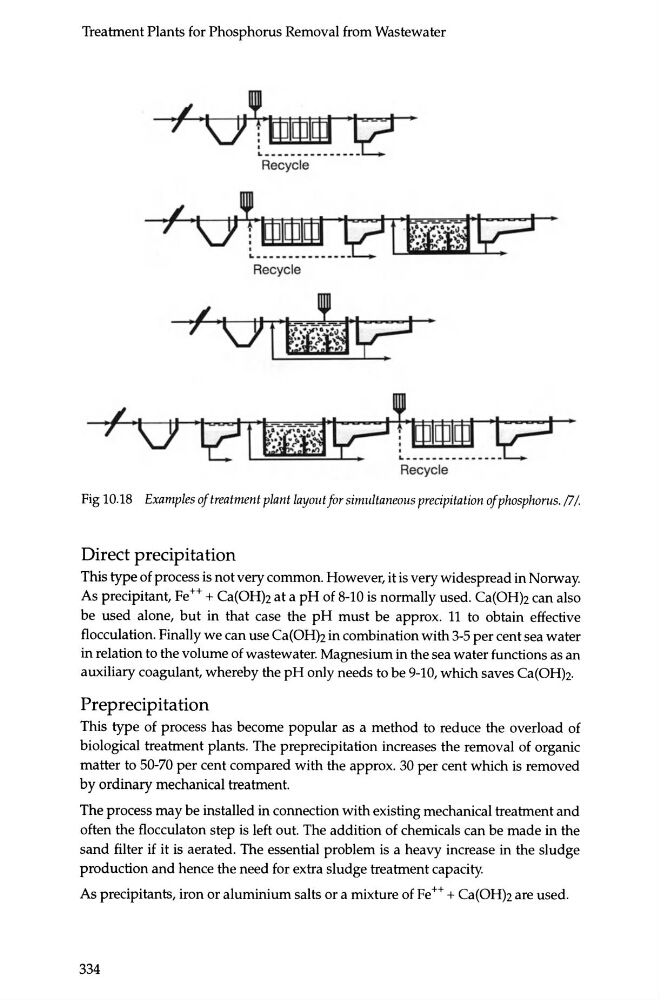
Fig 10.18 Examples of treatment plant layout for simultaneous precipitation of phosphonts. 11/.
Direct precipitation
This type of process is not very common. However, it is very widespread in Norway.
As precipitant, Fe+++ Ca(OH)2 at a pH of 8-10 is normally used. Ca(OH)2 can also
be used alone, but in that case the pH must be approx. 11 to obtain effective
flocculation. Finally we can use Ca(OH)2 in combination with 3-5 per cent sea water
in relation to the volume of wastewater. Magnesium in the sea water functions as an
auxiliary coagulant, whereby the pH only needs to be 9-10, which saves Ca(OH)z.
Preprecipitation
This type of process has become popular as a method to reduce the overload of
biological treatment plants. The preprecipitation increases the removal of organic
matter to SQ-70 per cent compared with the approx. 30 per cent which is removed
by ordinary mechanical treatment.
The process may be installed in connection with existing mechanical treatment and
often the flocculaton step is left out. The addition of chemicals can be made in the
sand filter if it is aerated. The essential problem is a heavy increase in the sludge
production and hence the need for extra sludge treatment capacity.
As precipitants, iron or aluminium salts or a mixture of Fe+++ Ca(OH)2 are used.
334
~--------------- Recycle
Recycle
t·v,·H~·
Recycle
Fig 10.18 Examples of treatment plant layout for simultaneous precipitation of phosphonts. 11/.
Direct precipitation
This type of process is not very common. However, it is very widespread in Norway.
As precipitant, Fe+++ Ca(OH)2 at a pH of 8-10 is normally used. Ca(OH)2 can also
be used alone, but in that case the pH must be approx. 11 to obtain effective
flocculation. Finally we can use Ca(OH)2 in combination with 3-5 per cent sea water
in relation to the volume of wastewater. Magnesium in the sea water functions as an
auxiliary coagulant, whereby the pH only needs to be 9-10, which saves Ca(OH)z.
Preprecipitation
This type of process has become popular as a method to reduce the overload of
biological treatment plants. The preprecipitation increases the removal of organic
matter to SQ-70 per cent compared with the approx. 30 per cent which is removed
by ordinary mechanical treatment.
The process may be installed in connection with existing mechanical treatment and
often the flocculaton step is left out. The addition of chemicals can be made in the
sand filter if it is aerated. The essential problem is a heavy increase in the sludge
production and hence the need for extra sludge treatment capacity.
As precipitants, iron or aluminium salts or a mixture of Fe+++ Ca(OH)2 are used.
334