

Treatment Plants for Phosphorus Removal from Wastewater
from which we find that 0.14 g 0 2/g Fe++ is used, or totally:
28 g Fe++/m 3 · 0.14 g 0 2/g Fe++= 3.9 g 0 2/m 3
A change in alkalinity occurs in all three reactions (1 0.8), (1 0.3) and (1 0.4).
(10.3) and (10.4) are:
Fe++++ H2P04 ---> FeP04 + 2 H+
Fe++++ 3 HC03 ---> Fe(OHb + 3 C02
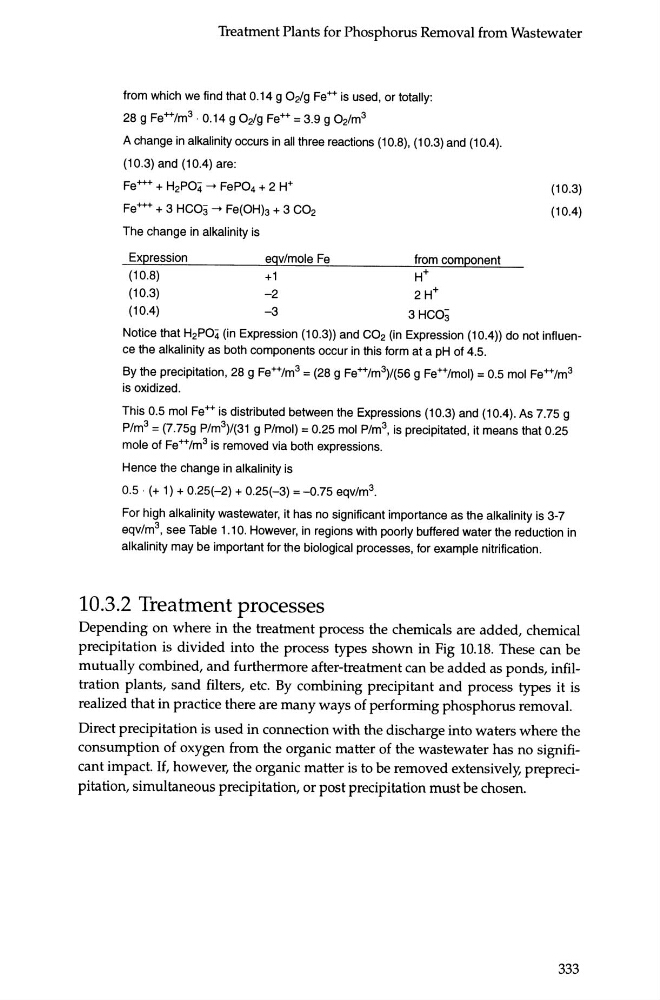
The change in alkalinity is
Expression
(1 0.8)
(10.3)
(1 0.4)
eqv/mole Fe
+1
-2
-3
from component
(1 0.3)
(1 0.4)
Notice that H2P04 (in Expression (1 0.3)) and C02 (in Expression (1 0.4)) do not influence the alkalinity as both components occur in this form at a pH of 4.5.
By the precipitation, 28 g Fe++/m 3 = (28 g Fe++/m 3 )/(56 g Fe++/mol) = 0.5 mol Fe++/m 3
is oxidized.
This 0.5 mol Fe++ is distributed between the Expressions (10.3) and (10.4). As 7.75 g
P/m 3 = (7.75g P/m 3 )/(31 g P/mol) = 0.25 mol P/m 3 , is precipitated, it means that 0.25
mole of Fe++/m 3 is removed via both expressions.
Hence the change in alkalinity is
0.5 · (+ 1) + 0.25(-2) + 0.25(-3) = -0.75 eqv/m 3 .
For high alkalinity wastewater, it has no significant importance as the alkalinity is 3-7
eqv/m 3 , see Table 1.1 0. However, in regions with poorly buffered water the reduction in
alkalinity may be important for the biological processes, for example nitrification.
10.3.2 Treatment processes
Depending on where in the treatment process the chemicals are added, chemical
precipitation is divided into the process types shown in Fig 10.18. These can be
mutually combined, and furthermore after-treatment can be added as ponds, infiltration plants, sand filters, etc. By combining precipitant and process types it is
realized that in practice there are many ways of performing phosphorus removal.
Direct precipitation is used in connection with the discharge into waters where the
consumption of oxygen from the organic matter of the wastewater has no significant impact. If, however, the organic matter is to be removed extensively; preprecipitation, simultaneous precipitation, or post precipitation must be chosen.
333
from which we find that 0.14 g 0 2/g Fe++ is used, or totally:
28 g Fe++/m 3 · 0.14 g 0 2/g Fe++= 3.9 g 0 2/m 3
A change in alkalinity occurs in all three reactions (1 0.8), (1 0.3) and (1 0.4).
(10.3) and (10.4) are:
Fe++++ H2P04 ---> FeP04 + 2 H+
Fe++++ 3 HC03 ---> Fe(OHb + 3 C02
The change in alkalinity is
Expression
(1 0.8)
(10.3)
(1 0.4)
eqv/mole Fe
+1
-2
-3
from component
(1 0.3)
(1 0.4)
Notice that H2P04 (in Expression (1 0.3)) and C02 (in Expression (1 0.4)) do not influence the alkalinity as both components occur in this form at a pH of 4.5.
By the precipitation, 28 g Fe++/m 3 = (28 g Fe++/m 3 )/(56 g Fe++/mol) = 0.5 mol Fe++/m 3
is oxidized.
This 0.5 mol Fe++ is distributed between the Expressions (10.3) and (10.4). As 7.75 g
P/m 3 = (7.75g P/m 3 )/(31 g P/mol) = 0.25 mol P/m 3 , is precipitated, it means that 0.25
mole of Fe++/m 3 is removed via both expressions.
Hence the change in alkalinity is
0.5 · (+ 1) + 0.25(-2) + 0.25(-3) = -0.75 eqv/m 3 .
For high alkalinity wastewater, it has no significant importance as the alkalinity is 3-7
eqv/m 3 , see Table 1.1 0. However, in regions with poorly buffered water the reduction in
alkalinity may be important for the biological processes, for example nitrification.
10.3.2 Treatment processes
Depending on where in the treatment process the chemicals are added, chemical
precipitation is divided into the process types shown in Fig 10.18. These can be
mutually combined, and furthermore after-treatment can be added as ponds, infiltration plants, sand filters, etc. By combining precipitant and process types it is
realized that in practice there are many ways of performing phosphorus removal.
Direct precipitation is used in connection with the discharge into waters where the
consumption of oxygen from the organic matter of the wastewater has no significant impact. If, however, the organic matter is to be removed extensively; preprecipitation, simultaneous precipitation, or post precipitation must be chosen.
333