

Treatment Plants for Phosphorus Removal from Wastewater
The floc removal, corresponding to the production of primary particles (or the
release of phosphorus from floes to primary particles) can be described as
- rv,f = rv,p = Ks' · · GP
(10.13)
where Ks'
is a constant with a varying unit depending on the size of p,
p
is a dimensionless constant.
In practice, p can be set at 2 in systems with iron, aluminium and calcium precipitations, corresponding to a floc removal taking place relatively faster than the floc
formation at high turbulence levels.
By applying the kinetics for floc formation and removal, the effluent concentration
of suspended phosphate can be determined for different reactor types. As shown in
Fig 10.13, reactors connected in series are especially relevant.
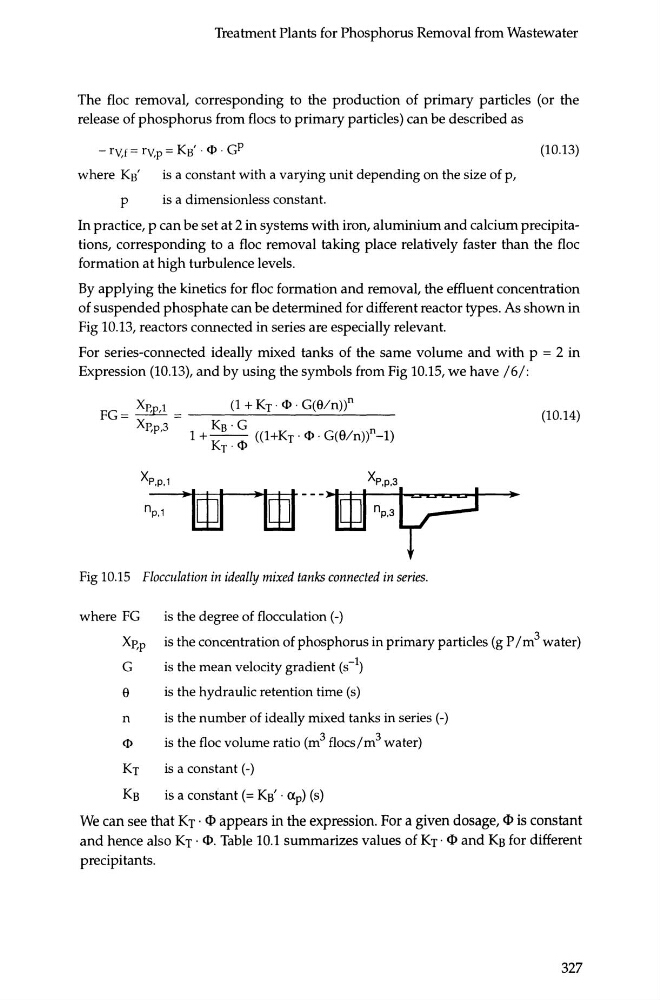
For series-connected ideally mixed tanks of the same volume and with p = 2 in
Expression (10.13), and by using the symbols from Fig 10.15, we have /6/:
FG = Xr,p,l = ___ (:....1_+_K....:.r:...·__· G_(:. . . . 9_/n. . . . :. ). . :. . . )n _ _ _
Xr,p, 3 1 +_K_s_· G_ ((1+Kr · · G(9/n)t-1)
Kr·
Fig 10.15 Flocculation in ideally mixed tanks connected in series.
where FG
is the degree of flocculation(-)
(10.14)
Xr,p is the concentration of phosphorus in primary particles (g PI m 3 water)
G
is the mean velocity gradient (s- 1 )
e
is the hydraulic retention time (s)
n
is the number of ideally mixed tanks in series(-)
is the floc volume ratio (m 3 flocs/m 3 water)
Kr
is a constant(-)
Ks
is a constant(= Ka' · CXp) (s)
We can see that Kr · ci> appears in the expression. For a given dosage, ci> is constant
and hence also Kr · <1>. Table 10.1 summarizes values of Kr · ci> and Ka for different
precipitants.
327
The floc removal, corresponding to the production of primary particles (or the
release of phosphorus from floes to primary particles) can be described as
- rv,f = rv,p = Ks' ·
(10.13)
where Ks'
is a constant with a varying unit depending on the size of p,
p
is a dimensionless constant.
In practice, p can be set at 2 in systems with iron, aluminium and calcium precipitations, corresponding to a floc removal taking place relatively faster than the floc
formation at high turbulence levels.
By applying the kinetics for floc formation and removal, the effluent concentration
of suspended phosphate can be determined for different reactor types. As shown in
Fig 10.13, reactors connected in series are especially relevant.
For series-connected ideally mixed tanks of the same volume and with p = 2 in
Expression (10.13), and by using the symbols from Fig 10.15, we have /6/:
FG = Xr,p,l = ___ (:....1_+_K....:.r:...·_
Xr,p, 3 1 +_K_s_· G_ ((1+Kr ·
Kr·
Fig 10.15 Flocculation in ideally mixed tanks connected in series.
where FG
is the degree of flocculation(-)
(10.14)
Xr,p is the concentration of phosphorus in primary particles (g PI m 3 water)
G
is the mean velocity gradient (s- 1 )
e
is the hydraulic retention time (s)
n
is the number of ideally mixed tanks in series(-)
is the floc volume ratio (m 3 flocs/m 3 water)
Kr
is a constant(-)
Ks
is a constant(= Ka' · CXp) (s)
We can see that Kr · ci> appears in the expression. For a given dosage, ci> is constant
and hence also Kr · <1>. Table 10.1 summarizes values of Kr · ci> and Ka for different
precipitants.
327