

Treatment Plants for Phosphorus Removal from Wastewater
Precipitant
KT·-10 4
KB · 10 7
Dosage/pH
[-]
[s]
Al+++
2.85 ± 0,08
3.45 ± 0.16
Al/P ~ 1.8
At++ + polymer
2.68 ± 0.11
0.98 ± O.Q7
Al/P ~ 1.8, polymer 0.5 mg/1
Ca(OH)2
5.58 ± 0.22
2.38 ± 0.15
pH~ 11.2
Fe++ + Ca(OH)z
7.68 ± 0.44
4.83 ± 0.40
pH~ 8 0, Fe/P ~ 3
Table 10.1
Summary of KT · and KB for different chemicals used for post-precipitation. Data from /6/.
Influent: 9.7 g P /m 3 Alkalinity: 2 eqv /m 3
Ks in Expression (10.14) equals K' Bin Expression (10.13) multiplied by the constant ap
which, according to Expression (10.10), expresses the volume of a primary particle.
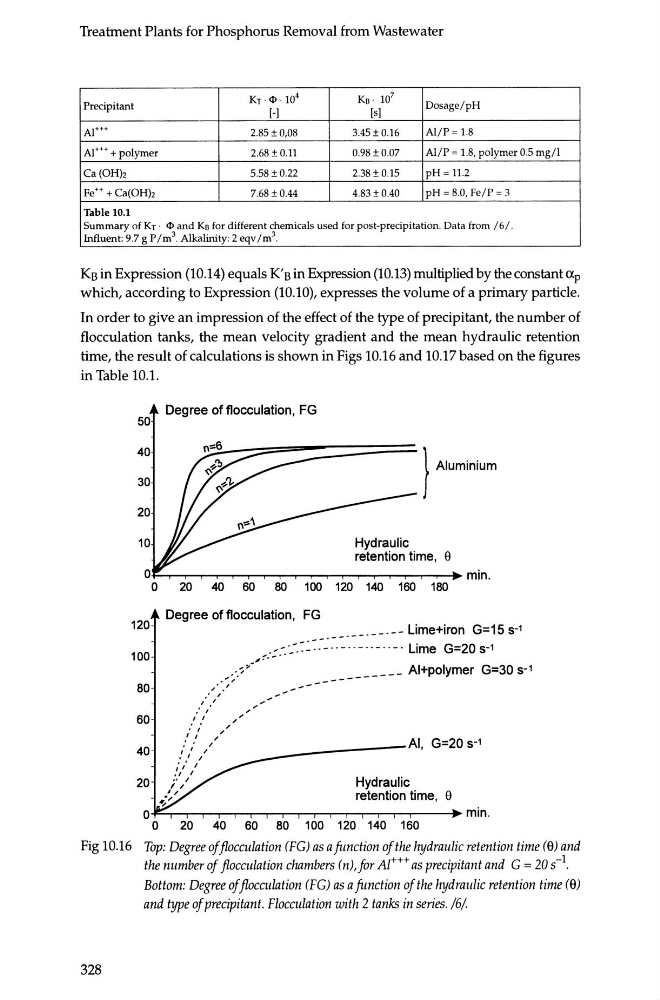
In order to give an impression of the effect of the type of precipitant, the number of
flocculation tanks, the mean velocity gradient and the mean hydraulic retention
time, the result of calculations is shown in Figs 10.16 and 10.17 based on the figures
in Table 10.1.
50
40
30
20
10
Degree of flocculation, FG
Hydraulic
retention time, e
o
min.
120
100
80
60
40
20
0
20
40 60
80 100 120 140 160 180
Degree of flocculation, FG
.-------------- Lime+iron G=15 s-1
_, - ·:. ~- --- -· - --- --- -· - · Lime G=20 s-1
,~~- ..
. -:/
_ _ _ _ _ _ Al+polymer G=30 s-1
,··.~'
.... -----. /
,· .'
: ,
I I
--------AI, G=20s-1
Hydraulic
retention time, e
o
min.
0
20
40
60
80 100 120 140 160
Fig 10.16 Top: Degree of flocculation (FG) as a function of the hydraulic retention time (8) and
the number of flocculation chambers (n), for At+++ as precipitant and G = 20 s- 1 .
Bottom: Degree of flocculation (FG) as a function of the hydraulic retention time (8)
and type of precipitant. Flocculation with 2 tanks in series. /6/.
328
Precipitant
KT·-10 4
KB · 10 7
Dosage/pH
[-]
[s]
Al+++
2.85 ± 0,08
3.45 ± 0.16
Al/P ~ 1.8
At++ + polymer
2.68 ± 0.11
0.98 ± O.Q7
Al/P ~ 1.8, polymer 0.5 mg/1
Ca(OH)2
5.58 ± 0.22
2.38 ± 0.15
pH~ 11.2
Fe++ + Ca(OH)z
7.68 ± 0.44
4.83 ± 0.40
pH~ 8 0, Fe/P ~ 3
Table 10.1
Summary of KT · and KB for different chemicals used for post-precipitation. Data from /6/.
Influent: 9.7 g P /m 3 Alkalinity: 2 eqv /m 3
Ks in Expression (10.14) equals K' Bin Expression (10.13) multiplied by the constant ap
which, according to Expression (10.10), expresses the volume of a primary particle.
In order to give an impression of the effect of the type of precipitant, the number of
flocculation tanks, the mean velocity gradient and the mean hydraulic retention
time, the result of calculations is shown in Figs 10.16 and 10.17 based on the figures
in Table 10.1.
50
40
30
20
10
Degree of flocculation, FG
Hydraulic
retention time, e
o
min.
120
100
80
60
40
20
0
20
40 60
80 100 120 140 160 180
Degree of flocculation, FG
.-------------- Lime+iron G=15 s-1
_, - ·:. ~- --- -· - --- --- -· - · Lime G=20 s-1
,~~- ..
. -:/
_ _ _ _ _ _ Al+polymer G=30 s-1
,··.~'
.... -----. /
,· .'
: ,
I I
--------AI, G=20s-1
Hydraulic
retention time, e
o
min.
0
20
40
60
80 100 120 140 160
Fig 10.16 Top: Degree of flocculation (FG) as a function of the hydraulic retention time (8) and
the number of flocculation chambers (n), for At+++ as precipitant and G = 20 s- 1 .
Bottom: Degree of flocculation (FG) as a function of the hydraulic retention time (8)
and type of precipitant. Flocculation with 2 tanks in series. /6/.
328