

Treatment Plants for Phosphorus Removal from Wastewater
4
3
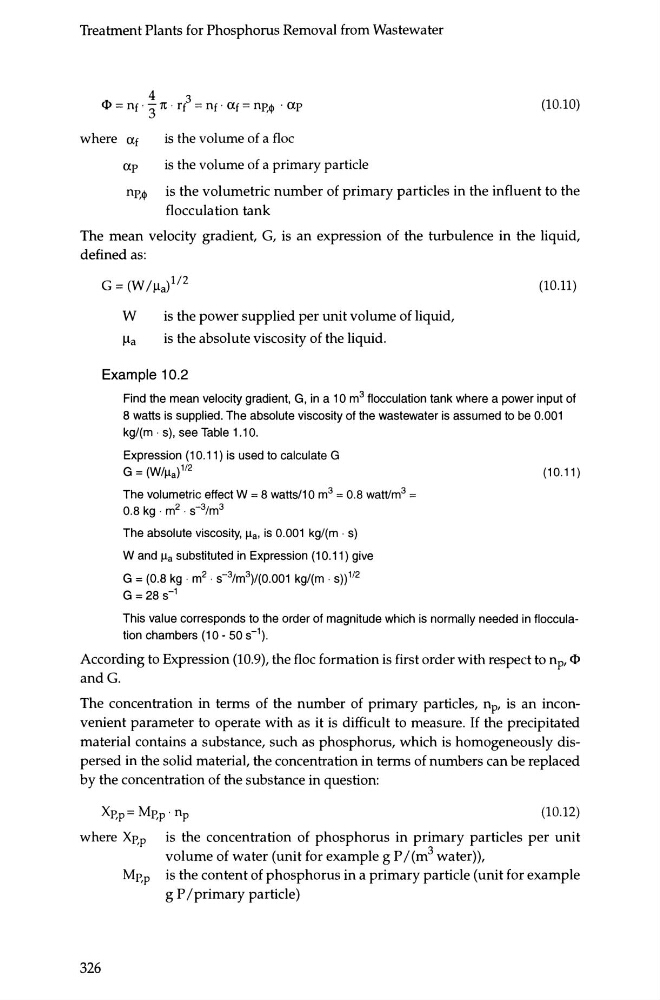
«<> = nf · 3 1t · rf = nf · CXf = np,cll · ap
(10.10)
where CXf
is the volume of a floc
ap
is the volume of a primary particle
np,cll is the volumetric number of primary particles in the influent to the
flocculation tank
The mean velocity gradient, G, is an expression of the turbulence in the liquid,
defined as:
(10.11)
W
is the power supplied per unit volume of liquid,
f..La
is the absolute viscosity of the liquid.
Example 10.2
Find the mean velocity gradient, G, in a 10m 3 flocculation tank where a power input of
8 watts is supplied. The absolute viscosity of the wastewater is assumed to be 0.001
kg/(m · s), see Table 1.1 0.
Expression (1 0.11) is used to calculate G
G = (Willa) 112
The volumetric effect W = 8 watts/1 0 m 3 = 0.8 watt/m 3 =
0.8 kg · m 2 · s- 3 /m 3
The absolute viscosity, lla. is 0.001 kg/(m · s)
W and lla substituted in Expression (1 0.11) give
G = (0.8 kg· m 2 · s- 3 /m 3 )/(0.001 kg/(m · s)) 112
G =28 s- 1
(10.11)
This value corresponds to the order of magnitude which is normally needed in flocculation chambers (10- 50 s- 1 ).
According to Expression (10.9), the floc formation is first order with respect to np, «<>
and G.
The concentration in terms of the number of primary particles, np, is an inconvenient parameter to operate with as it is difficult to measure. If the precipitated
material contains a substance, such as phosphorus, which is homogeneously dispersed in the solid material, the concentration in terms of numbers can be replaced
by the concentration of the substance in question:
XP,p = MP,p · np
(10.12)
where XP,p
326
is the concentration of phosphorus in primary particles per unit
volume of water (unit for example g P /{m 3 water)),
is the content of phosphorus in a primary particle (unit for example
g P /primary particle)
4
3
«<> = nf · 3 1t · rf = nf · CXf = np,cll · ap
(10.10)
where CXf
is the volume of a floc
ap
is the volume of a primary particle
np,cll is the volumetric number of primary particles in the influent to the
flocculation tank
The mean velocity gradient, G, is an expression of the turbulence in the liquid,
defined as:
(10.11)
W
is the power supplied per unit volume of liquid,
f..La
is the absolute viscosity of the liquid.
Example 10.2
Find the mean velocity gradient, G, in a 10m 3 flocculation tank where a power input of
8 watts is supplied. The absolute viscosity of the wastewater is assumed to be 0.001
kg/(m · s), see Table 1.1 0.
Expression (1 0.11) is used to calculate G
G = (Willa) 112
The volumetric effect W = 8 watts/1 0 m 3 = 0.8 watt/m 3 =
0.8 kg · m 2 · s- 3 /m 3
The absolute viscosity, lla. is 0.001 kg/(m · s)
W and lla substituted in Expression (1 0.11) give
G = (0.8 kg· m 2 · s- 3 /m 3 )/(0.001 kg/(m · s)) 112
G =28 s- 1
(10.11)
This value corresponds to the order of magnitude which is normally needed in flocculation chambers (10- 50 s- 1 ).
According to Expression (10.9), the floc formation is first order with respect to np, «<>
and G.
The concentration in terms of the number of primary particles, np, is an inconvenient parameter to operate with as it is difficult to measure. If the precipitated
material contains a substance, such as phosphorus, which is homogeneously dispersed in the solid material, the concentration in terms of numbers can be replaced
by the concentration of the substance in question:
XP,p = MP,p · np
(10.12)
where XP,p
326
is the concentration of phosphorus in primary particles per unit
volume of water (unit for example g P /{m 3 water)),
is the content of phosphorus in a primary particle (unit for example
g P /primary particle)