

Treatment Plants for Phosphorus Removal from Wastewater
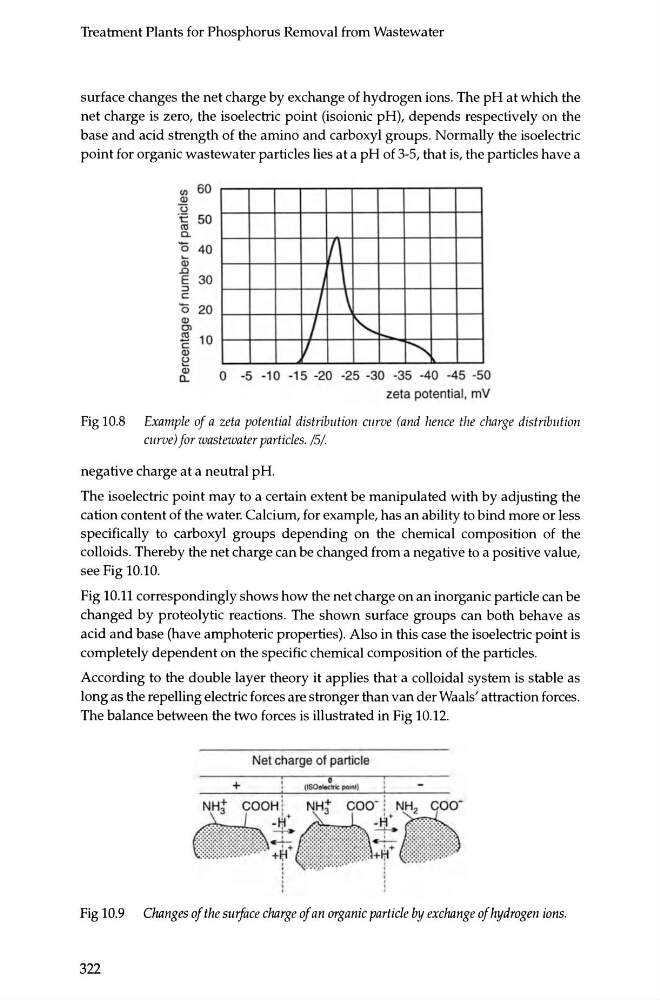
surface changes the net charge by exchange of hydrogen ions. The pH at which the
net charge is zero, the isoelectric point (isoionic pH), depends respectively on the
base and acid strength of the amino and carboxyl groups. Normally the isoelectric
point for organic wastewater particles lies at a pH of 3-5, that is, the particles have a
en 60
Q)
u
'€ 50
«<
a.
0 40
li>
.0
E 30
::I
c
0 20
Q)
Ol
«< 10
c Q)
~
Q)
a..
I'
I \
I \
I i'-.. !'-.
II
1'--,
0 -5 -10 -15 -20 -25 -30 -35 -40 -45 -50
zeta potential, mV
Fig 10.8 Example of a zeta potential distribution curve (and hence the charge distribution
curve) for wastewater particles. /5/.
negative charge at a neutral pH
The isoelectric point may to a certain extent be manipulated with by adjusting the
cation content of the water. Calcium, for example, has an ability to bind more or less
specifically to carboxyl groups depending on the chemical composition of the
colloids. Thereby the net charge can be changed from a negative to a positive value,
see Fig 10.10.
Fig 10.11 correspondingly shows how the net charge on an inorganic particle can be
changed by proteolytic reactions. The shown surface groups can both behave as
acid and base (have amphoteric properties). Also in this case the isoelectric point is
completely dependent on the specific chemical composition of the particles.
According to the double layer theory it applies that a colloidal system is stable as
long as the repelling electric forces are stronger than van der Waals' attraction forces.
The balance between the two forces is illustrated in Fig 10.12.
Net charge of particle
+
(~poino)
•f.ii:i:lli
Fig 10.9 Changes of the surface charge of an organic particle by exchange of hydrogen ions.
322
surface changes the net charge by exchange of hydrogen ions. The pH at which the
net charge is zero, the isoelectric point (isoionic pH), depends respectively on the
base and acid strength of the amino and carboxyl groups. Normally the isoelectric
point for organic wastewater particles lies at a pH of 3-5, that is, the particles have a
en 60
Q)
u
'€ 50
«<
a.
0 40
li>
.0
E 30
::I
c
0 20
Q)
Ol
«< 10
c Q)
~
Q)
a..
I'
I \
I \
I i'-.. !'-.
II
1'--,
0 -5 -10 -15 -20 -25 -30 -35 -40 -45 -50
zeta potential, mV
Fig 10.8 Example of a zeta potential distribution curve (and hence the charge distribution
curve) for wastewater particles. /5/.
negative charge at a neutral pH
The isoelectric point may to a certain extent be manipulated with by adjusting the
cation content of the water. Calcium, for example, has an ability to bind more or less
specifically to carboxyl groups depending on the chemical composition of the
colloids. Thereby the net charge can be changed from a negative to a positive value,
see Fig 10.10.
Fig 10.11 correspondingly shows how the net charge on an inorganic particle can be
changed by proteolytic reactions. The shown surface groups can both behave as
acid and base (have amphoteric properties). Also in this case the isoelectric point is
completely dependent on the specific chemical composition of the particles.
According to the double layer theory it applies that a colloidal system is stable as
long as the repelling electric forces are stronger than van der Waals' attraction forces.
The balance between the two forces is illustrated in Fig 10.12.
Net charge of particle
+
(~poino)
•f.ii:i:lli
Fig 10.9 Changes of the surface charge of an organic particle by exchange of hydrogen ions.
322