

Treatment Plants for Phosphorus Removal from Wastewater
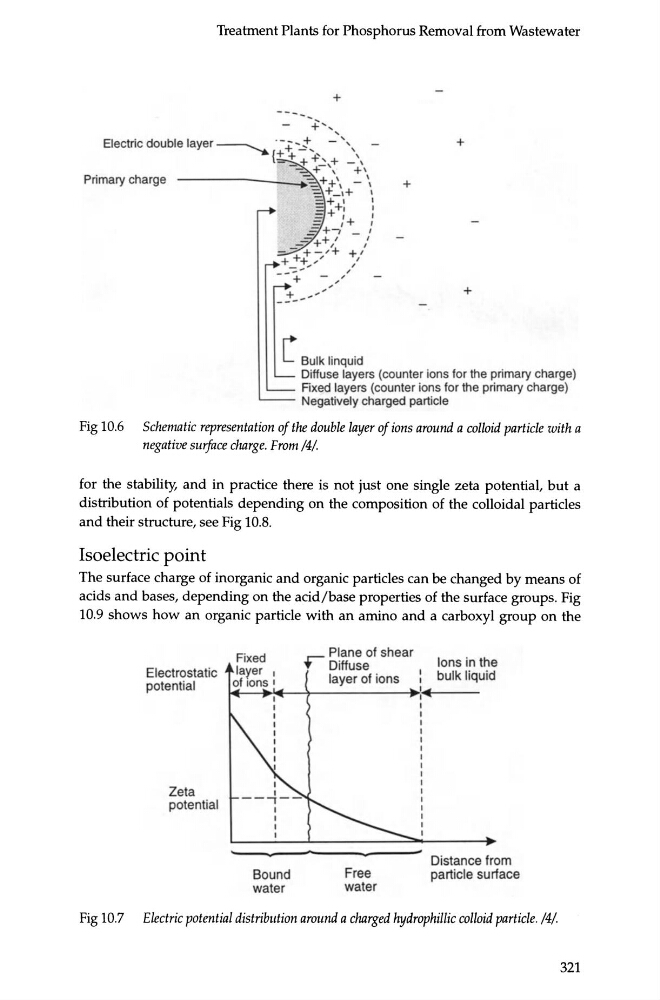
Primary charge
+
+
+
+
l Bulk linquid
Diffuse layers (counter ions for the primary charge)
Fixed layers (counter ions for the primary charge)
Negatively charged particle
Fig 10.6 Schematic representation of the double layer of ions around a colloid particle with a
negative surface charge. From /4/.
for the stability, and in practice there is not just one single zeta potential, but a
distribution of potentials depending on the composition of the colloidal particles
and their structure, see Fig 10.8.
Isoelectric point
The surface charge of inorganic and organic particles can be changed by means of
acids and bases, depending on the acid/base properties of the surface groups. Fig
10.9 shows how an organic particle with an amino and a carboxyl group on the
Electrostatic
potential
Zeta
potential
Fixed
layer
of 1ons
Bound
water
.r- Plane of shear
..- Diffuse
1
Ions in the
layer of ions
1
bulk liquid
I ll(
Free
water
Distance from
particle surface
Fig 10.7 Electric potential distribution around a charged hydrophillic colloid particle. /4/.
321
Primary charge
+
+
+
+
l Bulk linquid
Diffuse layers (counter ions for the primary charge)
Fixed layers (counter ions for the primary charge)
Negatively charged particle
Fig 10.6 Schematic representation of the double layer of ions around a colloid particle with a
negative surface charge. From /4/.
for the stability, and in practice there is not just one single zeta potential, but a
distribution of potentials depending on the composition of the colloidal particles
and their structure, see Fig 10.8.
Isoelectric point
The surface charge of inorganic and organic particles can be changed by means of
acids and bases, depending on the acid/base properties of the surface groups. Fig
10.9 shows how an organic particle with an amino and a carboxyl group on the
Electrostatic
potential
Zeta
potential
Fixed
layer
of 1ons
Bound
water
.r- Plane of shear
..- Diffuse
1
Ions in the
layer of ions
1
bulk liquid
I ll(
Free
water
Distance from
particle surface
Fig 10.7 Electric potential distribution around a charged hydrophillic colloid particle. /4/.
321