

Treatment Plants for Phosphorus Removal from Wastewater
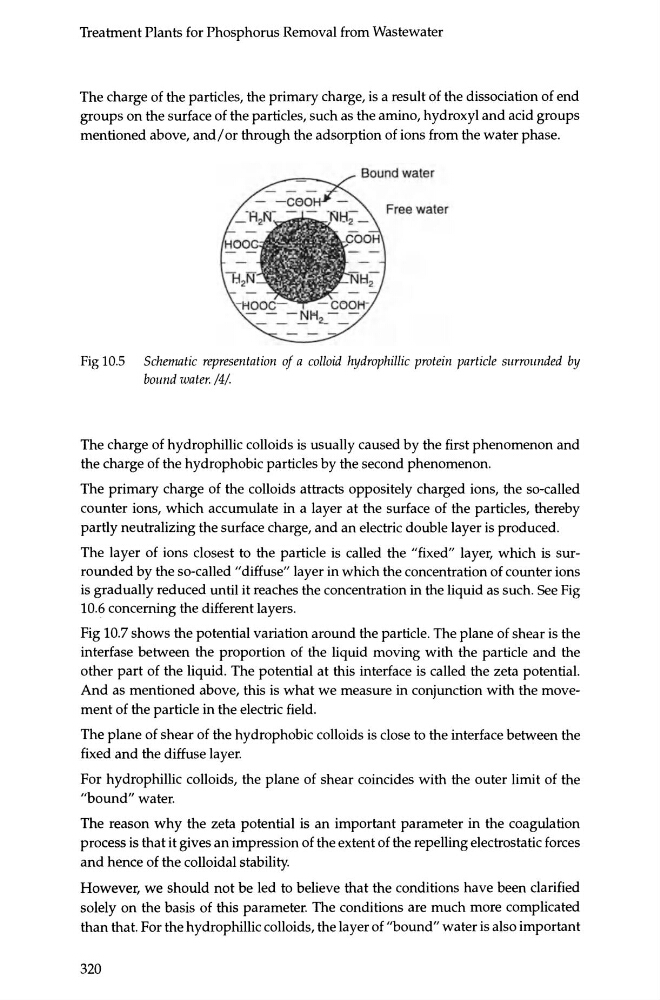
The charge of the particles, the primary charge, is a result of the dissociation of end
groups on the surface of the particles, such as the amino, hydroxyl and acid groups
mentioned above, and/ or through the adsorption of ions from the water phase.
Free water
Fig 10.5 Schematic representation of a colloid hydrophillic protein particle surrounded by
bound water. /4/.
The charge of hydrophillic colloids is usually caused by the first phenomenon and
the charge of the hydrophobic particles by the second phenomenon.
The primary charge of the colloids attracts oppositely charged ions, the so-called
counter ions, which accumulate in a layer at the surface of the particles, thereby
partly neutralizing the surface charge, and an electric double layer is produced.
The layer of ions closest to the particle is called the "fixed" layer, which is surrounded by the so-called "diffuse" layer in which the concentration of counter ions
is gradually reduced until it reaches the concentration in the liquid as such. See Fig
10.6 concerning the different layers.
Fig 10.7 shows the potential variation around the particle. The plane of shear is the
interfase between the proportion of the liquid moving with the particle and the
other part of the liquid. The potential at this interface is called the zeta potential.
And as mentioned above, this is what we measure in conjunction with the movement of the particle in the electric field .
The plane of shear of the hydrophobic colloids is close to the interface between the
fixed and the diffuse layer.
For hydrophillic colloids, the plane of shear coincides with the outer limit of the
"bound" water.
The reason why the zeta potential is an important parameter in the coagulation
process is that it gives an impression of the extent of the repelling electrostatic forces
and hence of the colloidal stability.
However, we should not be led to believe that the conditions have been clarified
solely on the basis of this parameter. The conditions are much more complicated
than that. For the hydrophillic colloids, the layer of "bound" water is also important
320
The charge of the particles, the primary charge, is a result of the dissociation of end
groups on the surface of the particles, such as the amino, hydroxyl and acid groups
mentioned above, and/ or through the adsorption of ions from the water phase.
Free water
Fig 10.5 Schematic representation of a colloid hydrophillic protein particle surrounded by
bound water. /4/.
The charge of hydrophillic colloids is usually caused by the first phenomenon and
the charge of the hydrophobic particles by the second phenomenon.
The primary charge of the colloids attracts oppositely charged ions, the so-called
counter ions, which accumulate in a layer at the surface of the particles, thereby
partly neutralizing the surface charge, and an electric double layer is produced.
The layer of ions closest to the particle is called the "fixed" layer, which is surrounded by the so-called "diffuse" layer in which the concentration of counter ions
is gradually reduced until it reaches the concentration in the liquid as such. See Fig
10.6 concerning the different layers.
Fig 10.7 shows the potential variation around the particle. The plane of shear is the
interfase between the proportion of the liquid moving with the particle and the
other part of the liquid. The potential at this interface is called the zeta potential.
And as mentioned above, this is what we measure in conjunction with the movement of the particle in the electric field .
The plane of shear of the hydrophobic colloids is close to the interface between the
fixed and the diffuse layer.
For hydrophillic colloids, the plane of shear coincides with the outer limit of the
"bound" water.
The reason why the zeta potential is an important parameter in the coagulation
process is that it gives an impression of the extent of the repelling electrostatic forces
and hence of the colloidal stability.
However, we should not be led to believe that the conditions have been clarified
solely on the basis of this parameter. The conditions are much more complicated
than that. For the hydrophillic colloids, the layer of "bound" water is also important
320