

Treatment Plants for Phosphorus Removal from Wastewater
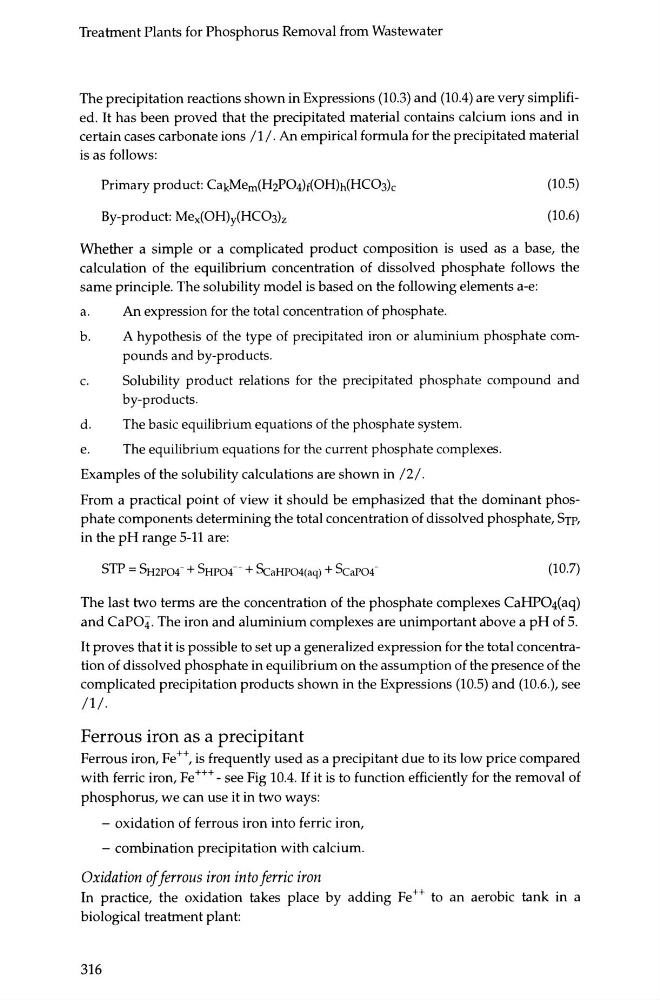
The precipitation reactions shown in Expressions (10.3) and (10.4) are very simplified. It has been proved that the precipitated material contains calcium ions and in
certain cases carbonate ions /1 I. An empirical formula for the precipitated material
is as follows:
By-product: Mex(OH)y(HC03)z
(10.5)
(10.6)
Whether a simple or a complicated product composition is used as a base, the
calculation of the equilibrium concentration of dissolved phosphate follows the
same principle. The solubility model is based on the following elements a-e:
a.
An expression for the total concentration of phosphate.
b.
A hypothesis of the type of precipitated iron or aluminium phosphate compounds and by-products.
c.
Solubility product relations for the precipitated phosphate compound and
by-products.
d.
The basic equilibrium equations of the phosphate system.
e.
The equilibrium equations for the current phosphate complexes.
Examples of the solubility calculations are shown in /2/.
From a practical point of view it should be emphasized that the dominant phosphate components determining the total concentration of dissolved phosphate, Srr,
in the pH range 5-11 are:
STP = SH2P04- + SHP04-- + Sc:aHP04(aq) + ScaP04(10.7)
The last two terms are the concentration of the phosphate complexes CaHP04(aq)
and CaP04. The iron and aluminium complexes are unimportant above a pH of 5.
It proves that it is possible to set up a generalized expression for the total concentration of dissolved phosphate in equilibrium on the assumption of the presence of the
complicated precipitation products shown in the Expressions (10.5) and (10.6.), see
/1/.
Ferrous iron as a precipitant
Ferrous iron, Fe++, is frequently used as a precipitant due to its low price compared
with ferric iron, Fe+++- see Fig 10.4. If it is to function efficiently for the removal of
phosphorus, we can use it in two ways:
- oxidation of ferrous iron into ferric iron,
- combination precipitation with calcium.
Oxidation of ferrous iron into ferric iron
In practice, the oxidation takes place by adding Fe++ to an aerobic tank in a
biological treatment plant:
316
The precipitation reactions shown in Expressions (10.3) and (10.4) are very simplified. It has been proved that the precipitated material contains calcium ions and in
certain cases carbonate ions /1 I. An empirical formula for the precipitated material
is as follows:
By-product: Mex(OH)y(HC03)z
(10.5)
(10.6)
Whether a simple or a complicated product composition is used as a base, the
calculation of the equilibrium concentration of dissolved phosphate follows the
same principle. The solubility model is based on the following elements a-e:
a.
An expression for the total concentration of phosphate.
b.
A hypothesis of the type of precipitated iron or aluminium phosphate compounds and by-products.
c.
Solubility product relations for the precipitated phosphate compound and
by-products.
d.
The basic equilibrium equations of the phosphate system.
e.
The equilibrium equations for the current phosphate complexes.
Examples of the solubility calculations are shown in /2/.
From a practical point of view it should be emphasized that the dominant phosphate components determining the total concentration of dissolved phosphate, Srr,
in the pH range 5-11 are:
STP = SH2P04- + SHP04-- + Sc:aHP04(aq) + ScaP04(10.7)
The last two terms are the concentration of the phosphate complexes CaHP04(aq)
and CaP04. The iron and aluminium complexes are unimportant above a pH of 5.
It proves that it is possible to set up a generalized expression for the total concentration of dissolved phosphate in equilibrium on the assumption of the presence of the
complicated precipitation products shown in the Expressions (10.5) and (10.6.), see
/1/.
Ferrous iron as a precipitant
Ferrous iron, Fe++, is frequently used as a precipitant due to its low price compared
with ferric iron, Fe+++- see Fig 10.4. If it is to function efficiently for the removal of
phosphorus, we can use it in two ways:
- oxidation of ferrous iron into ferric iron,
- combination precipitation with calcium.
Oxidation of ferrous iron into ferric iron
In practice, the oxidation takes place by adding Fe++ to an aerobic tank in a
biological treatment plant:
316