

Treatment Plants for Phosphorus Removal from Wastewater
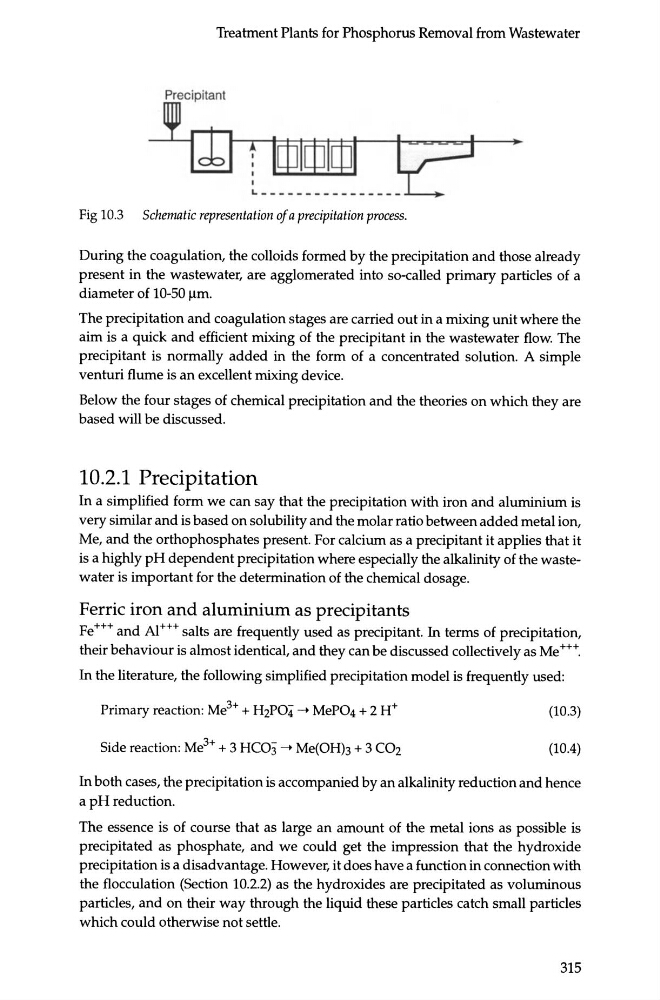
Precipitant
Fig 10.3 Schematic representation of a precipitation process.
During the coagulation, the colloids formed by the precipitation and those already
present in the wastewater, are agglomerated into so-called primary particles of a
diameter of 10-50 J.lm.
The precipitation and coagulation stages are carried out in a mixing unit where the
aim is a quick and efficient mixing of the precipitant in the wastewater flow. The
precipitant is normally added in the form of a concentrated solution. A simple
venturi flume is an excellent mixing device.
Below the four stages of chemical precipitation and the theories on which they are
based will be discussed.
10.2.1 Precipitation
In a simplified form we can say that the precipitation with iron and aluminium is
very similar and is based on solubility and the molar ratio between added metal ion,
Me, and the orthophosphates present. For calcium as a precipitant it applies that it
is a highly pH dependent precipitation where especially the alkalinity of the wastewater is important for the determination of the chemical dosage.
Ferric iron and aluminium as precipitants
Fe+++ and Al+++ salts are frequently used as precipitant. In terms of precipitation,
their behaviour is almost identical, and they can be discussed collectively as Me+++.
In the literature, the following simplified precipitation model is frequently used:
Primary reaction: Me 3 + + H2P04 --+ MeP04 + 2 H +
(10.3)
Side reaction: Me 3 + + 3 HC03--+ Me(OH)3 + 3 C02
(10.4)
In both cases, the precipitation is accompanied by an alkalinity reduction and hence
a pH reduction.
The essence is of course that as large an amount of the metal ions as possible is
precipitated as phosphate, and we could get the impression that the hydroxide
precipitation is a disadvantage. However, it does have a function in connection with
the flocculation (Section 10.2.2) as the hydroxides are precipitated as voluminous
particles, and on their way through the liquid these particles catch small particles
which could otherwise not settle.
315
Precipitant
Fig 10.3 Schematic representation of a precipitation process.
During the coagulation, the colloids formed by the precipitation and those already
present in the wastewater, are agglomerated into so-called primary particles of a
diameter of 10-50 J.lm.
The precipitation and coagulation stages are carried out in a mixing unit where the
aim is a quick and efficient mixing of the precipitant in the wastewater flow. The
precipitant is normally added in the form of a concentrated solution. A simple
venturi flume is an excellent mixing device.
Below the four stages of chemical precipitation and the theories on which they are
based will be discussed.
10.2.1 Precipitation
In a simplified form we can say that the precipitation with iron and aluminium is
very similar and is based on solubility and the molar ratio between added metal ion,
Me, and the orthophosphates present. For calcium as a precipitant it applies that it
is a highly pH dependent precipitation where especially the alkalinity of the wastewater is important for the determination of the chemical dosage.
Ferric iron and aluminium as precipitants
Fe+++ and Al+++ salts are frequently used as precipitant. In terms of precipitation,
their behaviour is almost identical, and they can be discussed collectively as Me+++.
In the literature, the following simplified precipitation model is frequently used:
Primary reaction: Me 3 + + H2P04 --+ MeP04 + 2 H +
(10.3)
Side reaction: Me 3 + + 3 HC03--+ Me(OH)3 + 3 C02
(10.4)
In both cases, the precipitation is accompanied by an alkalinity reduction and hence
a pH reduction.
The essence is of course that as large an amount of the metal ions as possible is
precipitated as phosphate, and we could get the impression that the hydroxide
precipitation is a disadvantage. However, it does have a function in connection with
the flocculation (Section 10.2.2) as the hydroxides are precipitated as voluminous
particles, and on their way through the liquid these particles catch small particles
which could otherwise not settle.
315