

Types of plants for denitrification
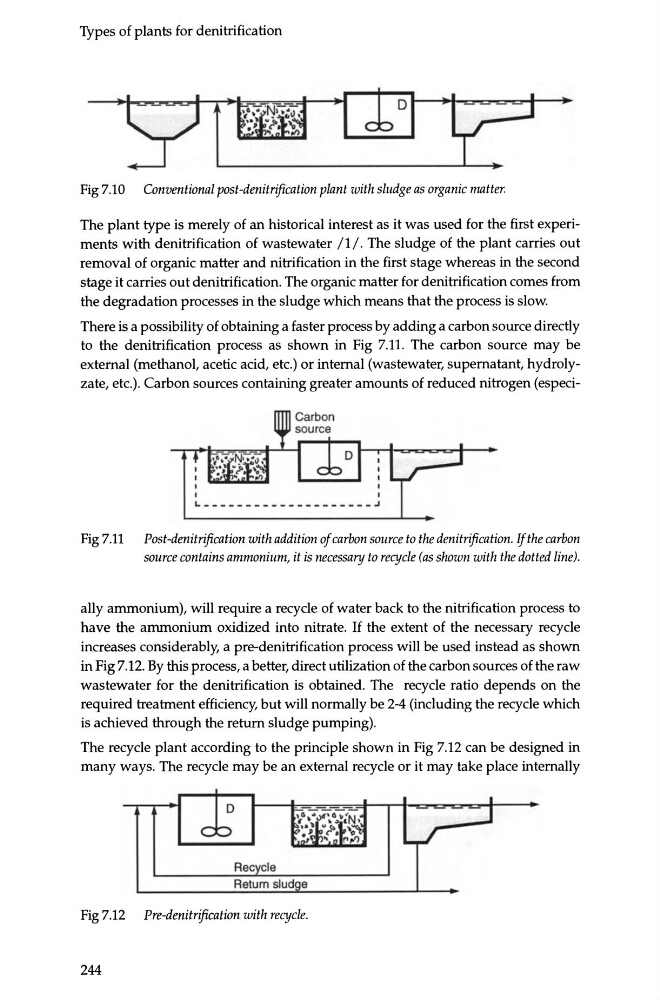
Fig 7.10 Conventional post-denitrification plant with sludge as organic matter.
The plant type is merely of an historical interest as it was used for the first experiments with denitrification of wastewater /1/. The sludge of the plant carries out
removal of organic matter and nitrification in the first stage whereas in the second
stage it carries out denitrification. The organic matter for denitrification comes from
the degradation processes in the sludge which means that the process is slow.
There is a possibility of obtaining a faster process by adding a carbon source directly
to the denitrification process as shown in Fig 7.11. The carbon source may be
external (methanol, acetic acid, etc.) or internal (wastewater, supernatant, hydrolyzate, etc.). Carbon sources containing greater amounts of reduced nitrogen (especiI
I
L--------------------~
Fig 7.11 Post-denitrification with addition of carbon source to the denitrification. If the carbon
source contains ammonium, it is necessary to recycle (as shown with the dotted line).
ally ammonium), will require a recycle of water back to the nitrification process to
have the ammonium oxidized into nitrate. If the extent of the necessary recycle
increases considerably, a pre-denitrification process will be used instead as shown
in Fig 7.12. By this process, a better, direct utilization of the carbon sources of the raw
wastewater for the denitrification is obtained. The recycle ratio depends on the
required treatment efficiency, but will normally be 2-4 (including the recycle which
is achieved through the return sludge pumping).
The recycle plant according to the principle shown in Fig 7.12 can be designed in
many ways. The recycle may be an external recycle or it may take place internally
D
Fig 7.12 Pre-denitrification with recycle.
244
Fig 7.10 Conventional post-denitrification plant with sludge as organic matter.
The plant type is merely of an historical interest as it was used for the first experiments with denitrification of wastewater /1/. The sludge of the plant carries out
removal of organic matter and nitrification in the first stage whereas in the second
stage it carries out denitrification. The organic matter for denitrification comes from
the degradation processes in the sludge which means that the process is slow.
There is a possibility of obtaining a faster process by adding a carbon source directly
to the denitrification process as shown in Fig 7.11. The carbon source may be
external (methanol, acetic acid, etc.) or internal (wastewater, supernatant, hydrolyzate, etc.). Carbon sources containing greater amounts of reduced nitrogen (especiI
I
L--------------------~
Fig 7.11 Post-denitrification with addition of carbon source to the denitrification. If the carbon
source contains ammonium, it is necessary to recycle (as shown with the dotted line).
ally ammonium), will require a recycle of water back to the nitrification process to
have the ammonium oxidized into nitrate. If the extent of the necessary recycle
increases considerably, a pre-denitrification process will be used instead as shown
in Fig 7.12. By this process, a better, direct utilization of the carbon sources of the raw
wastewater for the denitrification is obtained. The recycle ratio depends on the
required treatment efficiency, but will normally be 2-4 (including the recycle which
is achieved through the return sludge pumping).
The recycle plant according to the principle shown in Fig 7.12 can be designed in
many ways. The recycle may be an external recycle or it may take place internally
D
Fig 7.12 Pre-denitrification with recycle.
244