

Treatment Plants for Denitrification
in the combined nitrification-denitrification tank. The latter technology has especially been developed in South Africa where it is used in many plants.
In many plant designs there is not one special tank for nitrification and another one
for denitrification. In certain periods, a tank, or part of a tank, is used for nitrification
and in other periods for denitrification. In terms of the process, it may be pre-denitrification (as shown in Fig 7.12), or a mix of pre-denitrification and post denitrification.
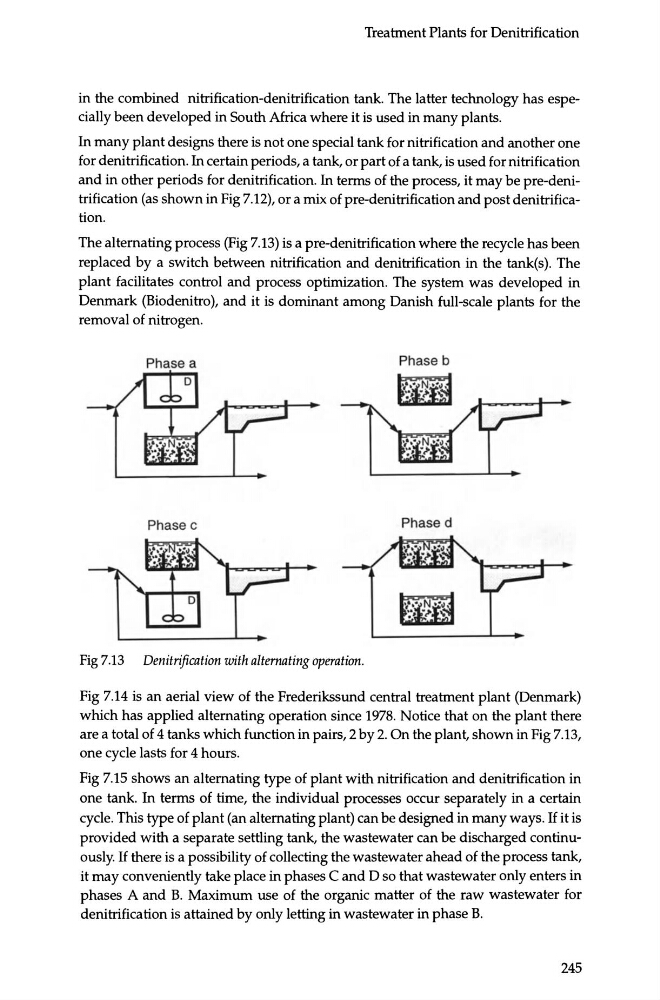
The alternating process (Fig 7.13) is a pre-denitrification where the recycle has been
replaced by a switch between nitrification and denitrification in the tank(s). The
plant facilitates control and process optimization. The system was developed in
Denmark (Biodenitro ), and it is dominant among Danish full-scale plants for the
removal of nitrogen.
Phase b
..
Phase c
Phased
Fig 7.13 Denitrification with alternating operation.
Fig 7.14 is an aerial view of the Frederikssund central treatment plant (Denmark)
which has applied alternating operation since 1978. Notice that on the plant there
are a total of 4 tanks which function in pairs, 2 by 2. On the plant, shown in Fig 7.13,
one cycle lasts for 4 hours.
Fig 7.15 shows an alternating type of plant with nitrification and denitrification in
one tank. In terms of time, the individual processes occur separately in a certain
cycle. This type of plant (an alternating plant) can be designed in many ways.lf it is
provided with a separate settling tank, the wastewater can be discharged continuously. If there is a possibility of collecting the wastewater ahead of the process tank,
it may conveniently take place in phases C and D so that wastewater only enters in
phases A and B. Maximum use of the organic matter of the raw wastewater for
denitrification is attained by only letting in wastewater in phase B.
245
in the combined nitrification-denitrification tank. The latter technology has especially been developed in South Africa where it is used in many plants.
In many plant designs there is not one special tank for nitrification and another one
for denitrification. In certain periods, a tank, or part of a tank, is used for nitrification
and in other periods for denitrification. In terms of the process, it may be pre-denitrification (as shown in Fig 7.12), or a mix of pre-denitrification and post denitrification.
The alternating process (Fig 7.13) is a pre-denitrification where the recycle has been
replaced by a switch between nitrification and denitrification in the tank(s). The
plant facilitates control and process optimization. The system was developed in
Denmark (Biodenitro ), and it is dominant among Danish full-scale plants for the
removal of nitrogen.
Phase b
..
Phase c
Phased
Fig 7.13 Denitrification with alternating operation.
Fig 7.14 is an aerial view of the Frederikssund central treatment plant (Denmark)
which has applied alternating operation since 1978. Notice that on the plant there
are a total of 4 tanks which function in pairs, 2 by 2. On the plant, shown in Fig 7.13,
one cycle lasts for 4 hours.
Fig 7.15 shows an alternating type of plant with nitrification and denitrification in
one tank. In terms of time, the individual processes occur separately in a certain
cycle. This type of plant (an alternating plant) can be designed in many ways.lf it is
provided with a separate settling tank, the wastewater can be discharged continuously. If there is a possibility of collecting the wastewater ahead of the process tank,
it may conveniently take place in phases C and D so that wastewater only enters in
phases A and B. Maximum use of the organic matter of the raw wastewater for
denitrification is attained by only letting in wastewater in phase B.
245