

Treatment Plants for Denitrification
Surplus sludge can be withdrawn directly from the filter. As yet, experiences with
the operation of denitrifying filters are few.
In the following, a number of plant types for denitrification are described. For
activated sludge plants, the types are described which are typically used in full-scale
plants supplemented by a few which are suitable to illustrate important characteristics of the process. For biofilters, of which very few types are used commercially,
examples are given of the designs which are considered to be the most attractive.
7.2.1 Denitrification plants with separate sludge
Plants with separate sludge have typically been used as full-scale plants, especially
in the USA The process design, where the plant for denitrification forms an
independent treatment stage, was used as an extension of plants with nitrification
and removal of organic matter where further requirements are made for the removal
of nitrogen. Fig 7.7a shows the design of such a post denitrification plant.
The denitrification plant is coupled to the effluent of the existing plant, but as
organic matter is needed for denitrification, it must be added, such as in the form of
methanol.
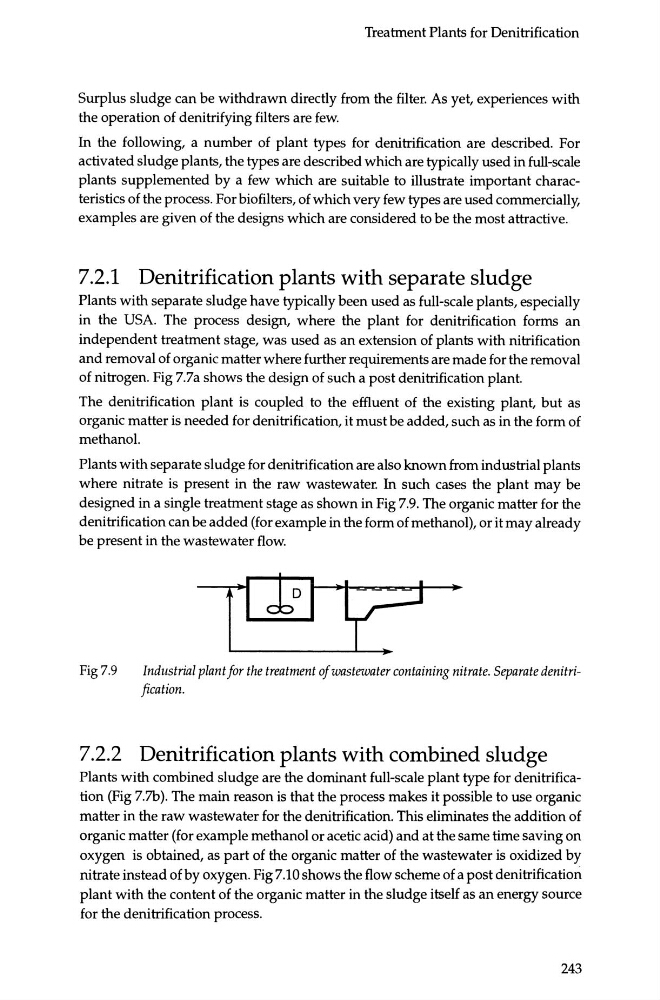
Plants with separate sludge for denitrification are also known from industrial plants
where nitrate is present in the raw wastewater. In such cases the plant may be
designed in a single treatment stage as shown in Fig 7.9. The organic matter for the
denitrification can be added (for example in the form of methanol), or it may already
be present in the wastewater flow.
j
Fig 7.9
Industrial plant for the treatment of wastewater containing nitrate. Separate denitrification.
7.2.2 Denitrification plants with combined sludge
Plants with combined sludge are the dominant full-scale plant type for denitrification (Fig 7.7b ). The main reason is that the process makes it possible to use organic
matter in the raw wastewater for the denitrification. This eliminates the addition of
organic matter (for example methanol or acetic acid) and at the same time saving on
oxygen is obtained, as part of the organic matter of the wastewater is oxidized by
nitrate instead of by oxygen. Fig 7.10 shows the flow scheme of a post denitrification
plant with the content of the organic matter in the sludge itself as an energy source
for the denitrification process.
243
Surplus sludge can be withdrawn directly from the filter. As yet, experiences with
the operation of denitrifying filters are few.
In the following, a number of plant types for denitrification are described. For
activated sludge plants, the types are described which are typically used in full-scale
plants supplemented by a few which are suitable to illustrate important characteristics of the process. For biofilters, of which very few types are used commercially,
examples are given of the designs which are considered to be the most attractive.
7.2.1 Denitrification plants with separate sludge
Plants with separate sludge have typically been used as full-scale plants, especially
in the USA The process design, where the plant for denitrification forms an
independent treatment stage, was used as an extension of plants with nitrification
and removal of organic matter where further requirements are made for the removal
of nitrogen. Fig 7.7a shows the design of such a post denitrification plant.
The denitrification plant is coupled to the effluent of the existing plant, but as
organic matter is needed for denitrification, it must be added, such as in the form of
methanol.
Plants with separate sludge for denitrification are also known from industrial plants
where nitrate is present in the raw wastewater. In such cases the plant may be
designed in a single treatment stage as shown in Fig 7.9. The organic matter for the
denitrification can be added (for example in the form of methanol), or it may already
be present in the wastewater flow.
j
Fig 7.9
Industrial plant for the treatment of wastewater containing nitrate. Separate denitrification.
7.2.2 Denitrification plants with combined sludge
Plants with combined sludge are the dominant full-scale plant type for denitrification (Fig 7.7b ). The main reason is that the process makes it possible to use organic
matter in the raw wastewater for the denitrification. This eliminates the addition of
organic matter (for example methanol or acetic acid) and at the same time saving on
oxygen is obtained, as part of the organic matter of the wastewater is oxidized by
nitrate instead of by oxygen. Fig 7.10 shows the flow scheme of a post denitrification
plant with the content of the organic matter in the sludge itself as an energy source
for the denitrification process.
243