

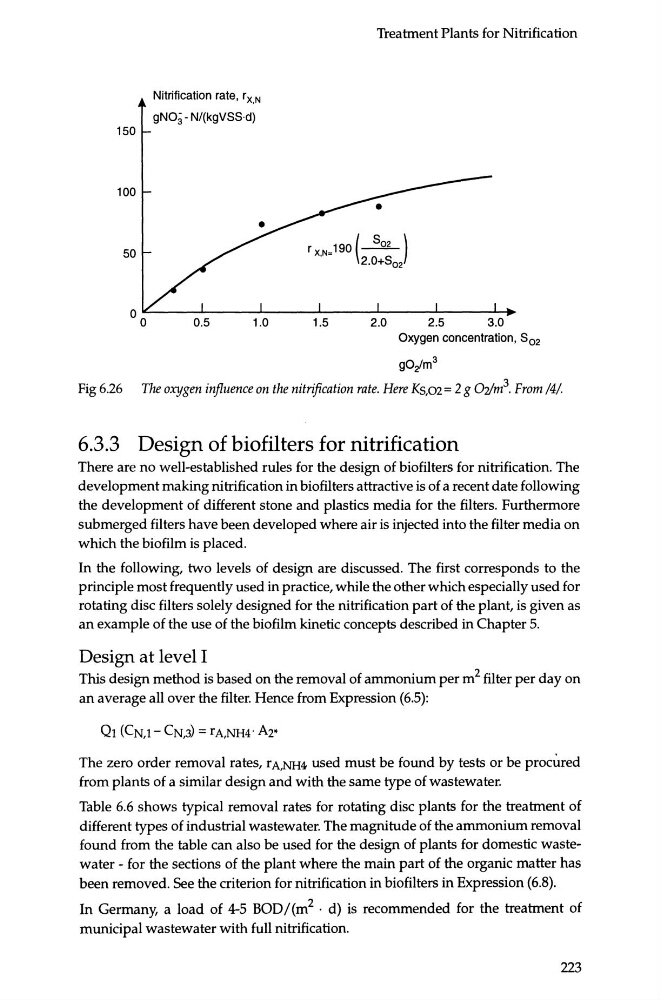
Nitrification rate, r x,N
gN03- N/{kgVSS·d)
Treabnent Plants for Nitrification
Oxygen concentration, 8 02
g0tm3
Fig 6.26 The oxygen influence on the nitrification rate. Here Ks,oz = 2 g ()'J!m 3 . From /4!
6.3.3 Design of biofilters for nitrification
There are no well-established rules for the design of biofilters for nitrification. The
development making nitrification in biofilters attractive is of a recent date following
the development of different stone and plastics media for the filters. Furthermore
submerged filters have been developed where air is injected into the filter media on
which the biofilm is placed.
In the following, two levels of design are discussed. The first corresponds to the
principle most frequently used in practice, while the other which especially used for
rotating disc filters solely designed for the nitrification part of the plant, is given as
an example of the use of the biofilm kinetic concepts described in Chapter 5.
Design at level I
This design method is based on the removal of ammonium per m 2 filter per day on
an average all over the filter. Hence from Expression (6.5):
The zero order removal rates, rA,NH4 used must be found by tests or be procUred
from plants of a similar design and with the same type of wastewater.
Table 6.6 shows typical removal rates for rotating disc plants for the treabnent of
different types of industrial wastewater. The magnitude of the ammonium removal
found from the table can also be used for the design of plants for domestic wastewater - for the sections of the plant where the main part of the organic matter has
been removed. See the criterion for nitrification in biofilters in Expression (6.8).
In Germany, a load of 4-5 BOD I (m 2 · d) is recommended for the treabnent of
municipal wastewater with full nitrification.
223
gN03- N/{kgVSS·d)
Treabnent Plants for Nitrification
Oxygen concentration, 8 02
g0tm3
Fig 6.26 The oxygen influence on the nitrification rate. Here Ks,oz = 2 g ()'J!m 3 . From /4!
6.3.3 Design of biofilters for nitrification
There are no well-established rules for the design of biofilters for nitrification. The
development making nitrification in biofilters attractive is of a recent date following
the development of different stone and plastics media for the filters. Furthermore
submerged filters have been developed where air is injected into the filter media on
which the biofilm is placed.
In the following, two levels of design are discussed. The first corresponds to the
principle most frequently used in practice, while the other which especially used for
rotating disc filters solely designed for the nitrification part of the plant, is given as
an example of the use of the biofilm kinetic concepts described in Chapter 5.
Design at level I
This design method is based on the removal of ammonium per m 2 filter per day on
an average all over the filter. Hence from Expression (6.5):
The zero order removal rates, rA,NH4 used must be found by tests or be procUred
from plants of a similar design and with the same type of wastewater.
Table 6.6 shows typical removal rates for rotating disc plants for the treabnent of
different types of industrial wastewater. The magnitude of the ammonium removal
found from the table can also be used for the design of plants for domestic wastewater - for the sections of the plant where the main part of the organic matter has
been removed. See the criterion for nitrification in biofilters in Expression (6.8).
In Germany, a load of 4-5 BOD I (m 2 · d) is recommended for the treabnent of
municipal wastewater with full nitrification.
223