

Design of nitrifying plants
6.3.2 Optimizing operation of nitrifying plants
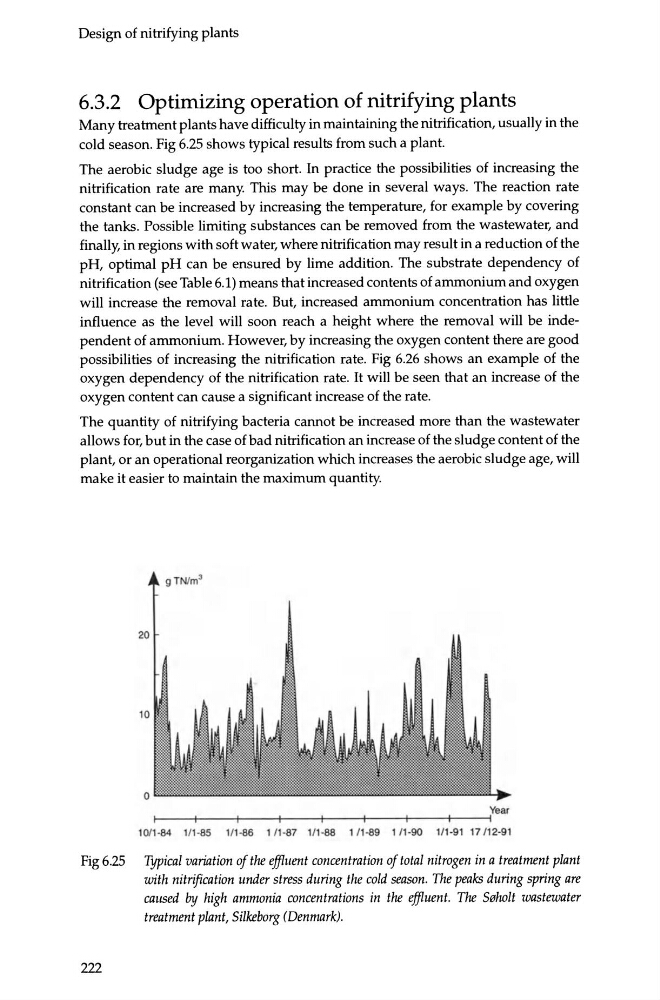
Many treatment plants have difficulty in maintaining the nitrification, usually in the
cold season. Fig 6.25 shows typical results from such a plant.
The aerobic sludge age is too short. In practice the possibilities of increasing the
nitrification rate are many. This may be done in several ways. The reaction rate
constant can be increased by increasing the temperature, for example by covering
the tanks. Possible limiting substances can be removed from the wastewater, and
finally, in regions with soft water, where nitrification may result in a reduction of the
pH, optimal pH can be ensured by lime addition. The substrate dependency of
nitrification (see Table 6.1) means that increased contents of ammonium and oxygen
will increase the removal rate. But, increased ammonium concentration has little
influence as the level will soon reach a height where the removal will be independent of ammonium. However, by increasing the oxygen content there are good
possibilities of increasing the nitrification rate. Fig 6.26 shows an example of the
oxygen dependency of the nitrification rate. It will be seen that an increase of the
oxygen content can cause a significant increase of the rate.
The quantity of nitrifying bacteria cannot be increased more than the wastewater
allows for, but in the case of bad nitrification an increase of the sludge content of the
plant, or an operational reorganization which increases the aerobic sludge age, will
make it easier to maintain the maximum quantity.
20
10
0
r----+----+---~-----+----+---~-----+--~~ar
10/1-84 1/1-85 1/ 1-86 1/1-87 1/ 1-88 1/1-89 1/1 -90 1/1-91 17/12-91
Fig 6.25 Typical variation of the effluent concentration of total nitrogen in a treatment plant
with nitrification under stress during the cold season. The peaks during spring are
caused by high ammonia concentrations in the effluent. The Seholt wastewater
treatment plant, Silkeborg (Denmark).
222
6.3.2 Optimizing operation of nitrifying plants
Many treatment plants have difficulty in maintaining the nitrification, usually in the
cold season. Fig 6.25 shows typical results from such a plant.
The aerobic sludge age is too short. In practice the possibilities of increasing the
nitrification rate are many. This may be done in several ways. The reaction rate
constant can be increased by increasing the temperature, for example by covering
the tanks. Possible limiting substances can be removed from the wastewater, and
finally, in regions with soft water, where nitrification may result in a reduction of the
pH, optimal pH can be ensured by lime addition. The substrate dependency of
nitrification (see Table 6.1) means that increased contents of ammonium and oxygen
will increase the removal rate. But, increased ammonium concentration has little
influence as the level will soon reach a height where the removal will be independent of ammonium. However, by increasing the oxygen content there are good
possibilities of increasing the nitrification rate. Fig 6.26 shows an example of the
oxygen dependency of the nitrification rate. It will be seen that an increase of the
oxygen content can cause a significant increase of the rate.
The quantity of nitrifying bacteria cannot be increased more than the wastewater
allows for, but in the case of bad nitrification an increase of the sludge content of the
plant, or an operational reorganization which increases the aerobic sludge age, will
make it easier to maintain the maximum quantity.
20
10
0
r----+----+---~-----+----+---~-----+--~~ar
10/1-84 1/1-85 1/ 1-86 1/1-87 1/ 1-88 1/1-89 1/1 -90 1/1-91 17/12-91
Fig 6.25 Typical variation of the effluent concentration of total nitrogen in a treatment plant
with nitrification under stress during the cold season. The peaks during spring are
caused by high ammonia concentrations in the effluent. The Seholt wastewater
treatment plant, Silkeborg (Denmark).
222