

Treatment Plants for Nitrification
Computer-designed plants
There are computer programs of varying complexity which can be used for the
design of nitrifying plants. This allows for daily variations to be included in the
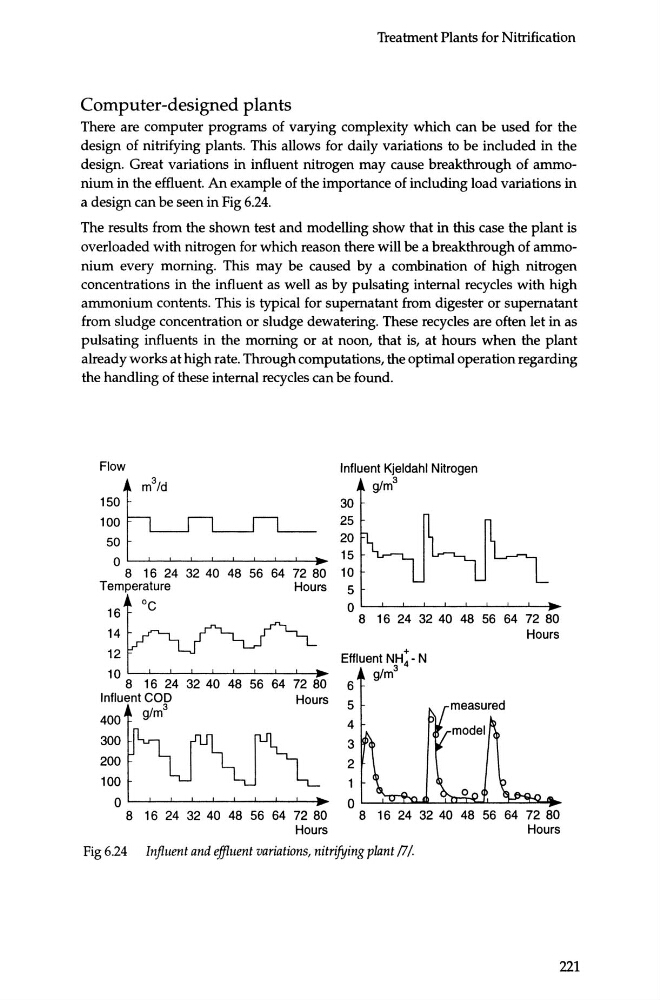
design. Great variations in influent nitrogen may cause breakthrough of ammonium in the effluent. An example of the importance of including load variations in
a design can be seen in Fig 6.24.
The results from the shown test and modelling show that in this case the plant is
overloaded with nitrogen for which reason there will be a breakthrough of ammonium every morning. This may be caused by a combination of high nitrogen
concentrations in the influent as well as by pulsating internal recycles with high
ammonium contents. This is typical for supernatant from digester or supernatant
from sludge concentration or sludge dewatering. These recycles are often let in as
pulsating influents in the morning or at noon, that is, at hours when the plant
already works at high rate. Through computations, the optimal operation regarding
the handling of these internal recycles can be found.
Flow
150
100
m 3 /d
Influent Kjeldahl Nitrogen
g/m3
30
25
50
20
Q ) l o 15
8 16 24 32 40 48 56 64 72 80 10
T~;~per:~ure Hours
14
12
1 0 ) 1 >
8 16 24 32 40 48 56 64 72 80
Influent COD
Hours
400
g/m3
300
200
100
OL--.J...-...1...--'---'---'---l.---1-J..-...
8 16 24 32 40 48 56 64 72 80
Hours
5
QL--.J...-....L..,_....L...---L..--l.-L--..L..--'--. . .
8 16 24 32 40 48 56 64 72 80
Hours
+
Effluent NH 4 - N
g/m3
6
5
4
3
2
1
OL--~~oi.III..---L..u:;;:J::::s..LL..-.=.~ ....
8 16 24 32 40 48 56 64 72 80
Hours
Fig 6.24 Influent and effluent variations, nitrifying plant !1 /.
221
Computer-designed plants
There are computer programs of varying complexity which can be used for the
design of nitrifying plants. This allows for daily variations to be included in the
design. Great variations in influent nitrogen may cause breakthrough of ammonium in the effluent. An example of the importance of including load variations in
a design can be seen in Fig 6.24.
The results from the shown test and modelling show that in this case the plant is
overloaded with nitrogen for which reason there will be a breakthrough of ammonium every morning. This may be caused by a combination of high nitrogen
concentrations in the influent as well as by pulsating internal recycles with high
ammonium contents. This is typical for supernatant from digester or supernatant
from sludge concentration or sludge dewatering. These recycles are often let in as
pulsating influents in the morning or at noon, that is, at hours when the plant
already works at high rate. Through computations, the optimal operation regarding
the handling of these internal recycles can be found.
Flow
150
100
m 3 /d
Influent Kjeldahl Nitrogen
g/m3
30
25
50
20
Q ) l o 15
8 16 24 32 40 48 56 64 72 80 10
T~;~per:~ure Hours
14
12
1 0 ) 1 >
8 16 24 32 40 48 56 64 72 80
Influent COD
Hours
400
g/m3
300
200
100
OL--.J...-...1...--'---'---'---l.---1-J..-...
8 16 24 32 40 48 56 64 72 80
Hours
5
QL--.J...-....L..,_....L...---L..--l.-L--..L..--'--. . .
8 16 24 32 40 48 56 64 72 80
Hours
+
Effluent NH 4 - N
g/m3
6
5
4
3
2
1
OL--~~oi.III..---L..u:;;:J::::s..LL..-.=.~ ....
8 16 24 32 40 48 56 64 72 80
Hours
Fig 6.24 Influent and effluent variations, nitrifying plant !1 /.
221