

Design of nitrifying plants
1 Hour
/
t
A
&:
-gl
D
B
Oil
El
21
" I
[t:l
c
I
I
'
I
I
SG
screen and grit chamber
N
nitrification
s settling
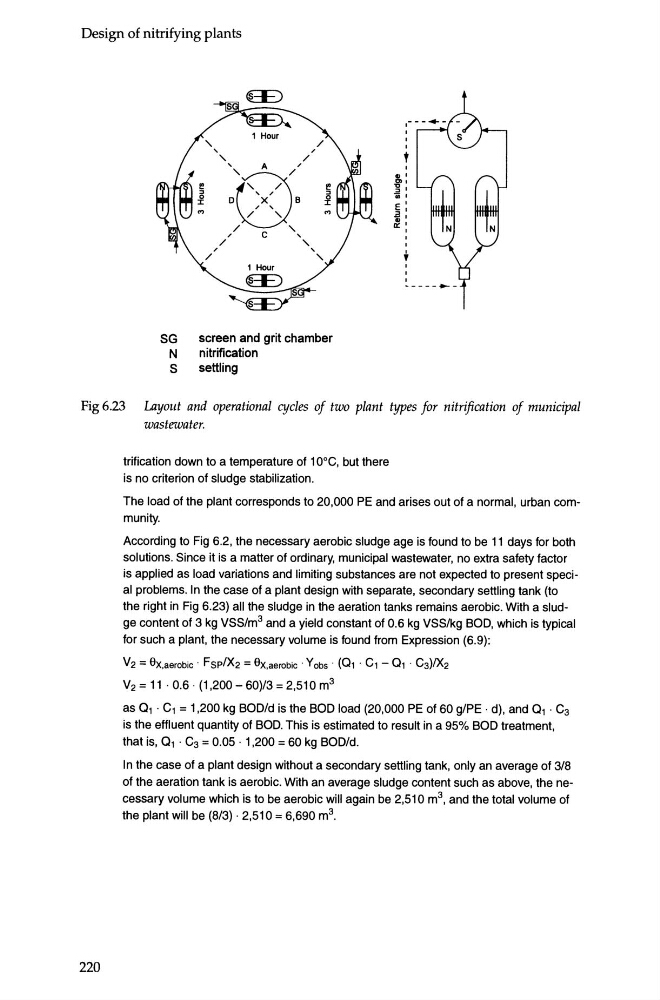
Fig 6.23 Layout and operational cycles of two plant types for nitrification of municipal
wastewater.
220
trification down to a temperature of 1 0°C, but there
is no criterion of sludge stabilization.
The load of the plant corresponds to 20,000 PE and arises out of a normal, urban community.
According to Fig 6.2, the necessary aerobic sludge age is found to be 11 days for both
solutions. Since it is a matter of ordinary, municipal wastewater, no extra safety factor
is applied as load variations and limiting substances are not expected to present special problems. In the case of a plant design with separate, secondary settling tank (to
the right in Fig 6.23) all the sludge in the aeration tanks remains aerobic. With a sludge content of 3 kg VSS/m 3 and a yield constant of 0.6 kg VSS/kg BOD, which is typical
for such a plant, the necessary volume is found from Expression (6.9):
V2 = 9x.aerobic · Fsp/X2 = 9x.aerobic · Yobs ·(a, · C,- a, · C3)/X2
v2 = 11 . 0.6 . (1 ,200- 60)/3 = 2,510 m 3
as a, · C, = 1 ,200 kg BOD/d is the BOD load (20,000 PE of 60 g/PE · d), and a, · C3
is the effluent quantity of BOD. This is estimated to result in a 95% BOD treatment,
that is, a, · C3 = 0.05 · 1 ,200 = 60 kg BOD/d.
In the case of a plant design without a secondary settling tank, only an average of 3/8
of the aeration tank is aerobic. With an average sludge content such as above, the necessary volume which is to be aerobic will again be 2,510 m 3 , and the total volume of
the plant will be (8/3). 2,510 = 6,690 m 3 .
1 Hour
/
t
A
&:
-gl
D
B
Oil
El
21
" I
[t:l
c
I
I
'
I
I
SG
screen and grit chamber
N
nitrification
s settling
Fig 6.23 Layout and operational cycles of two plant types for nitrification of municipal
wastewater.
220
trification down to a temperature of 1 0°C, but there
is no criterion of sludge stabilization.
The load of the plant corresponds to 20,000 PE and arises out of a normal, urban community.
According to Fig 6.2, the necessary aerobic sludge age is found to be 11 days for both
solutions. Since it is a matter of ordinary, municipal wastewater, no extra safety factor
is applied as load variations and limiting substances are not expected to present special problems. In the case of a plant design with separate, secondary settling tank (to
the right in Fig 6.23) all the sludge in the aeration tanks remains aerobic. With a sludge content of 3 kg VSS/m 3 and a yield constant of 0.6 kg VSS/kg BOD, which is typical
for such a plant, the necessary volume is found from Expression (6.9):
V2 = 9x.aerobic · Fsp/X2 = 9x.aerobic · Yobs ·(a, · C,- a, · C3)/X2
v2 = 11 . 0.6 . (1 ,200- 60)/3 = 2,510 m 3
as a, · C, = 1 ,200 kg BOD/d is the BOD load (20,000 PE of 60 g/PE · d), and a, · C3
is the effluent quantity of BOD. This is estimated to result in a 95% BOD treatment,
that is, a, · C3 = 0.05 · 1 ,200 = 60 kg BOD/d.
In the case of a plant design without a secondary settling tank, only an average of 3/8
of the aeration tank is aerobic. With an average sludge content such as above, the necessary volume which is to be aerobic will again be 2,510 m 3 , and the total volume of
the plant will be (8/3). 2,510 = 6,690 m 3 .