

Types of plants
In the fluidized filter, the filter medium is kept in suspension in the upflow turbulence. This turbulence can, of course, be established without upflow, and hence we
have the suspended biofilm reactor, see Fig 5.18. Consequently the connection to
the activated sludge plant has been established. The difference is just that for the
aeration tank, an inert carrier is intentionally added to which the bacteria adhere. In
this way the separation properties can be improved either on account of the weight
which the filter medium adds to each individual particle, or because the bigger
biofilm particles are easier to retain in the plant (due to a higher rate of settling). It
may, on the other hand, be necessary to supply more energy in the form of turbulence to the aeration tank to keep the material suspended. At the same time it is a
complication that the added filter medium must be handled in the sludge part of the
plant. The intentional addition of filter medium to the "activated plants" is as yet at
the experimental stage.
5.8.3 Rotating discs
As early as at the tum of the century, experiments were made to solve the three-phase
problem by rotating a filter medium alternately through water and air. All kinds of
filter media were used, for example branches fixed to a rotating shaft. Today this
principle is solely based on plastics in the form of semi-submerged, rotating discs or
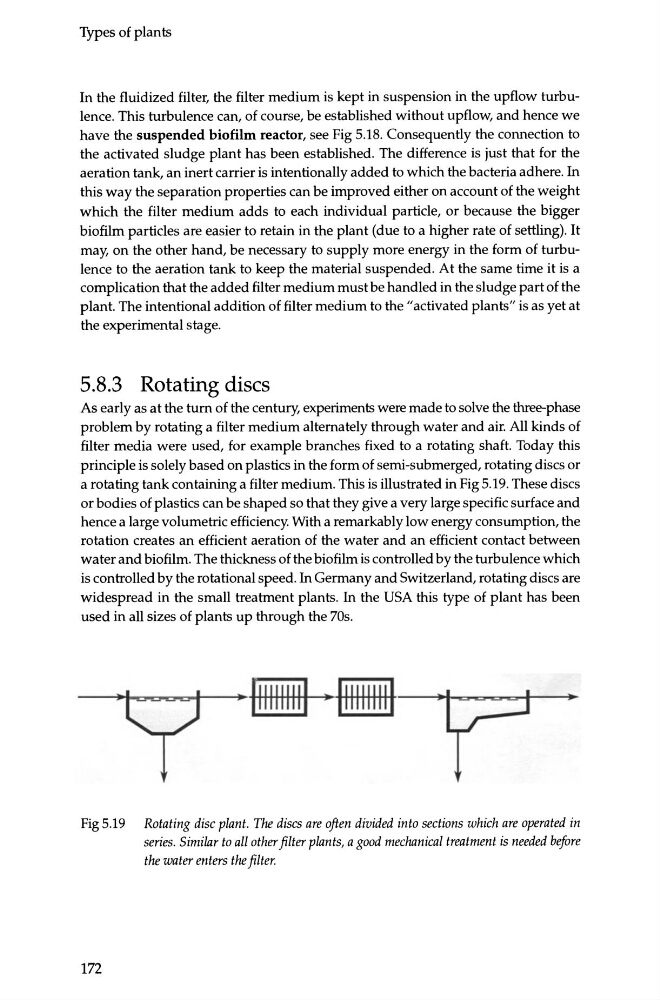
a rotating tank containing a filter medium. This is illustrated in Fig 5.19. These discs
or bodies of plastics can be shaped so that they give a very large specific surface and
hence a large volumetric efficiency. With a remarkably low energy consumption, the
rotation creates an efficient aeration of the water and an efficient contact between
water and biofilm. The thickness of the biofilm is controlled by the turbulence which
is controlled by the rotational speed. In Germany and Switzerland, rotating discs are
widespread in the small treatment plants. In the USA this type of plant has been
used in all sizes of plants up through the 70s.
11111111 11 )r 1111111 111
Fig 5.19 Rotating disc plant. The discs are often divided into sections which are operated in
series. Similar to all other filter plants, a good mechanical treatment is needed before
the water enters the filter.
172
In the fluidized filter, the filter medium is kept in suspension in the upflow turbulence. This turbulence can, of course, be established without upflow, and hence we
have the suspended biofilm reactor, see Fig 5.18. Consequently the connection to
the activated sludge plant has been established. The difference is just that for the
aeration tank, an inert carrier is intentionally added to which the bacteria adhere. In
this way the separation properties can be improved either on account of the weight
which the filter medium adds to each individual particle, or because the bigger
biofilm particles are easier to retain in the plant (due to a higher rate of settling). It
may, on the other hand, be necessary to supply more energy in the form of turbulence to the aeration tank to keep the material suspended. At the same time it is a
complication that the added filter medium must be handled in the sludge part of the
plant. The intentional addition of filter medium to the "activated plants" is as yet at
the experimental stage.
5.8.3 Rotating discs
As early as at the tum of the century, experiments were made to solve the three-phase
problem by rotating a filter medium alternately through water and air. All kinds of
filter media were used, for example branches fixed to a rotating shaft. Today this
principle is solely based on plastics in the form of semi-submerged, rotating discs or
a rotating tank containing a filter medium. This is illustrated in Fig 5.19. These discs
or bodies of plastics can be shaped so that they give a very large specific surface and
hence a large volumetric efficiency. With a remarkably low energy consumption, the
rotation creates an efficient aeration of the water and an efficient contact between
water and biofilm. The thickness of the biofilm is controlled by the turbulence which
is controlled by the rotational speed. In Germany and Switzerland, rotating discs are
widespread in the small treatment plants. In the USA this type of plant has been
used in all sizes of plants up through the 70s.
11111111 11 )r 1111111 111
Fig 5.19 Rotating disc plant. The discs are often divided into sections which are operated in
series. Similar to all other filter plants, a good mechanical treatment is needed before
the water enters the filter.
172