

Biofilters
5.9. Design of biofilters
Based on experiences from many years' operation of conventional biofilters, a set of
design criteria has been established which is generally used for the practical design
of these plants. These criteria are based on the idea that a given type of plant can be
loaded hydraulically or with organic matter up to a limit which can be determined
for ordinary use in the design phase. This may sometimes be combined with
requirements of the retention time in the system. These design criteria are not based
on any special understanding of the phenomena on which the treatment is based,
but they are exclusively based on a systematizing of experiences from an endless
number of thoroughly measured plants. The criteria are very simple, just like it is
remarkable that in spite of this simplicity they have actually been most useful for
decades. Likewise there is no doubt that they have given rise to design errors
because the circumstances change from one plant to another to a greater extent than
it can be expressed in such simple relationships as it will be illustrated for trickling
filters and for rotating discs.
5.9.1 Design of trickling filters
According to the classic design criteria for trickling filters the treatment result
exclusively depends on the organic volumetric loading rate and the hydraulic
surface loading rate.
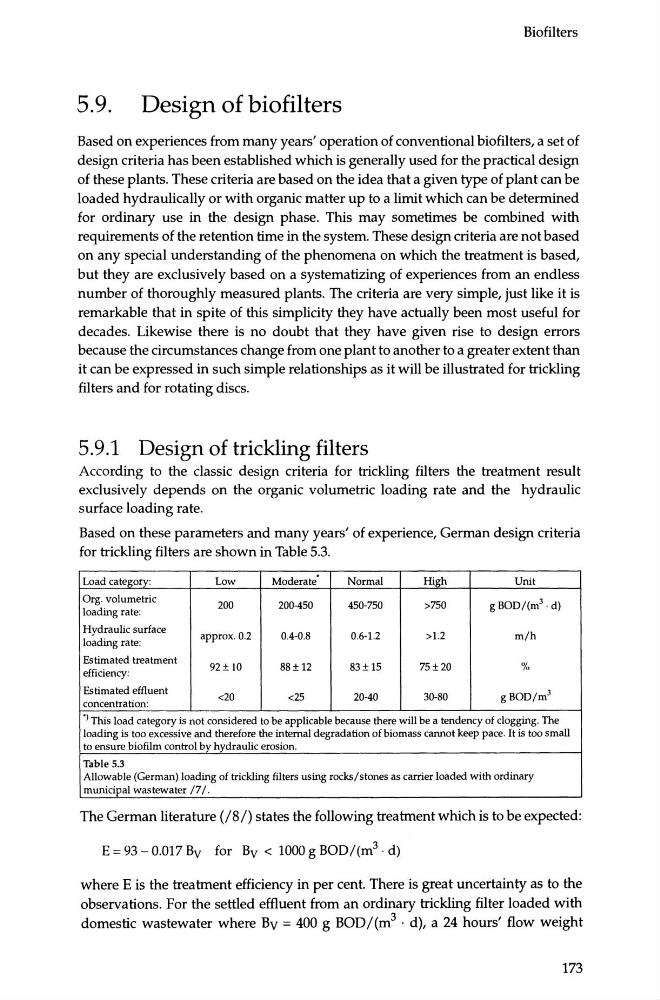
Based on these parameters and many years' of experience, German design criteria
for trickling filters are shown in Table 5.3 .
Load category:
Low
Moderate
. Normal Hig_h
Unit
Org. volumetric
200
200-450
450-750
>750
g BOD/(m 3 ·d)
loading rate:
Hydraulic surface
approx. 0.2
0.4-0.8
0.6-1.2
>1.2
m/h
loading rate:
Estimated treatment
92± 10
88± 12
83± 15
75±20
%
efficiency:
Estimated effluent
<20
<25
20-40
30-80
gBOD/m 3
concentration:
') This load category is not considered to be applicable because there will be a tendency of clogging. The
loading is too excessive and therefore the internal degradation of biomass cannot keep pace. It is too small
to ensure biofilm control by hydraulic erosion.
Table 5.3
Allowable (German) loading of trickling filters using rocks/stones as carrier loaded with ordinary
municipal wastewater /7 I.
The German literature {/8/) states the following treatment which is to be expected:
E = 93-0.017 Bv for Bv < 1000 g BOD/(m 3 ·d)
where E is the treatment efficiency in per cent. There is great uncertainty as to the
observations. For the settled effluent from an ordinary trickling filter loaded with
domestic wastewater where Bv = 400 g BOD I (m 3 · d), a 24 hours' flow weight
173
5.9. Design of biofilters
Based on experiences from many years' operation of conventional biofilters, a set of
design criteria has been established which is generally used for the practical design
of these plants. These criteria are based on the idea that a given type of plant can be
loaded hydraulically or with organic matter up to a limit which can be determined
for ordinary use in the design phase. This may sometimes be combined with
requirements of the retention time in the system. These design criteria are not based
on any special understanding of the phenomena on which the treatment is based,
but they are exclusively based on a systematizing of experiences from an endless
number of thoroughly measured plants. The criteria are very simple, just like it is
remarkable that in spite of this simplicity they have actually been most useful for
decades. Likewise there is no doubt that they have given rise to design errors
because the circumstances change from one plant to another to a greater extent than
it can be expressed in such simple relationships as it will be illustrated for trickling
filters and for rotating discs.
5.9.1 Design of trickling filters
According to the classic design criteria for trickling filters the treatment result
exclusively depends on the organic volumetric loading rate and the hydraulic
surface loading rate.
Based on these parameters and many years' of experience, German design criteria
for trickling filters are shown in Table 5.3 .
Load category:
Low
Moderate
. Normal Hig_h
Unit
Org. volumetric
200
200-450
450-750
>750
g BOD/(m 3 ·d)
loading rate:
Hydraulic surface
approx. 0.2
0.4-0.8
0.6-1.2
>1.2
m/h
loading rate:
Estimated treatment
92± 10
88± 12
83± 15
75±20
%
efficiency:
Estimated effluent
<20
<25
20-40
30-80
gBOD/m 3
concentration:
') This load category is not considered to be applicable because there will be a tendency of clogging. The
loading is too excessive and therefore the internal degradation of biomass cannot keep pace. It is too small
to ensure biofilm control by hydraulic erosion.
Table 5.3
Allowable (German) loading of trickling filters using rocks/stones as carrier loaded with ordinary
municipal wastewater /7 I.
The German literature {/8/) states the following treatment which is to be expected:
E = 93-0.017 Bv for Bv < 1000 g BOD/(m 3 ·d)
where E is the treatment efficiency in per cent. There is great uncertainty as to the
observations. For the settled effluent from an ordinary trickling filter loaded with
domestic wastewater where Bv = 400 g BOD I (m 3 · d), a 24 hours' flow weight
173