

Mass balances, activated sludge plants
Different mass balances can be set up for the plant.
The water balance looks as follows:
A total mass balance looks as follows:
(4.1)
(4.2)
The conversion term rv,s · V2 can also be written in such a way that tank volume, V2,
as well as activated sludge concentration, Xs,2, are included separately, that is as rv,s ·
V2· XB,2·
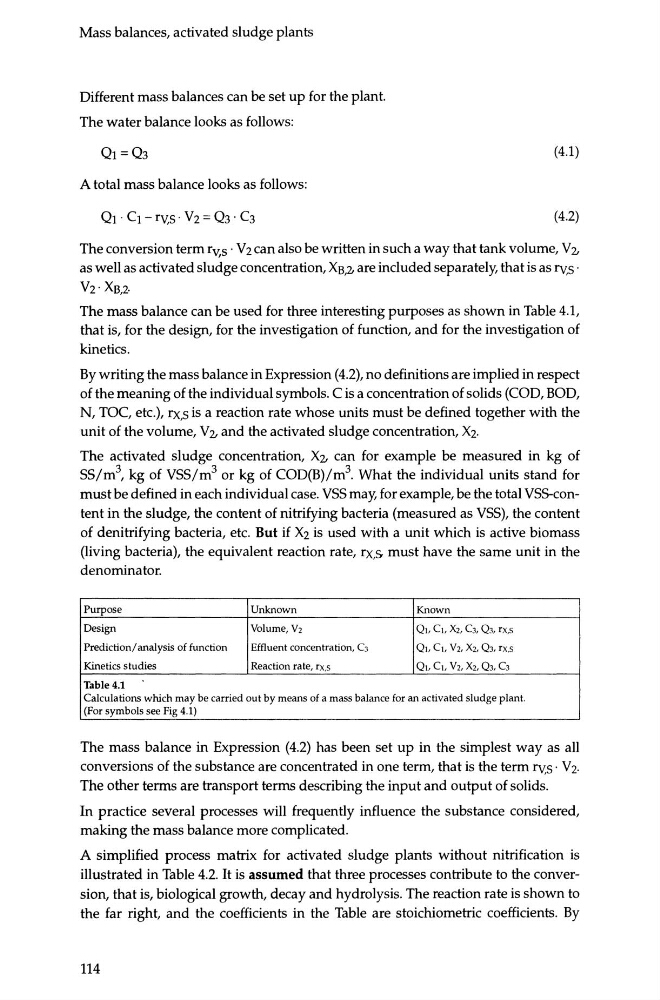
The mass balance can be used for three interesting purposes as shown in Table 4.1,
that is, for the design, for the investigation of function, and for the investigation of
kinetics.
By writing the mass balance in Expression (4.2), no definitions are implied in respect
of the meaning of the individual symbols. Cis a concentration of solids (COD, BOD,
N, TOC, etc.), rx,s is a reaction rate whose units must be defined together with the
unit of the volume, V2, and the activated sludge concentration, X2.
The activated sludge concentration, X2, can for example be measured in kg of
SS/m 3 , kg of VSS/m 3 or kg of COD(B)/m 3 . What the individual units stand for
must be defined in each individual case. VSS may, for example, be the total VS5-content in the sludge, the content of nitrifying bacteria (measured as VSS), the content
of denitrifying bacteria, etc. But if X2 is used with a unit which is active biomass
(living bacteria), the equivalent reaction rate, rx,s. must have the same unit in the
denominator.
Purpose
Unknown
Known
Design
Volume, V2
Q1, C1, X2, C3, Q3, rx,s
Prediction/ analysis of function
Effluentconcenttation,C3
Q1, C1, V2, X2, Q3, rx,s
Kinetics studies
Reaction rate, rx,s
Q1, C1, V2, X:z, Q3, C3
Table4.1
Calculations which may be carried out by means of a mass balance for an activated sludge plant.
(For symbols see Fig 4.1)
The mass balance in Expression (4.2) has been set up in the simplest way as all
conversions of the substance are concentrated in one term, that is the term rv,s · V2.
The other terms are transport terms describing the input and output of solids.
In practice several processes will frequently influence the substance considered,
making the mass balance more complicated.
A simplified process matrix for activated sludge plants without nitrification is
illustrated in Table 4.2. It is assumed that three processes contribute to the conversion, that is, biological growth, decay and hydrolysis. The reaction rate is shown to
the far right, and the coefficients in the Table are stoichiometric coefficients. By
114
Different mass balances can be set up for the plant.
The water balance looks as follows:
A total mass balance looks as follows:
(4.1)
(4.2)
The conversion term rv,s · V2 can also be written in such a way that tank volume, V2,
as well as activated sludge concentration, Xs,2, are included separately, that is as rv,s ·
V2· XB,2·
The mass balance can be used for three interesting purposes as shown in Table 4.1,
that is, for the design, for the investigation of function, and for the investigation of
kinetics.
By writing the mass balance in Expression (4.2), no definitions are implied in respect
of the meaning of the individual symbols. Cis a concentration of solids (COD, BOD,
N, TOC, etc.), rx,s is a reaction rate whose units must be defined together with the
unit of the volume, V2, and the activated sludge concentration, X2.
The activated sludge concentration, X2, can for example be measured in kg of
SS/m 3 , kg of VSS/m 3 or kg of COD(B)/m 3 . What the individual units stand for
must be defined in each individual case. VSS may, for example, be the total VS5-content in the sludge, the content of nitrifying bacteria (measured as VSS), the content
of denitrifying bacteria, etc. But if X2 is used with a unit which is active biomass
(living bacteria), the equivalent reaction rate, rx,s. must have the same unit in the
denominator.
Purpose
Unknown
Known
Design
Volume, V2
Q1, C1, X2, C3, Q3, rx,s
Prediction/ analysis of function
Effluentconcenttation,C3
Q1, C1, V2, X2, Q3, rx,s
Kinetics studies
Reaction rate, rx,s
Q1, C1, V2, X:z, Q3, C3
Table4.1
Calculations which may be carried out by means of a mass balance for an activated sludge plant.
(For symbols see Fig 4.1)
The mass balance in Expression (4.2) has been set up in the simplest way as all
conversions of the substance are concentrated in one term, that is the term rv,s · V2.
The other terms are transport terms describing the input and output of solids.
In practice several processes will frequently influence the substance considered,
making the mass balance more complicated.
A simplified process matrix for activated sludge plants without nitrification is
illustrated in Table 4.2. It is assumed that three processes contribute to the conversion, that is, biological growth, decay and hydrolysis. The reaction rate is shown to
the far right, and the coefficients in the Table are stoichiometric coefficients. By
114