

Activated Sludge Treatment Plants
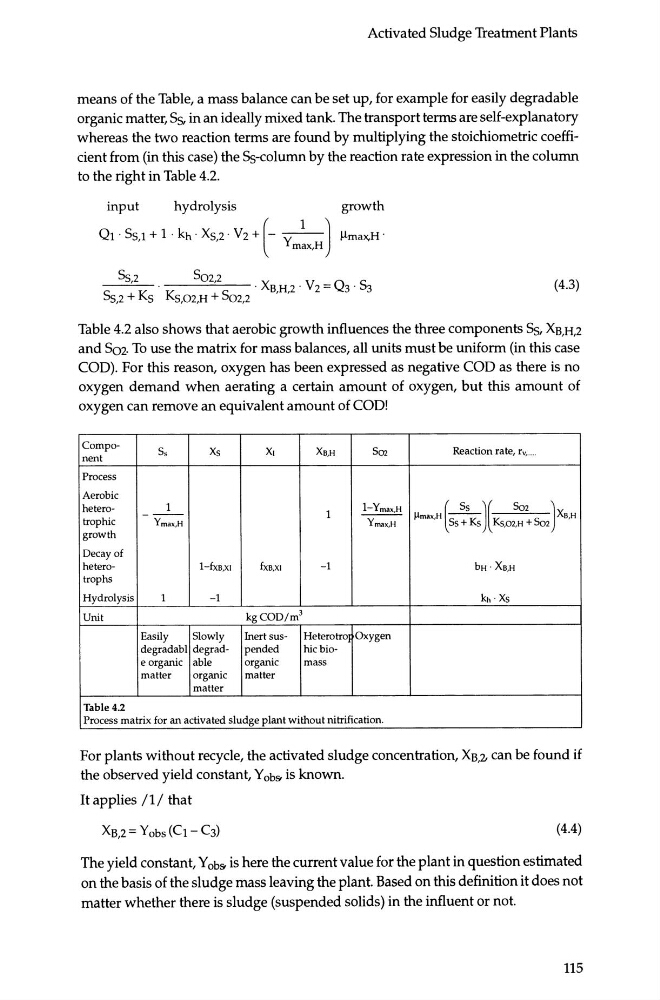
means of the Table, a mass balance can be set up, for example for easily degradable
organic matter, Ss, in an ideally mixed tank. The transport terms are self-explanatory
whereas the two reaction terms are found by multiplying the stoichiometric coefficient from (in this case) the Ss-column by the reaction rate expression in the column
to the right in Table 4.2.
input
hydrolysis
growth
Q1 · Ss,1 + 1 · kh · Xs,2 · V2 + (- - - 1 -J J..lmax,H ·
l Ymax,H
Ss,2
Sm2
----'-- ·
'
· XB H 2 · V 2 = Q3 · S3
Ss,2 + Ks Ks,oz,H + Sm,2
' '
(4.3)
Table 4.2 also shows that aerobic growth influences the three components Ss, Xs,H,2
and Sm. To use the matrix for mass balances, all units must be uniform (in this case
COD). For this reason, oxygen has been expressed as negative COD as there is no
oxygen demand when aerating a certain amount of oxygen, but this amount of
oxygen can remove an equivalent amount of COD!
CompoS,
Xs
XI
Xa,H
Sm
Reaction rate, rv, ....
nent
Process
Aerobic
hetero1
1-Ymax,H
( Ss )(
Sm
)x
trophic
- - -
1
~max,H SK Ks
S
B,H
Ymax,H
Ymax,H
s+ s
,02,H + 02
growth
Decay of
hetero1-fxB,Xl
fxBXI
-1
bH · Xa,H
trophs
Hydrolysis
1
-1
kh · Xs
Unit
kgCOD/m 3
Easily
Slowly
Inert sus- Heterotro Oxygen
degradabl degrad- pended
hicbioe organic able
organic
mass
matter
organic
matter
matter
Table 4.2
Process matrix for an activated sludge plant without nitrification.
For plants without recycle, the activated sludge concentration, Xs,z, can be found if
the observed yield constant, Yobs- is known.
It applies /1/ that
(4.4)
The yield constant, Yobs- is here the current value for the plant in question estimated
on the basis of the sludge mass leaving the plant. Based on this definition it does not
matter whether there is sludge (suspended solids) in the influent or not.
115
means of the Table, a mass balance can be set up, for example for easily degradable
organic matter, Ss, in an ideally mixed tank. The transport terms are self-explanatory
whereas the two reaction terms are found by multiplying the stoichiometric coefficient from (in this case) the Ss-column by the reaction rate expression in the column
to the right in Table 4.2.
input
hydrolysis
growth
Q1 · Ss,1 + 1 · kh · Xs,2 · V2 + (- - - 1 -J J..lmax,H ·
l Ymax,H
Ss,2
Sm2
----'-- ·
'
· XB H 2 · V 2 = Q3 · S3
Ss,2 + Ks Ks,oz,H + Sm,2
' '
(4.3)
Table 4.2 also shows that aerobic growth influences the three components Ss, Xs,H,2
and Sm. To use the matrix for mass balances, all units must be uniform (in this case
COD). For this reason, oxygen has been expressed as negative COD as there is no
oxygen demand when aerating a certain amount of oxygen, but this amount of
oxygen can remove an equivalent amount of COD!
CompoS,
Xs
XI
Xa,H
Sm
Reaction rate, rv, ....
nent
Process
Aerobic
hetero1
1-Ymax,H
( Ss )(
Sm
)x
trophic
- - -
1
~max,H SK Ks
S
B,H
Ymax,H
Ymax,H
s+ s
,02,H + 02
growth
Decay of
hetero1-fxB,Xl
fxBXI
-1
bH · Xa,H
trophs
Hydrolysis
1
-1
kh · Xs
Unit
kgCOD/m 3
Easily
Slowly
Inert sus- Heterotro Oxygen
degradabl degrad- pended
hicbioe organic able
organic
mass
matter
organic
matter
matter
Table 4.2
Process matrix for an activated sludge plant without nitrification.
For plants without recycle, the activated sludge concentration, Xs,z, can be found if
the observed yield constant, Yobs- is known.
It applies /1/ that
(4.4)
The yield constant, Yobs- is here the current value for the plant in question estimated
on the basis of the sludge mass leaving the plant. Based on this definition it does not
matter whether there is sludge (suspended solids) in the influent or not.
115