

4. Activated Sludge Treatment Plants
By Mogens Henze
Activated sludge treatment plants are built to remove organic matter from wastewater to avoid the situation described by Joseph Heller in Something Happened: "You
don't find fish in lakes and rivers anymore. You have to catch them in cans. Towns
die. Oil spills. Money talks".
The principle in activated sludge plants is that a mass of activated sludge is kept
moving in water by stirring or aeration. Apart from the living biomass, the suspended solids contain inorganic as well as organic particles. Some of the organic
particles can be degraded by subjecting them to hydrolysis whereas others are
non-degradable (inert).
The amount of suspended solids in the treatment plant is regulated through recycle
of the suspended solids and by removing the so-called excess sludge. Organic
matter that enters an activated sludge process has 3 outlets only: carbon dioxide,
excess sludge or the effluent.
4.1. Mass balances, activated sludge plants
By setting up mass balances from the expressions of reaction derived in Chapter 3,
each term is now signed. If the substance in question is removed, the sign is
negative.
4.1.1 "Activated sludge" plant without recycle
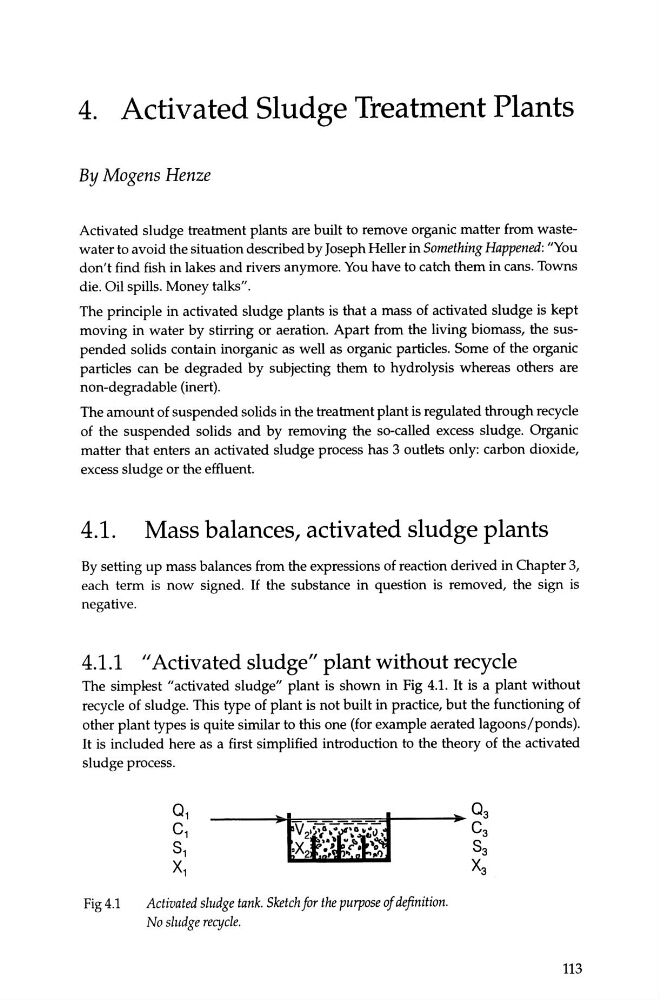
The simplest "activated sludge" plant is shown in Fig 4.1. It is a plant without
recycle of sludge. This type of plant is not built in practice, but the functioning of
other plant types is quite similar to this one (for example aerated lagoons/ponds).
It is included here as a first simplified introduction to the theory of the activated
sludge process.
Fig4.1
Activated sludge tank. Sketch for the purpose of definition.
No sludge recycle.
113
By Mogens Henze
Activated sludge treatment plants are built to remove organic matter from wastewater to avoid the situation described by Joseph Heller in Something Happened: "You
don't find fish in lakes and rivers anymore. You have to catch them in cans. Towns
die. Oil spills. Money talks".
The principle in activated sludge plants is that a mass of activated sludge is kept
moving in water by stirring or aeration. Apart from the living biomass, the suspended solids contain inorganic as well as organic particles. Some of the organic
particles can be degraded by subjecting them to hydrolysis whereas others are
non-degradable (inert).
The amount of suspended solids in the treatment plant is regulated through recycle
of the suspended solids and by removing the so-called excess sludge. Organic
matter that enters an activated sludge process has 3 outlets only: carbon dioxide,
excess sludge or the effluent.
4.1. Mass balances, activated sludge plants
By setting up mass balances from the expressions of reaction derived in Chapter 3,
each term is now signed. If the substance in question is removed, the sign is
negative.
4.1.1 "Activated sludge" plant without recycle
The simplest "activated sludge" plant is shown in Fig 4.1. It is a plant without
recycle of sludge. This type of plant is not built in practice, but the functioning of
other plant types is quite similar to this one (for example aerated lagoons/ponds).
It is included here as a first simplified introduction to the theory of the activated
sludge process.
Fig4.1
Activated sludge tank. Sketch for the purpose of definition.
No sludge recycle.
113