

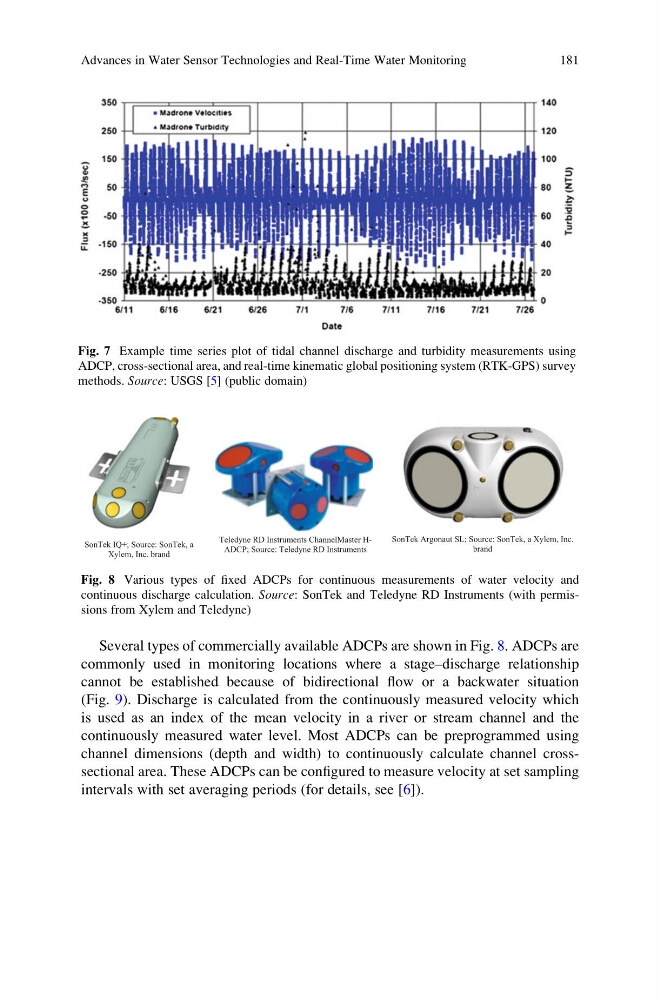
Several types of commercially available ADCPs are shown in Fig. 8. ADCPs are
commonly used in monitoring locations where a stage–discharge relationship
cannot be established because of bidirectional flow or a backwater situation
(Fig. 9). Discharge is calculated from the continuously measured velocity which
is used as an index of the mean velocity in a river or stream channel and the
continuously measured water level. Most ADCPs can be preprogrammed using
channel dimensions (depth and width) to continuously calculate channel crosssectional area. These ADCPs can be configured to measure velocity at set sampling
intervals with set averaging periods (for details, see [6]).
Fig. 7 Example time series plot of tidal channel discharge and turbidity measurements using
ADCP, cross-sectional area, and real-time kinematic global positioning system (RTK-GPS) survey
methods. Source: USGS [5] (public domain)
SonTek IQ+; Source: SonTek, a
Xylem, Inc. brand
Teledyne RD Instruments ChannelMaster HADCP; Source: Teledyne RD Instruments
SonTek Argonaut SL; Source: SonTek, a Xylem, Inc.
brand
Fig. 8 Various types of fixed ADCPs for continuous measurements of water velocity and
continuous discharge calculation. Source: SonTek and Teledyne RD Instruments (with permissions from Xylem and Teledyne)
Advances in Water Sensor Technologies and Real-Time Water Monitoring
181
commonly used in monitoring locations where a stage–discharge relationship
cannot be established because of bidirectional flow or a backwater situation
(Fig. 9). Discharge is calculated from the continuously measured velocity which
is used as an index of the mean velocity in a river or stream channel and the
continuously measured water level. Most ADCPs can be preprogrammed using
channel dimensions (depth and width) to continuously calculate channel crosssectional area. These ADCPs can be configured to measure velocity at set sampling
intervals with set averaging periods (for details, see [6]).
Fig. 7 Example time series plot of tidal channel discharge and turbidity measurements using
ADCP, cross-sectional area, and real-time kinematic global positioning system (RTK-GPS) survey
methods. Source: USGS [5] (public domain)
SonTek IQ+; Source: SonTek, a
Xylem, Inc. brand
Teledyne RD Instruments ChannelMaster HADCP; Source: Teledyne RD Instruments
SonTek Argonaut SL; Source: SonTek, a Xylem, Inc.
brand
Fig. 8 Various types of fixed ADCPs for continuous measurements of water velocity and
continuous discharge calculation. Source: SonTek and Teledyne RD Instruments (with permissions from Xylem and Teledyne)
Advances in Water Sensor Technologies and Real-Time Water Monitoring
181